
Subscribe
to receive news by email

Poll
Will the Trump Administration Shift U.S. Policy in Favor of Palestine?
- No (86%)
- Yes (14%)
 Loading ...
Copyright © 2026 Arab America
Go topDevastation of Iran War Is Equivalent to a Nuclear Bomb
By: Ghassan Rubeiz / Arab America Contributing Writer
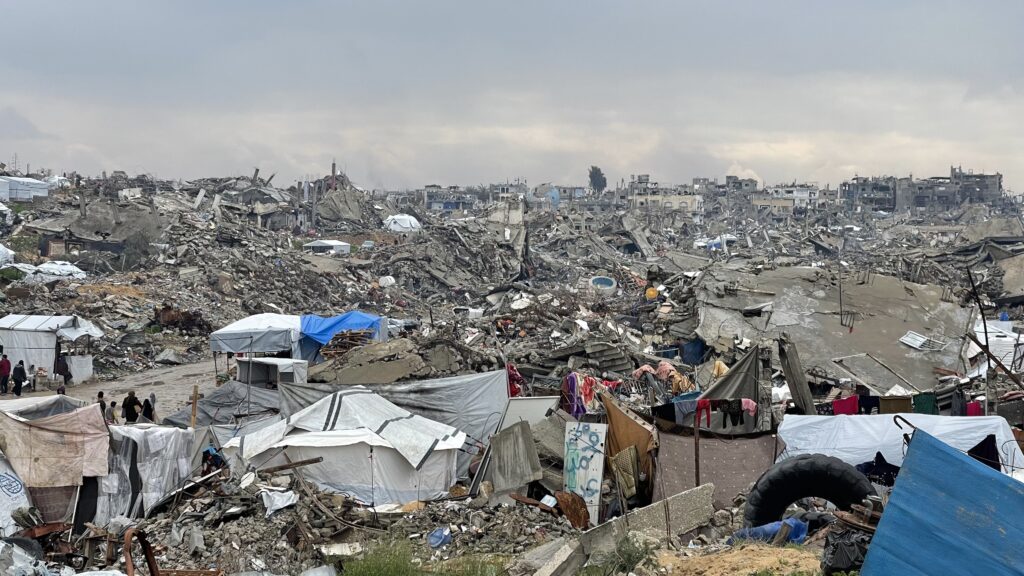
In trying to stop Iran’s presumed march toward a nuclear bomb and to defeat its armed groups in the region, Israel and the United States have effectively detonated a massive nuclear bomb without a mushroom cloud. Many Palestinians consider the devastation tantamount to a holocaust. The pervasive fallout is to be seen everywhere in the region and beyond: unbelievable death and destruction in Gaza; erased villages in southern Lebanon; shuttered desalination plants across the Arab Gulf; devastated Israeli border communities; a spike in regional carbon emissions; disrupted global markets; rising tensions in the region; and the erosion of international law.
The irony is stark. Israel remains the only country in the Middle East with a nuclear arsenal, built in part with help from the same Western governments now backing its war on Iran. Underlying the acquisition of nuclear weapons is the deep sense of insecurity that has shaped Israeli military doctrine since the state’s founding.
The devastation has been most visible in Gaza, where the Health Ministry counts nearly 74,000 dead — about 3.5 percent of the prewar population — with most homes destroyed and large parts of the territory under indefinite occupation. Independent demographic surveys put the real toll higher still. But Gaza is only one epicenter of a wider environmental catastrophe. Carnegie Endowment analysts warn that targeting Iran’s energy infrastructure carries “an inherent environmental dimension, devastating surrounding ecosystems” far beyond the battlefield. Months of bombardment have compounded water scarcity and crippled state capacity across West Asia, already one of the world’s most climate-vulnerable regions.
Iran itself is suffering severe ecological damage. Years of drought had already pushed its water systems to the brink; rainfall remains well below average, and several major dams are operating at less than 10 percent capacity. The war has destroyed pumping stations, polluted rivers, and strained an agricultural sector that feeds tens of millions. In the Gulf, Iranian strikes have damaged desalination plants in Kuwait and Bahrain — states that depend on them for most of their drinking water — threatening the basic survival of millions. Strikes on oil wells and refineries have caused spills, fires, and toxic emissions that drift across borders. Lebanon, meanwhile, has seen villages in the south wiped out, forests burned, and farmland rendered unusable.
President Trump is weighing a return to massive strikes if Tehran does not accept Washington’s terms for ending the conflict and reopening the Strait of Hormuz. Netanyahu has called regime change in Tehran a “central task” that is “within reach.” His coalition trailed the opposition for months ahead of the October 27 election, though recent polling shows the gap has been eliminated — a reminder that political survival in Tel Aviv, as much as strategy, may be shaping what happens next.
The tragedy is that all sides — the United States, Israel, and Iran — define victory by losses inflicted on the enemy rather than by the objectives achieved. Washington’s campaign to contain Iran is not new: sanctions have squeezed Tehran for decades, and the fight against its regional proxies has been going on for nearly three years, since Gaza and the wider region caught fire in October 2023. But the heavy shooting war itself that has gone on for several months, and even in that short span, the war objective has drifted. What began as an effort to halt Iran’s nuclear program and its regional influence has become a fight to reopen Hormuz, tame inflation, and protect oil wells and U.S. troops in the Gulf. The original purpose lies buried under the rubble of shifting priorities, now driven less by strategic logic than by electoral dynamics in Washington and Tel Aviv. Its human consequences — for the peoples of Iran, Gaza, Lebanon, the Gulf, Israel, and the world — have become secondary to short-sighted political calculation.
This still-active war has undermined global order. In a world already strained by climate shocks, economic instability, and geopolitical fragmentation, wars cannot be resolved without restored respect for justice and observance of international law. In trying to stop Iran’s march toward the bomb, Israel and the United States have unleashed a different kind of nuclear fallout — measured not in kilotons, but in environmental collapse, regional instability, and the erosion of the norms that hold the world together.
If this war is to end without further nuclear-scale devastation, the international community must reclaim the principles it has abandoned: accountability for all parties, protection of the region’s collapsing environment, and restored authority for international law as the only path out of perpetual conflict. The Middle East cannot survive another year of a war that behaves like a nuclear bomb without the cloud. Preventing Iran from acquiring a weapon must not come at the cost of denying justice or the destruction of the region’s future. The world must act now — not to choose sides, but to choose the principles that guarantee its survival.
Ghassan Rubeiz is the former Middle East Secretary of the World Council of Churches. Earlier, he taught psychology and social work in his country of birth, Lebanon, and later in the United States, where he currently lives. He has contributed to political commentary for the past twenty years and has delivered occasional public talks on peace, justice, and interfaith topics. You can reach him at rubeizg@gmail.com
The views and opinions expressed in this article are those of the author and do not necessarily reflect the position of Arab America. The reproduction of this article is permissible with proper credit to Arab America and the author.
Want more articles like this? Sign up for our e-newsletter!
Check our blog here!