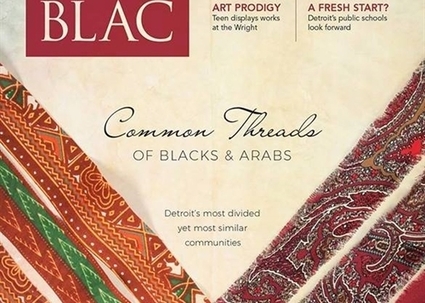
Traditional fabrics from Africa and the Middle East enliven the August cover. (Photo by Lauren Jeziorski)
By Alan Stamm
Deadline Detroit
The editor of BLAC Detroit magazine, just nine months into the job, tackles an urgent, touchy topic in August’s cover story.
Aaron Foley explores “Detroit’s most divided, yet most similar, communities” — blacks and Arabs — and gathers suggestions about bridging the gap.
“It’s a little unorthodox for us to discuss Arab-Americans in a magazine for black readers,” he acknowledges up front in a monthly editor’s “letter” about the magazine’s content. “I ask that you read this issue with an open mind.”
For his part, he addresses the topic with an open notebook, eight interviews and the homegrown context of someone who “only saw Arabs in gas stations, certain grocery stores and in Dearborn.” The result is a richly informed, sensitively nuanced and bluntly direct presentation that fills five pages.
Foley also devotes a page to frank observations by Isra El-Beshir, a curator at Dearborn’s Arab American National Museum. As a Sudanese-American, she describes personal knowledge of “anti-blackness” among some local Arab-Americans.
The topic has a personal tug for Foley, his introductory note shows:
A deep divide between African-Americans and Arab-Americans in metro Detroit [is] something I’ve thought about a lot, as I get older and my circle of friends grows and evolves.
He gets right to it with a basic heads-up: “The correct way of pronouncing it is ‘air-ub.’ But when you hear someone pronounce it as ‘aye-rabb,’ not only is it incorrect, it’s often derogatory.”
Yes, this is real, not a Benetton ad or 1971 Coke commercial.
The 3,560-word article quotes an Arab Muslim law school instructor, a black educator, a Somali-American who’s Muslim, the first Muslim-American woman in Michigan’s Legislature, a black teacher who converted to Islam, a Wayne State board member, a black former Deadline columnist and others.
“Both communities have more in common than we realize,” Foley writes.
There is so much that we can relate to and empathize about within our communities, and yet here in Detroit, where our numbers are plentiful, there exists a great divide and misunderstanding.
How can we bridge the gap? It starts with understanding our similarities to overcome our differences.
The magazine sketches the paths that originally brought Southern blacks, Arab Christians and Arab Muslims to Detroit; the challenges both groups faced and face; the misconceptions and racism that arise; the dietary and religious nuances that can cause unintended missteps.
Kim Trent, an education policy associate for Michigan Future and an elected WSU Board of Governors member, talks about shared experiences:
“Arab-Americans had been dealing with profiling. And black folks have been dealing with profiling forever. We found some common ground that we didn’t have in 2001. You know, as mothers – we all worry for our children.”
Her chapter of Delta Sigma Theta sorority has co-hosted discussions between blacks and Arabs for 15 years.
The article also quotes from a 2013 column at this site by Darrell Dawsey, headlined “African Americans Need to Stop Shopping Where They’re Disrespected.” The Detroit writer, now communications director at the American Civil Liberties Union of Michigan, tells Foley:
“There’s a willingness by a lot of immigrant groups to assert your proximity to whiteness by doing what Americans do, which is disrespect black people. That is American as apple pie.”
In her separate commentary, El-beshir — who has a 2008 business degree from Grand Valley State University and a 2013 master’s in cultural anthropology from WSU — writes:
I am the daughter of many narratives: Black, but not African-American; Arab, but not Middle Eastern; the daughter of two Muslim immigrants, and born an American. . . .
In addressing the relationship between African-Americans and Arab-Americans in metro Detroit, it is necessary to understand the relationship is not one, but one of many. It is built around social, political and economic institutions.
I still get a few surprised gasps when I speak in Arabic or identify as an Arab from Arab-Americans in Dearborn, who are predominantly Middle Eastern and ignorant of the diversity in the Arab world.
El-beshir offers advice for bridging gaps, one interaction at a time:
- Start with understanding the fluidity of identity that exists in both groups.
- Confront the stereotypes.
- Identify the common traits.
- Simply look for the humanity – starting here, right now.
Source: www.deadlinedetroit.com


 Loading ...