Subscribe
to receive news by email

Poll
Will the Trump Administration Shift U.S. Policy in Favor of Palestine?
- No (86%)
- Yes (14%)
 Loading ...
Copyright © 2026 Arab America
Go topCould Abdul El-Sayed Bring Arab American Representation Back to the U.S. Senate?
By Aziz Hellal / Arab America Contributing Writer
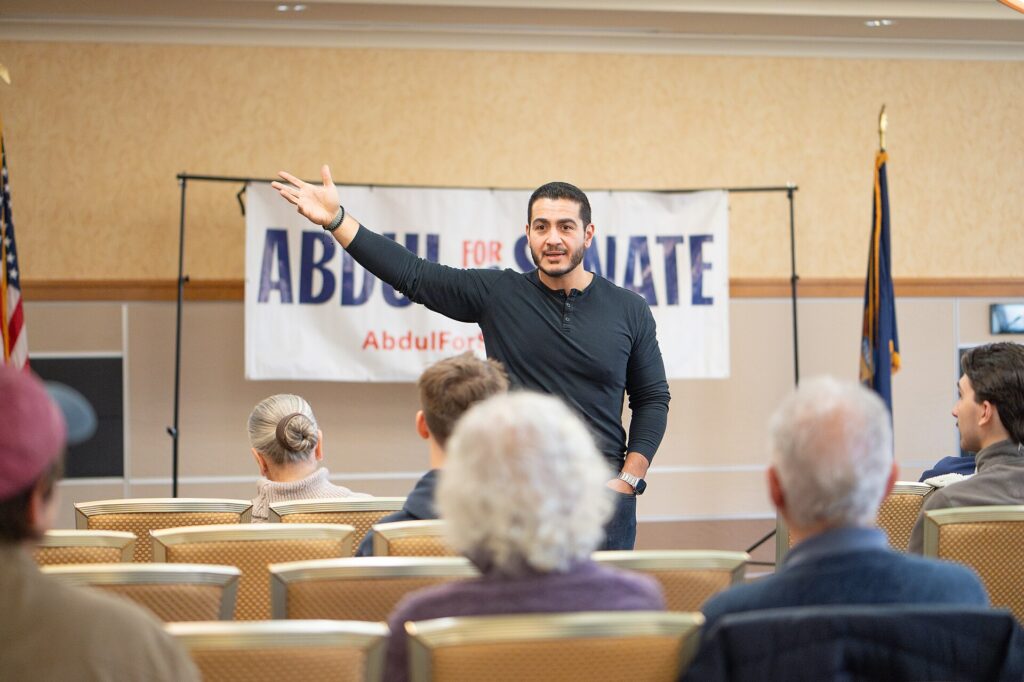
For nearly twenty-five years, there hasn’t been an Arab American voice in the United States Senate. That could soon change. Abdul El-Sayed—a Michigan-born doctor and son of an Egyptian immigrant—is officially seeking the Democratic nomination for the U.S. Senate in Michigan.
El-Sayed isn’t your typical candidate. A physician with degrees from Columbia and Oxford, he built his reputation on the ground, leading public health departments in Detroit and Wayne County. Since then, he’s become a familiar face in national conversations about healthcare reform and progressive policy.
His run comes as Arab Americans are becoming more visible in the political arena than ever before. For many, El-Sayed represents a chance to see an Egyptian American back in one of the country’s most influential rooms.
Whether he wins the primary or not. His campaign shows that Arab American political influence is no longer limited to local politics.
From Public Health to Politics
Abdul El-Sayed did not begin his career with the intention of entering politics. Like many physicians, he set out to help people by treating illnesses and improving public health. Over time, however, he came to believe that many of the problems affecting Americans were rooted not only in hospitals and clinics, but also in government decisions and public policy.
El-Sayed was born and raised in Southeast Michigan. He is the son of an Egyptian immigrant Father. He studied at the University of Michigan, earned his medical degree from Columbia University, and later completed a doctorate at the University of Oxford as a Rhodes Scholar. These academic achievements established him as both a physician and a leading public health expert.
Rather than pursuing a traditional medical career, El-Sayed moved into public service. He helped rebuild the Detroit Health Department after the city’s bankruptcy. He later led Wayne County’s Department of Health, Human Services, and Veterans Services, serving nearly two million Michigan residents.
These experiences shaped his view that politics and public policy play a decisive role in people’s lives. In his view, healthcare problems cannot be solved by doctors alone if government policies continue to make life more expensive and healthcare less accessible.
That belief ultimately led him from medicine and public health into the political arena. Now, he hopes to bring his reform agenda to the U.S Senate.
A Primary With Historic Meaning
Abdul El-Sayed is not entering the 2026 race as a symbolic candidate. He has emerged as one of the leading contenders in the Democratic primary for Michigan’s open United States Senate seat. The seat became available after Gary Peters announced that he would not seek reelection.
According to filings with the Federal Election Commission, El-Sayed raised more than $7.6 million by the end of March 2026, demonstrating that his campaign has built a strong fundraising operation.
Recent polling suggests that he has become a serious force in the primary. A May 2026 Mitchell-MIRS survey placed El-Sayed at 28%, about 10 percentage points ahead of Haley Stevens and well ahead of Mallory McMorrow, although a large share of voters remained undecided.
The Democratic primary, scheduled for August 4, 2026, has become one of the most closely watched Senate contests in the country. Abdul El-Sayed still faces a competitive race, and victory is far from guaranteed.
Yet his strong fundraising, growing list of endorsements, and rising poll numbers have transformed his candidacy from an underdog campaign into a credible opportunity to make history.
A Grassroots Campaign With Progressive Energy
El-Sayed’s campaign has also been strengthened by endorsements from major progressive figures, including Senator Bernie Sanders and Representative Rashida Tlaib. Tlaib’s backing is especially important because it connects his campaign to Michigan’s Arab American community and to progressive voters who want a more confrontational voice in Washington.
Organizations such as National Nurses United and Our Revolution have also supported his campaign. Their support gives him credibility among labor activists, healthcare advocates, and grassroots organizers.
His campaign draws a striking comparison to the grassroots energy of figures like Zohran Mamdani. It isn’t just about high-level TV ads; it’s about a massive wave of young volunteers and organizers who are hitting the pavement.
This approach has helped El-Sayed build a visible statewide presence. His campaign says it has held more than 360 events across 90 cities, from college campuses to community spaces.
For supporters, that energy is part of what makes his campaign different: it feels less like a traditional Senate run and more like a movement trying to push new voices into national politics.
A New Chapter for Arab American Representation
For Arab Americans, Abdul El-Sayed’s campaign is more than just another competitive Senate race in Michigan. It’s a reminder of how much the community’s role in American public life has shifted. While Arab Americans have been leaders in business, medicine, and academia, that influence hasn’t always reached the highest levels of national politics.
If El-Sayed wins the primary and goes on to the general election, he would be the first Arab American elected to the U.S. Senate since Spencer Abraham left office in 2001.
For Egyptian Americans, there’s an extra layer of pride. As the son of an Egyptian immigrant, El-Sayed represents a generation that is fully engaged in the American political system without losing touch with its cultural roots.
This campaign is happening at a moment when the community is more politically active than ever. From healthcare and civil rights to U.S. policy in the Middle East, today’s issues are driving younger Arab Americans into the streets and the voting booths.
We’ve already seen leaders like Rashida Tlaib and Abdullah Hammoud prove that Arab Americans can build serious, influential careers. El-Sayed’s run suggests that this “new guard” is only getting started.
Whether he wins or not, this campaign is a major milestone. It shows that a community that used to be on the sidelines of national politics is now producing candidates who can compete for the most powerful offices in the country.
For many Arab Americans, especially younger generations, it’s a clear sign that a new chapter may be beginning.
Want more articles like this? Sign up for our e-newsletter!
Check out our blog here!