
Subscribe
to receive news by email

Poll
Will the Trump Administration Shift U.S. Policy in Favor of Palestine?
- No (86%)
- Yes (14%)
 Loading ...
Copyright © 2026 Arab America
Go topPathbreakers of Arab America--Hala Nafez Alyan

Photo Wikipedia
By: John Mason / Arab America Contributing Writer
This is our one hundred and twenty-first in Arab America’s series on American pathbreakers of Arab descent. The series features personalities from various fields, including entertainment, business, sports, science, the arts, academia, journalism, and politics. Our 121st pathbreaker is Hala Nafez Alyan, a Palestinian American writer, poet, and clinical psychologist. In her work and in her art, Hala focuses on the intersection of healing and the creative arts. Her prolific authorship of novels, poetry, and commentaries evokes strong feelings about her identity as a Palestinian and the many faces of that identity.
Palestinian American Hala Alyan’s poignant contribution to the story of the diaspora following the birth of Israel, and how Palestinians have since searched for their own place to call home
Alyan was born to Palestinian parents in Carbondale, Illinois, on July 27, 1986. Following her birth, her family lived in Kuwait, from which it sought political asylum in the U.S., resulting from Iraqi Saddam Hussein’s invasion of Kuwait in 1990. She has moved back to the U.S. twice since her birth, once as a child, after the Iraqi invasion of Kuwait, followed by her return for graduate school. Hala says that as a youth, in adolescence and young adulthood, she had privilege, “in countries where being Palestinian was fairly common. The identity could be heavy, but it was not contested. I hadn’t had to learn the respectability politics of being a Palestinian adult. I learned quickly.”
Hala did her undergraduate studies at the American University of Beirut and her MA studies at Columbia University. She did her doctoral studies in clinical psychology at Rutgers University and is presently a Clinical Assistant Professor of Applied Psychology at New York University. She, her husband, and family live in Brooklyn, New York. In addition, Alyan is a licensed clinical psychologist specializing in treating trauma, substance abuse, anxiety, mood, among other mental health conditions. She practices using the latest therapeutic methodologies.
Alyan’s roots in Palestine go deep; for starters, her father was born in Gaza. Her claim to Gaza is her father, “My oak tree of a father, born without a passport, now an American. His mother and father married in Gaza in 1954. My grandfather’s family was living in a refugee camp near the beach.” Hala recalls that throughout her youth, she “was often exposed to narratives that equated Zionism with Judaism. For me, this became enormously confusing. From childhood, I understood the government that displaced my grandparents and my father to be a terrifying, militarized entity, a powerful, unrelenting thing. It was to be feared. Meanwhile, I intuitively understood the harrowing narrative of the Jewish struggle.” With the Gaza war still going on, Gaza continues to be a central feature of Hala’s writings.
Hala is the author of the novels ‘Salt Houses’ — winner of the Dayton Literary Peace Prize and the Arab American Book Award, and a finalist for the Chautauqua Prize — and ‘The Arsonists’ City,’ a finalist for the Aspen Words Literary Prize. She is also the author of five highly acclaimed collections of poetry, including ‘The Twenty-Ninth Year’ and ‘The Moon That Turns You Back.’ What is more, Hala has published her work in ‘The New Yorker,’ The Academy of American Poets, ‘The New York Times,’ ‘The Guardian,’ and ‘Guernica.’ She recently published her debut memoir, ‘I’ll Tell You When I’m Home.’
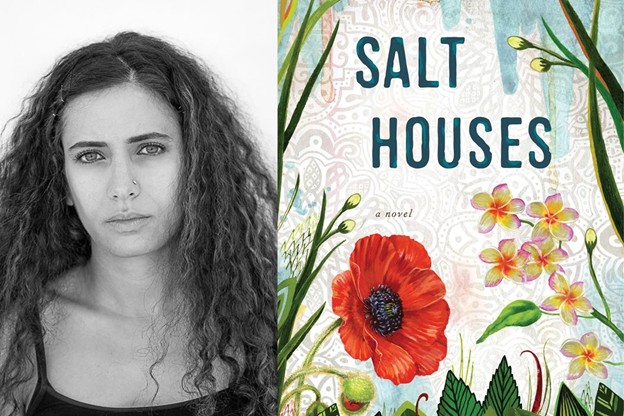
In Alyan’s writings, everything returns to the Palestinian diaspora and its aftermath
In Hala’s novel, ‘Salt Houses,’ she tells the story of how a family scatters, ending up in seven different cities: Nablus, Kuwait City, Amman, Paris, Beirut, and Jaffa. She follows multiple generations of the fictional Yacoub family, “tracing their lives across decades and major regional upheavals, including displacement following the Six-Day War of 1967 and later disruption during the 1990 Gulf War.”
Since Palestinians constitute one of the largest refugee populations, with “the diasporic community … strewn all over the planet in the world,” Hala wanted to follow the trajectory of a “single family that sought shelter in a nation (i.e., Kuwait) experiencing its own tragic political turmoil,” then to be scattered all over the Middle East. Her one caveat is that the diaspora does not treat everyone equally because “not everyone gets to leave.”
On the Gaza war itself, Aylan has expended many words as she “watched devastation from five thousand miles away. But what is the task of the diasporic witness, even depicting the lives of Gaza’s zoo animals starved to death? “There was a close-up on a trio of Palestinian foxes, flies swatting around them. The bodies were gathered together. Their eyes were ajar. Dead.”
In her writing and as part of who she is, Aylan is a devotee of Edward Said. Said, of course, was a Palestinian American academic, political activist, and literary critic who examined literature through the lens of social and cultural politics and was an outspoken proponent of the political rights of the Palestinian people and the creation of an independent Palestinian state. On exile, he once wrote, “Exile is strangely compelling to think about, but terrible to experience. It is the unhealable rift forced between a human being and a native place.” Furthermore, he defines it as occurring “by design.”
It is not by accident, then, that “On a July day in 1948, David Ben-Gurion wrote in his diary: ‘We must do everything to ensure they never do return…”
In a recent ‘Guardian’ article, “Hala cannot get the scenes of the Gaza war out of her mind: “We have been let into the lives of the people in Gaza in the most awful, intimate ways. We’ve watched them bury their granddaughters. We’ve watched them recognize their mother’s limp arms. We’ve watched them keel and mourn and beg, in their most despairing moments, in the face of inexpressible physical pain. We’ve watched their home videos. Their befores. We’ve watched their first and last birthday parties.”
Hala shared a very personal and poignant experience in a recent ‘New York Times’ article, “The Palestine Double Standard.” She discusses the thorny issue of a Palestinian’s need to prove she or he deserves empathy and compassion. “A couple of weeks ago, in a professional space, someone called Palestinians by name and spoke of the seven decades of their anguish. I sat among dozens of co-workers and realized my lip was quivering. I was crying before I understood it was happening. I fled the room, and it took 10 minutes for me to stop sobbing…By the simple naming of my people. By increasing recognition of the link to liberation. By spaces of Palestinian-Jewish solidarity. By what has become controversial: the simple speaking aloud of Palestinian suffering.”
In a recent ‘Teen Vogue’ issue, Aylan discusses the role of pro-Palestinian indoctrination or propaganda. She says, “Our perception of the world, our understanding of order and fairness and retribution, is curated for us as something static and predetermined.” Thus, she confesses, “Throughout my youth, I was often exposed to narratives that equated Zionism with Judaism. For me, this became enormously confusing. From childhood, I understood the government that displaced my grandparents and my father to be a terrifying, militarized entity, a powerful, unrelenting thing. It was to be feared.”
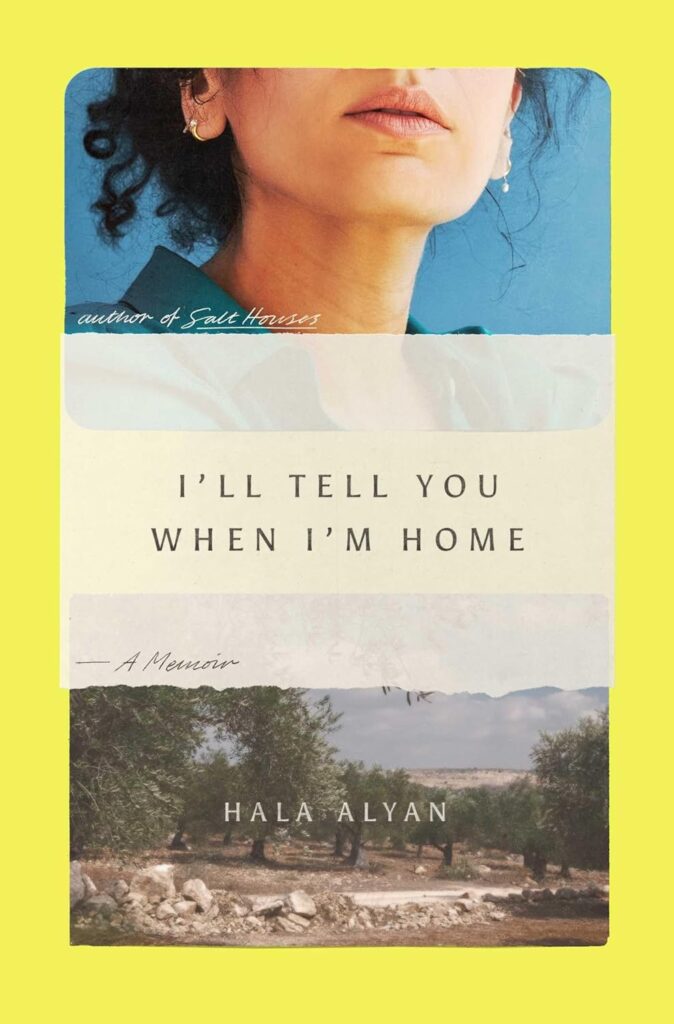
At the same time, she admits she had an intuitive understanding of “…the harrowing narrative of the Jewish struggle. I wept over novels and films and wrote essays about the lone survivors of entire family lines. I understood Jewish resilience to be a thing of softness and endurance, filled with music and art and philosophy that withstood, which made me ask better questions of myself, of liberation, of the world.”
In her most recent book, ‘I’ll Tell You When I’m Home: A Memoir,” a Pulitzer Prize Finalist selection, Hala links the diaspora and the long consequences of war to a highly personal experience of her using a surrogate mother for having a child. In the face of numerous personal issues, “She turns to family stories and communal myths: of grandmothers mapping their lives through Palestine, Kuwait, Syria, Lebanon; of eradicated villages and invading armies; of places of refuge that proved only temporary; of men that left and women that stayed; of the contradictions of her own Midwestern childhood, and adolescence in various Arab cities.”
“A stunningly lyrical and brutally honest quest for motherhood, selfhood, and peoplehood, ’I’ll Tell You When I’m Home’ is a powerful story of unraveling and becoming, of destruction and redemption, and of homelands lost and recreated.”
Palestinians worldwide and almost anyone else of a humanist bent can not help but be compassionate and empathic towards Hala Alyan. At the same time, she has a lot to teach all of us from her journey.
Sources
Hala Alyan,” Wikipedia Series on Arab Americans, 2026.
“About Hala Alyan,” Author’s Website, 2026.
“The 2026 Pulitzer Prize Finalist in Memoir or Autobiography,” ‘I’ll Tell You When I’m Home: A Memoir, by Hala Alyan (Avid Reader Press/Simon & Schuster), 2026.
“How to Recreate Palestine: Researching Salt Houses,” JSTOR Daily Newsletter, 3/11/2026.
“I am not there, and I am not here’: a Palestinian American poet on bearing witness to atrocity,” Hala Alyan, The Guardian, 1/28/2024.
“The Palestine Double Standard,” Guest Essay, Hala Alyan, The New York Times, 10/25/2023.
“What a Palestinian American Wants You to Know About Dehumanization,” Hala Alyan, Teen Vogue, 12/20/2023.
John Mason, Ph.D., focuses on Arab culture, society, and history and is the author of LEFT-HANDED IN AN ISLAMIC WORLD: An Anthropologist’s Journey into the Middle East, New Academia Publishing, 2017 and of his new novel, WHISPERS FROM THE DESERT: Zaki, a Little Genie’s Tales of Good and Evil (2025), under his pen name, Yahia Al-Banna. He has taught at the University of Libya in Benghazi, Rensselaer Polytechnic Institute in New York, and the American University in Cairo. John served with the United Nations in Tripoli, Libya, and consulted extensively on socioeconomic and political development for USAID and the World Bank in 65 countries.
The views and opinions expressed in this article are those of the author and do not necessarily reflect the position of Arab America. The reproduction of this article is permissible with proper credit to Arab America and the author.
Want more articles like this? Sign up for our e-newsletter!
Check out our blog here!