
Subscribe
to receive news by email

Poll
Will the Trump Administration Shift U.S. Policy in Favor of Palestine?
- No (86%)
- Yes (14%)
 Loading ...
Copyright © 2026 Arab America
Go topNo Shelter from the Storm: Winter in Gaza
By: Luma Alaraje / Arab America Contributing Writer
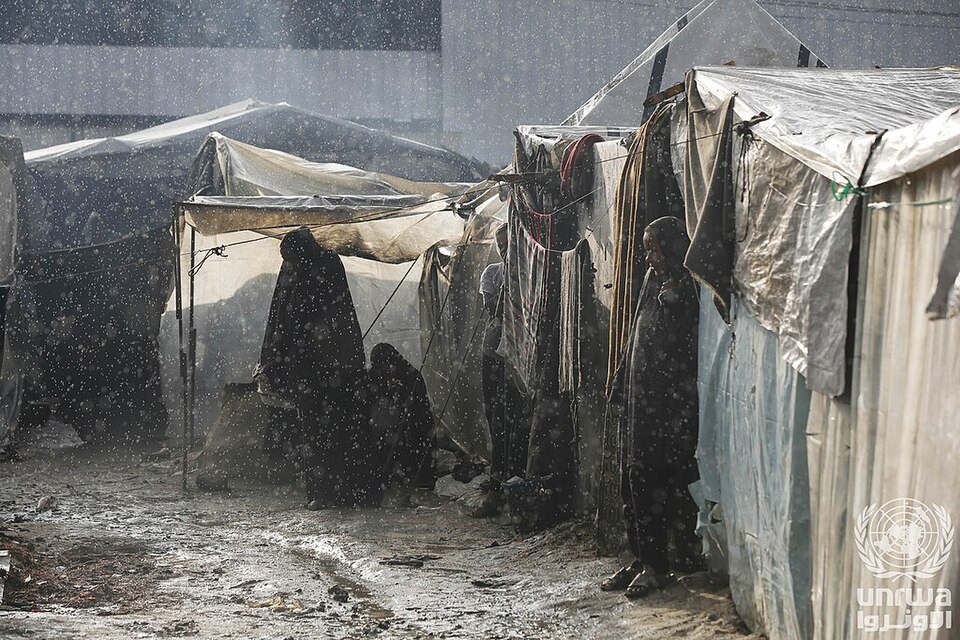
For Palestinians in Gaza, winter brings more than just colder temperatures. Heavy rains have flooded tents, destroyed what little belongings families have left, and left thousands exposed to freezing conditions without adequate shelter. As food and humanitarian supplies remain desperately limited, families are facing yet another winter in conditions that threaten their health and survival. The worsening humanitarian crisis created in Gaza as winter approaches emphasizes the need for increased humanitarian assistance, and an end to the devastating genocide that has placed these conditions on Palestinians in Gaza.
Winter Without Shelter
Heavy rainfall and strong winds swept across Gaza beginning November 6, flooding displacement camps and damaging shelters throughout the region. According to the United Nations Office for the Coordination of Humanitarian Affairs (OCHA), humanitarian organizations received appeals from more than 26,000 households reporting damage to their shelters and belongings by November 8. Floods reportedly destroyed more than 6,000 family shelters, while another 17,400 sustained damage. For families living in makeshift shelters, the flooding has meant losing what little protection they had against this weather, along with essential belongings such as clothing, bedding, medication, and personal documents.
The consequences have been particularly devastating for children and other vulnerable populations. Five Palestinians, including three children, were killed after a sandy hill collapsed onto their tents near Deir al-Balah. An infant also reportedly drowned at a displacement site. These incidents demonstrate the dangers that displaced families face when forced to seek shelter in unstable tents and overcrowded areas. Activists, like Ms. Rachel For Littles, took to social media to express their deep disdain for the powers and forces that placed Palestinian children at the brink of freezing to death. In an Instagram video, Ms. Rachel shared her perception of the stark contrast of taking care of her own child in her warm home, whilst seeing videos of children in Gaza being flooded in their tents. She emphasizes the importance of continuing to speak up against these atrocities and calling for humanitarian assistance to be let in to Gaza.
A post shared by Ms Rachel (@msrachelforlittles)
Beyond the Rain
While flooding has intensified the immediate threat faced by Gazans, the lack of adequate shelter is only one aspect of Gaza’s broader humanitarian crisis. Families are also restricted from access to sufficient food, clean water, medical care, and other basic necessities. According to the World Food Programme (WFP), approximately 1.4 million people in Gaza are experiencing crisis-level or worse food insecurity. Funding shortages have also forced the organization to reduce its food assistance by approximately one-third, leaving an estimated half a million people without access to critical assistance.
These shortages are particularly concerning as temperatures continue to drop. Malnutrition, inadequate shelter and exposure to cold can increase existing health risks, particularly among children, elderly people and at-risk individuals with medical needs. Floodwater and problems with sanitation also increase the risk of infections, skin conditions, and waterborne diseases.
Families in Gaza are already struggling to obtain enough food to survive, and preparing for colder weather presents yet another challenge. Obtaining blankets, finding dry clothing, and securing adequate shelter becomes increasingly difficult when even the most basic necessities remain out of reach.
Why Are Gazans Without Shelter?
The conditions Palestinians are facing cannot be understood as simply the result of seasonal weather. Years of destruction and displacement have left much of Gaza’s population without permanent housing, let alone the infrastructure necessary to withstand severe weather. According to OCHA, approximately 1.4 million Palestinians, or 65% of Gaza’s population, were living in tents or makeshift shelters before the recent flooding. Many of these shelters are worn out and provide little protection against the heavy rain and strong winds.
Humanitarian organizations have also raised concerns about Israeli restrictions affecting the entry of supplies into Gaza. According to OCHA, more than 150,000 tents purchased by humanitarian partners and member states were waiting outside Gaza, ready to be delivered. However, Israeli restrictions on the entry of shelter material have limited the supplies available to families who urgently need them. Families in Gaza are not only restricted access to food and humanitarian aid, but also to the resources needed to rebuild their communities.
The Norwegian Refugee Council has similarly warned that restrictions on shelter materials and construction supplies are preventing humanitarian organizations from adequately preparing for winter. Without sufficient tents, repair materials and heavy machinery, relief organizations face significant issues in providing displaced families with safer and more durable shelters.
Another Winter of Devastation
For Palestinians living in Gaza, the arrival of another winter means preparing to lose what little they have left. Families are left trying to remove floodwater from their tents, save their soaked belongings and find ways to keep their children warm. Meanwhile, humanitarian organizations continue to warn that the available supplies fall far short of the needs across Gaza.
As winter continues, Palestinians in Gaza will continue to face the consequences of displacement, inadequate shelter and limited access to essential resources. The humanitarian response to this winter must go beyond emergency distributions and reactionary measures. It must address the conditions placed on families that prevent them from accessing the necessities required to survive. For a population that has already endured years and decades of destruction and displacement, another winter without adequate shelter is not simply a seasonal hardship, it is another threat to their survival.
Want more articles like this? Sign up for our e-newsletter!
Check out our blog here!