

Subscribe
to receive news by email

Poll
Will the Trump Administration Shift U.S. Policy in Favor of Palestine?
- No (86%)
- Yes (14%)
 Loading ...
Copyright © 2026 Arab America
Go topIn Lebanon, as in Gaza, Israel is Applying a Skewed Security Doctrine
By: Ghassan Rubeiz / Arab America Contributing Writer
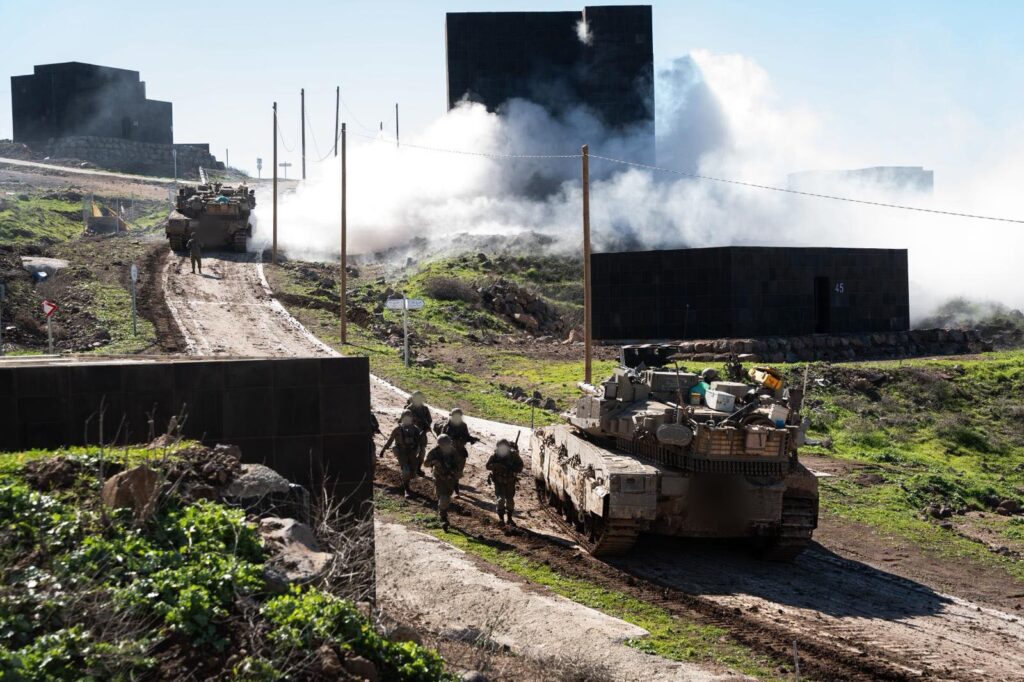
Israel has a security doctrine with a structural flaw: it generates the insecurity it claims to prevent. Nowhere is this more visible today than in Lebanon, where resistance to military onslaught is treated as terrorism and performative peace negotiations rationalize the continuation of an unnecessary war. Washington has reportedly given Israel the green light to escalate its Gaza-like campaign in Lebanon — a move that may also be designed (mainly by Netanyahu) to sabotage a fragile deal with Iran that Trump now appears reluctant to sign.
Since early March, Israel’s campaign in Lebanon has killed more than three thousand people, injured over ten thousand — many of them women and children — displaced over a million, leveled entire neighborhoods, and damaged hospitals, schools, roads, and irreplaceable historical sites. This destruction is not inevitable collateral damage. It reflects a deliberate strategy: punish Lebanon for harboring an armed resistance, pressure society to turn against Hezbollah, and undermine any diplomatic opening between Iran and the United States.
A new round of Washington talks — two separate meetings, one on “security,” one on political negotiations — has done nothing to close the gap. With its boots on Lebanon’s neck, Israel is not in a position to find common ground with its northern neighbor.
Israel’s security doctrine has long relied on preemption, occupation, buffer zones, and overwhelming force rather than diplomacy or negotiated borders. It seeks to weaken any state capable of challenging its military dominance, and it has repeatedly maneuvered Washington into supporting its wars — in 1967, 1973, 1982, 2023, and now in 2026. As the late Lebanese-American historian Philip Hitti observed, no nation has suffered more from its geography than Lebanon — positioned at the crossroads of empires that have never stopped competing.
Washington and Tehran are in the process of drafting a ceasefire that would reopen the Strait of Hormuz, create a two-month window for nuclear and sanctions negotiations, and chart a path toward de-escalation. The war on Iran was futile — it did not significantly diminish Iran as a regional power, it inflicted enormous diplomatic damage on both Washington and Tel Aviv, and the global oil crisis triggered by the closure of the Strait exposed its recklessness. All sides are exhausted. Yet Israel, feeling sidelined, has urged Trump to reject or delay the agreement. Trump obliged, insisting he is in “no hurry.” That posture may now be shifting: in a furious phone call on June 2nd, Trump reportedly told Netanyahu — “everybody hates you now, everybody hates Israel because of this” — and demanded he stand down from a planned assault on Beirut, a rare rupture that signals the limits of Netanyahu’s hold over Washington. Hawks in Washington and Tel Aviv continue to apply high-voltage pressure. If the deal is eventually signed, Israel will likely only pause its attacks on Lebanon while pressing ahead with population displacement in Gaza and the West Bank, insisting as usual that no agreement restricts its “right to self-defense.”
Lebanon enters this storm already broken — not by this war alone, but by years of accumulated failure. Political deadlock paralyzed the state long before the first Israeli strike. Into that vacuum, Hezbollah expanded. Israel followed, treating Lebanon not as a sovereign state but as an extension of Iran’s battlefield. The Lebanese people are caught between Hezbollah’s choices and Israel’s punishment.
Washington’s persistent error is to view the region through compartmentalized crises: terrorism, nuclear files, shipping lanes, oil markets, close allies. This reductionist lens blinds the United States to how Israel’s security doctrine, Palestinian dispossession, Iran’s regional strategy, and Lebanon’s state failure are interconnected. By refusing to confront the political roots of conflict, Washington’s diplomacy becomes reactive, trailing behind events, and perpetually vulnerable to sabotage from the ground.
A different posture is conceivable and overdue: one that treats questions of justice as seriously as it treats enrichment centrifuges. One conclusion is now clear: Israel’s leadership has built a security doctrine that manufactures insecurity — relying on force to solve political problems, on occupation to manage borders, and on perpetual conflict to maintain dominance. Lebanon, fragmented and exposed, is the latest victim. Washington, by refusing to challenge Israel’s assumptions, becomes its enabler. Unless the United States begins to treat Israel simply as a Middle Eastern state — with its own interests, not identical to America’s — the cycle of war will not end.
Ghassan Rubeiz is the former Middle East Secretary of the World Council of Churches. Earlier, he taught psychology and social work in his country of birth, Lebanon, and later in the United States, where he currently lives. He has contributed to political commentary for the past twenty years and has delivered occasional public talks on peace, justice, and interfaith topics. You can reach him at rubeizg@gmail.com
The views and opinions expressed in this article are those of the author and do not necessarily reflect the position of Arab America. The reproduction of this article is permissible with proper credit to Arab America and the author.
Want more articles like this? Sign up for our e-newsletter!
Check our blog here!