Subscribe
to receive news by email

Poll
Will the Trump Administration Shift U.S. Policy in Favor of Palestine?
- No (86%)
- Yes (14%)
 Loading ...
Copyright © 2026 Arab America
Go topPathbreakers of Arab America—Lina AbiRafeh
By: John Mason / Arab America Contributing Writer
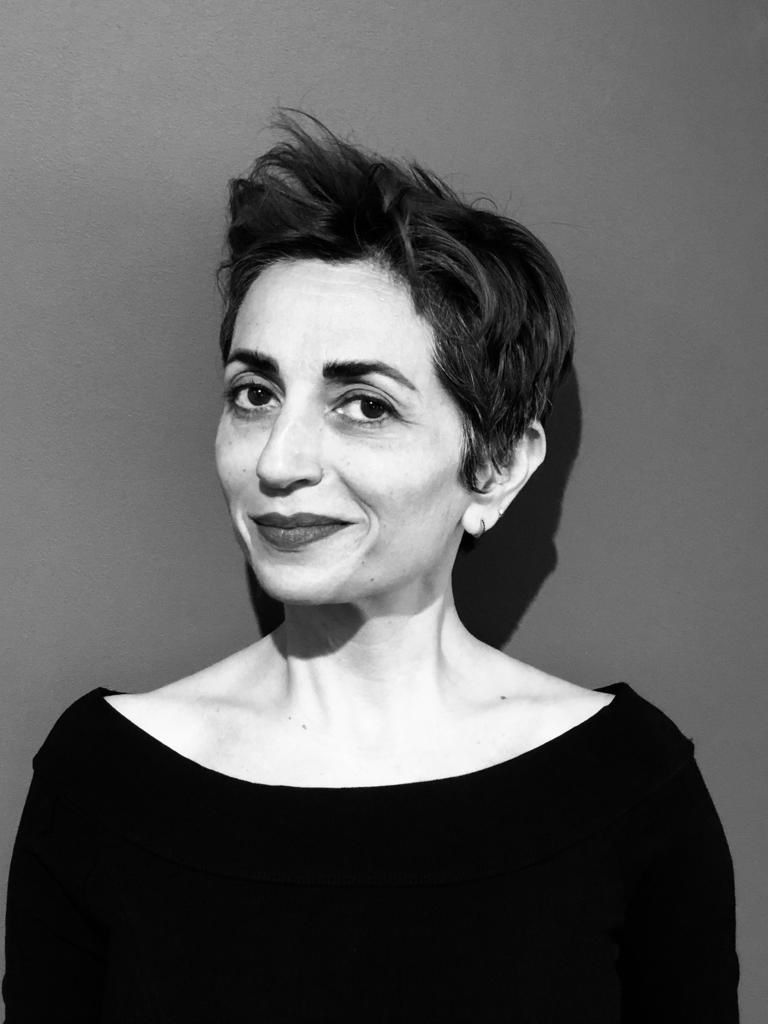
This is our 123rd in Arab America’s series on American pathbreakers of Arab descent. The series features personalities from various fields, including entertainment, business, sports, science, the arts, academia, journalism, and politics. Our 123rd pathbreaker, Lina AbiRafeh, is a globally recognized Arab American feminist activist, author, and expert on women’s rights in humanitarian and development contexts. She is known for her fearless advocacy, practical innovation, and decades of frontline work dedicated to ending gender-based violence and advancing equality. At the core of AbiRafeh’s philosophy is an unshakable belief in the imperative of absolute gender equality as a foundation for just and prosperous societies.
AbiRafeh–instrumental in advancing gender-based violence prevention and response–her advocacy for gender equality is well-documented
Born in 1974, Lina AbiRafeh is the daughter of a Palestinian mother and a Lebanese father. During her early years in Saudi Arabia, her mother worked as a pharmacist and her father as an engineer. At the age of ten, Lina moved with her parents to northern Virginia, an experience that “added a further layer of cross-cultural perspective to her formative years,” in addition to her multicultural upbringing within the Arab world. Both experiences “provided an early lens through which to view complex social dynamics.”
Lina attended Boston College for her undergraduate degree and earned her master’s degree in international relations from the Johns Hopkins University. She completed her PhD. in development studies at the London School of Economics and Political Science in 2008. AbiRafeh wrote about her lifelong passion in her doctoral thesis, which focused on gender-focused aid in Afghanistan in the aftermath of the 2001 Bonn Agreement. That agreement envisaged the creation of the International Security Assistance Force to maintain security there. It aimed to centralize governance and protect the rights of women and minorities.
This scholarly work established the “evidence-based, critical approach that would define AbiRafeh’s career, grounding her activism in a deep understanding of how interventions function within complex, real-world environments.” Her academic and applied career well qualified her to serve as the executive director of the Arab Institute for Women at the Lebanese American University from 2015 to 2022. There, she spearheaded numerous initiatives linking academic scholarship with activism. She championed projects that documented women’s experiences during the Arab uprisings and advocated for legal and social reforms across the Middle East and North Africa.
AbiRafeh’s work as a specialist in gender-based violence in emergencies with various United Nations and humanitarian organizations has taken her to conflict and disaster zones including Afghanistan, the Democratic Republic of the Congo, Haiti, and Papua New Guinea, where she developed and implemented programs to protect and empower women and girls. In these roles, she witnessed firsthand the critical gap between policy intentions and practical outcomes for women in crises. This frontline experience shaped her conviction that effective solutions must be context-specific and driven by the needs of affected communities. It also cemented her expertise in the specialized field of preventing and responding to gender-based violence in emergencies.
Today, AbiRafeh regularly acts in an advisory capacity for a multitude of public and private organizations, including a range of United Nations agencies and the Arab Institute for Women, on issues relating to gender-based violence and gender equality. She serves on the international advisory board of many organizations, including the Global Institute for Women’s Leadership, Forced Migration Review, the Society of Gender Professionals, and the Global Women’s Institute. Since 2022, AbiRafeh has been a senior advisor, acting in an independent capacity as a self-described “thought leader, opinion-shaper, and fearless changemaker for global women’s rights.”
Lina is the author of three books and over 100 articles, and her honors include participation in an Oxford Union debate about the Arab Spring, a slot at TEDx, and presentations to international media outlets such as CNN, Al Jazeera, and Good Morning America. In 2018 and 2019, AbiRafeh was identified by ‘Apolitical Group’ as one of the most influential people in gender equity policy. In 2021, she received a ‘Vital Voices’ fellowship for outstanding women leaders. She was also recognized by the Women’s Media Center as one of its Progressive Women’s Voices for 2021, and in 2022, she was awarded a Women in Power fellowship and, in 2023, a Council on Foreign Relations and British-American Project fellowship.
AbiRafeh’s career trajectory demonstrates a consistent evolution–from direct implementation to institutional leadership, to independent entrepreneurship and thought leadership
In 2022, AbiRafeh transitioned to a new entrepreneurial venture, founding Better4Women. This boutique advisory firm represents the culmination of her experience, offering practical and innovative consulting services to advance gender equality. As its Founder and Chief Changemaker, she works directly with organizations to design and implement effective gender strategies. Her work with Better4Women focuses on translating feminist principles into actionable organizational change. The firm advises a range of public- and private-sector clients, “helping them move beyond performative gestures to create tangible, systemic improvements in their policies and practices related to gender equity.”
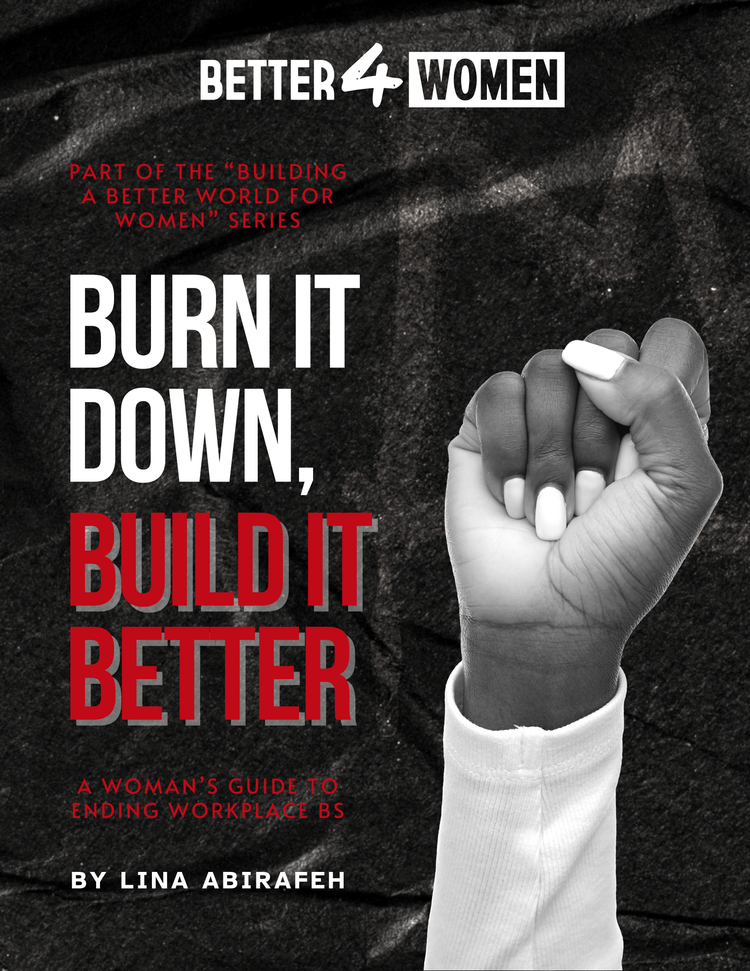
Her latest book, ‘Burn it Down, Build it Better: A Woman’s Guide to Ending Workplace BS,’ published in 2025, applies her feminist critique to corporate and organizational environments. It offers “a direct, actionable guide for challenging and dismantling patriarchal structures in professional settings.” The book nicely reflects Abi Rafeh’s leadership style, which is characterized by “directness, passion, and a refusal to accept bureaucratic inertia.” She is known to her colleagues as “a fearless and tireless advocate who speaks truth to power without hesitation. She leads with a sense of urgency, driven by the conviction that delays in advancing women’s rights have real and devastating consequences for lives in the balance.”
Lina’s management style is a critical aspect of her overall approach; it is based on her fostering of “collaboration and mentorship, particularly for younger feminists and women from the Global South. Her leadership involves amplifying marginalized voices and creating platforms for others. This supportive yet demanding style encourages excellence and resilience in those who work with her, building a wider network of effective advocates.” At the core of AbiRafeh’s philosophy is an unshakable belief in “the imperative of absolute gender equality as a foundation for just and prosperous societies.” She views the fight for women’s rights not as a separate issue but as integral to solving broader global challenges, from conflict to poverty to climate change. Her worldview is fundamentally intersectional, recognizing how gender discrimination compounds with other forms of oppression based on race, class, and nationality.
Being honest and frank about the primary issues Arab women face, AbiRafeh notes that the Arab region “continues to rank at the bottom of all social indicators when it comes to gender equality. Gaps between males and females in political and public life, leadership and decision-making, economic empowerment, and so on, remain very large. There are many crises in the region – Palestine, Iraq, Syria, Yemen, and so on. Women’s lives are in jeopardy in those settings…Additionally, there is a resurgence of fundamentalist views in many places, provoking a backlash and restricting women’s rights and fundamental freedoms.”
Gender alone is not the only societal issue that concerns AbiRafeh. In a 2024 article titled “Gaza Genocide: Voices from Rafah,” she wrote about the Israeli Occupation Forces’ (IOF) preparations for a ground invasion of Rafah, a city in southern Gaza. She averred at the time, “Further escalation will make it the deadliest massacre yet because, in the words of Lynn Hastings, Humanitarian Coordinator for the Occupied Palestinian Territory, ‘there is no safe place in Gaza and there is nowhere left to go.’” AbiRafeh predicted correctly the deadly rate of death and destruction in Gaza, the deadliest massacre of the 21st century. In addition, she depicted Israel as starving Gaza — “a direct result of the occupation’s genocidal policies.”
The disproportionate harm to women and children of Gaza because of the IOF attack was noted by AbiRafeh. She reported, “In Gaza, nearly 1 million women and girls have been displaced, women and children make up 70% of civilian fatalities, and two mothers are killed every hour. In four months, more than 12,300 Palestinian children have been killed by Israel. If this alone does not stop anyone in their tracks, then humanity has failed on such an incomprehensible scale.”
When it counts to be present, to be caring, to be a voice, Laila AbiRafeh will be there–for half the world that is comprised of girls and women and for the downtrodden people of Palestine! That is more than anyone can ask of her.
Sources:
“Lina AbiRafeh,” Wikipedia Series on Arab Americans, 2026
“Lina AbiRafeh,” 2026 The Notable People Project, 2026
“Burn it Down, Build it Better: A Woman’s guide to ending workplace BS,” Lina AbiRafeh, ‘Better World for Women’ series, 2026
“Gaza Genocide: Voices from Rafah,” Lina AbiRafeh, Medium, 2/16/2024
John Mason, Ph.D., focuses on Arab culture, society, and history and is the author of LEFT-HANDED IN AN ISLAMIC WORLD: An Anthropologist’s Journey into the Middle East, New Academia Publishing, 2017 and of his new novel, WHISPERS FROM THE DESERT: Zaki, a Little Genie’s Tales of Good and Evil (2025), under his pen name, Yahia Al-Banna. He has taught at the University of Libya in Benghazi, Rensselaer Polytechnic Institute in New York, and the American University in Cairo. John served with the United Nations in Tripoli, Libya, and consulted extensively on socioeconomic and political development for USAID and the World Bank in 65 countries.
The views and opinions expressed in this article are those of the author and do not necessarily reflect the position of Arab America. The reproduction of this article is permissible with proper credit to Arab America and the author.
Want more articles like this? Sign up for our e-newsletter!
Check out our blog here!