
Subscribe
to receive news by email
Poll
Will the Trump Administration Shift U.S. Policy in Favor of Palestine?
- No (86%)
- Yes (14%)
 Loading ...
Copyright © 2026 Arab America
Go top(Un)Freedom of Movement in Palestinian Ecosystem
By: Rami Balin / Arab America Contributing Writer
Walks Through the Landscape
In his memoir “Palestinian Walks” writer and lawyer Raja Shehadeh describes seven walks that he took over the span of a few decades. He calls each of these walks sarha (sarhat plural), not just a stroll in nature but a wandering, through time and place alike. “Going on a sarha,” he writes, “implies letting go.” Some of the trails he follows are near his home in Ramallah, some are in other parts of the West Bank. During these walks, he carefully notices the landscape around him, the places that he has vivid memories of. He catalogs the seasons and all their changes, the flowers, rocks, the sounds and the smells of Palestine. Some trails he revisits, some he follows, remembering them from the time when he was a kid.
The sarhat are interrupted by the encroaching occupation and its consequences. The space is constantly collapsing, the trails that he has known all his life become inaccessible, fenced off, dangerous, or cease existing altogether, bulldozed over, piled with new settlements. “The countryside I grew up in was being transformed so rapidly I could hardly keep up,” he writes about the staggering changes he discovers on each of the walks, observing the unstable landscape: the settlements, the roads, the seizures of land. These disrupt the very landscape, alienating Shehadeh and restraining his mobility, not only cutting through the hills but shredding the very experience of being there.
Boundaries
In the occupied territories, where internal carceral borders are continuously redrawn, such alienation is downright dangerous. Any kind of movement, whether a sarha, a walk to work or school in the morning or a visit to another town for a family gathering can have serious consequences. Even ambulances get stopped at checkpoints, despite the emergency, and in some cases the delays are lethal. Physical barriers are drawn alongside bureaucratic ones, creating a system of confinement that has been aptly called the biggest prison on earth.
The ever-changing nature of those barriers means that the land is getting quartered perpetually and unpredictably. This forces Palestinians to live in a state of constant fugitivity where evading these colonial borders and instruments of control becomes an integral part of daily life. Such circumstances leave many Palestinians feeling like they are quite literally fugitives in their own land. With that, Shehadeh’s walks become a way of resisting the boundaries and the confinement, emphasizing presence and Palestinian Indigenous connection to the land.
Human and More Than Human
In discussions of movement in Palestine birds, animals, insects and other inhabitants of the land are often omitted. In fact, according to the Palestine Institute for Biodiversity and Sustainability of Bethlehem University, Palestine is home to roughly 3% of global biodiversity, more than some countries ten times its size. More than human life is also influenced greatly by the colonial barriers and borders that are by definition unnatural.
In the eyes of the settler-colonial government, nature is a battlefield, and not just when it comes to resources that can be extracted from it – it is inevitably a terrain that houses ambitions of the settler government and other Zionist actors. In that terrain all living organisms are symbolically divided into those “on our side” and “on the other side”, viewed as emblems for the Zionist cause and for Palestinian cause. For instance, the olive trees have been associated with Palestinians and their Indigenous presence on the land and are therefore contained, appropriated or eradicated to give way to conifers and other European trees.
A lot of the connotations fueling the us/them dynamic imposed by the settler colonialism in this case are rooted in the imaginations of what the Biblical landscape of Palestine ought to look like. It defines policies and interactions alike and is the crux of what Irus Braverman calls eco-Zionist mindset. A lot of species have been introduced, like the Persian fallow deer, Asian white ass, and others. Belonging to this Biblical category gives animals protections and sometimes privileges of movement, forming hunting laws and other rules of land use, including protections for national parks and nature reserves as parts of that Judeo-Christian Biblical imaginary.
Controlling Borders
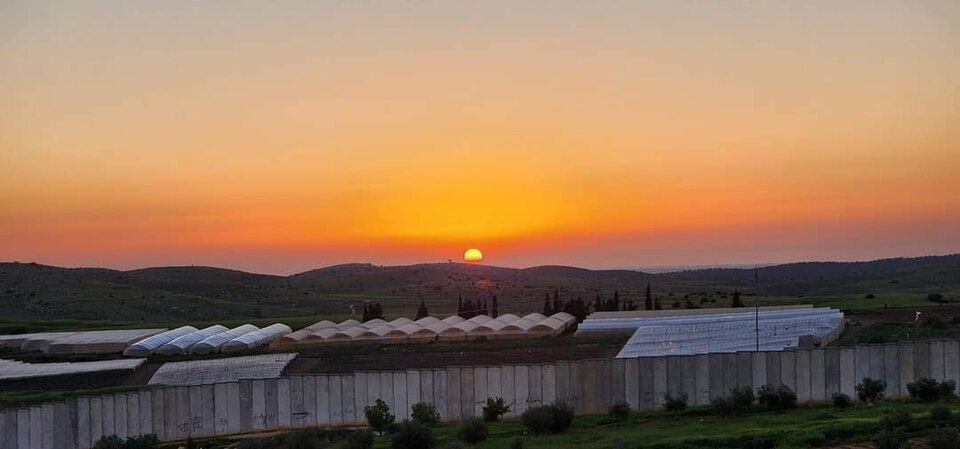
Protected status of species does not always guarantee freedom of movement, and a perfect example of that is the Separation Wall. It is not a uniform structure; rather, it is an electronic fence, or a dirt road with border patrol, or the infamous concrete block structure. Due to those differences, the Wall can be porous, but not for domesticated animals such as sheep or goats who are not allowed to cross it without special permits. After the construction of the Wall, Israel Nature and Parks Agency insisted that holes be made in it, first for small animals, then for larger ones. Despite that, animals bigger than a fox, like wolves, hyenas and wild boars still have difficulty crossing the barrier. Gazelles get trapped between the settlements and the Wall, victims of the fragmentation of their already shrinking living space and the whole ecosystem. Some species of plants suffer, unable to grow by the Wall as it also blocks the wind that carries their seeds. This way, even protected and reintroduced species are victims of settler-colonial violence.
When it comes to movement control, the security state is built to accommodate wild species at the expense of domestic ones and Palestinians alike. While one needs to be surveilled scrupulously, the other can pass through a hole in the slab of cement.
Some species are also set to police others. Recently, far-right groups in Israel made a proposal to build a mote around Ketziot Prison where Palestinians are incarcerated and fill it with crocodiles, inspired by the US Alligator Alcatraz prison in Florida that was closed due to, among other things, its inhumane conditions. For this purpose, the Nile crocodiles were reclassified from protected species to “tended wild animal.” This proposal was pulled back thanks to interventions by animal rights groups whose concern was the wellbeing of crocodiles, not Palestinian humans.
Of all the species in Palestine, birds can perhaps most easily cross borders and have become a symbol of freedom for Palestinians. Airborne, they are capable of crossing over the Separation Wall with no difficulty and are freer than Palestinians themselves. They appear prominently in Palestinian culture, a sign of hope and a future where unnatural militarized barriers are no longer immovable obstacles.
Want more articles like this? Sign up for our e-newsletter!
Check our blog here!