
Subscribe
to receive news by email

Poll
Will the Trump Administration Shift U.S. Policy in Favor of Palestine?
- No (86%)
- Yes (14%)
 Loading ...
Copyright © 2026 Arab America
Go topPathbreakers of Arab America—Alixa Naff
By: John Mason / Arab America Contributing Writer
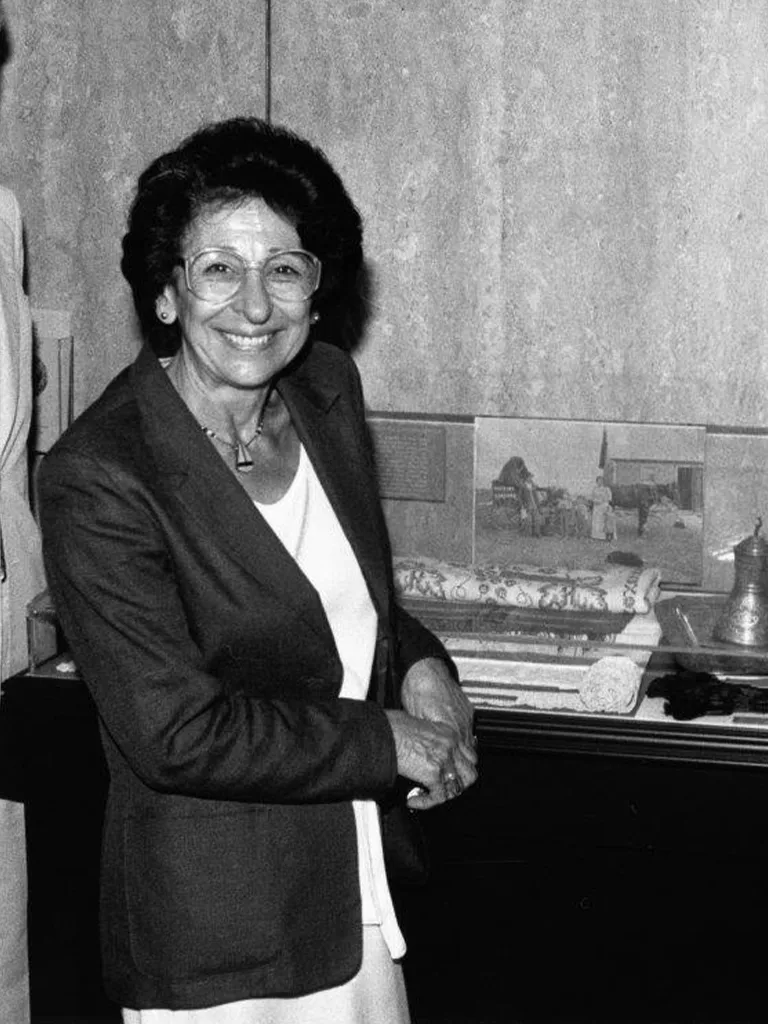
This is the 127th article in Arab America’s series on American pathbreakers of Arab descent. The series features figures from entertainment, business, sports, science, the arts, academia, journalism, and politics. Our 127th pathbreaker is Lebanese American Alixa Naff, scholar, oral historian, archivist, and activist. Called ‘The Mother” of Arab American Studies,’ she assiduously researched Arab immigrants’ adaptations to their new country. Alixa developed a rich collection of her primary sources documenting the lives of Arab Americans in the 20th century. Alixa died in 2013, at the age of 93.
Alixa Naff, Lebanese American, Grande Dame of Arab American Social History
Naff was born on September 15, 1919, in Rashayya al-Wadi, a village in the Anti-Lebanon, the western mountain range of the former Syrian province in what is today Lebanon. Her parents, Faris and Yamna Naff, immigrated to the U.S. in 1921 and arrived in Spring Valley, Illinois, on January 1, 1922. There, they joined a substantial group of immigrant families from Rashayya as well. Alixa’s father, Faris, was familiar with the town, having migrated to the U.S. from 1895 to 1913, when he was a door-to-door salesman in the Midwest. When the family immigrated, her father resumed his itinerant sales job, using Spring Valley as a base.
During her childhood in Spring Valley, Alixa recalled how her parents would encourage her to attend American Protestant churches, in addition to their own St. George’s Syrian Orthodox Church, so that she could learn English. Her family still cherished their Lebanese roots, but Alixa became aware that one of the key reasons for their immigration to the U.S. was not just economic but also the political turmoil in the Levant. It was not that long ago that her grandparents on her mother’s side were murdered in 1925 during internal conflict between Druze and Christian sects in Lebanon.
In 1929, the family moved to Fort Wayne, Indiana, to open a grocery store, which apparently had failed in less than a year. Alixa was then sent to live with a family member in Detroit, “and there she developed a habit for clipping papers and for collecting various writings, pictures, and other intriguing objects.” In June 1931, her father brought the whole family to Detroit, where he tried his luck in the grocery store business.
This start for Alixa in the U.S. did not, at first blush, seem propitious for what became her life’s work: researching Arab American immigration. From her autobiography, we learn how “her eclectic habits of daydreaming and reading led her to diverge from expectations for ‘Syrian’ women in America, and she developed a special interest in English literature in school.” Nevertheless, the financial precariousness of her family prevailed, and Alixa ended up working for Western Union for several years in Detroit, and “she credited this experience with broadening her horizons for independent career options.” Even after that work, she was forced to return to managing the family grocery store during World War II while her brothers served in the war effort.
Finally, Alixa instigated the selling of the family grocery in Detroit, and she and her father moved to California in 195, following her mother’s sudden death. She encouraged her father to process his mourning by writing his life story in Arabic in a brown spiral-bound notebook. This artifact is a treasured piece in the Naff collection, about which more below, and, as Naff later improved her Arabic, she eventually translated it into English.
There, in California, Alixa decided to enroll at the University of California, Los Angeles, to obtain a B.A. degree in History in 1962. She relates that during her senior year, she was required to write a paper for an American history seminar on immigration, and she chose the subject of the Arabs in America. She recalled that, because of the lack of scholarship, her paper was largely “based on conversations with my parents’ friends, because there was little on library shelves.” This difficult experience intrigued her professor, who facilitated a grant for her to collect Arab oral histories and folklore. This was one of those stellar moments that put Alixa on the path to eventually becoming the ‘Mother of Arab American Studies.’
Realizing that her true goal was research, supported by government grants, Alexi set about collecting oral histories and primary sources on the history of Arab immigrants to the United States. In the summer of 1962, she traveled the United States in a blue Volkswagen Beetle, known as ‘the camel,’ conducting oral interviews with first-generation Arab American immigrants and collecting their photographs and artifacts. She visited sixteen communities with Arab immigrants in the United States and eastern Canada and interviewed eighty-seven people, the last surviving members of the ‘pioneer’ generation.
Following her fieldwork, Naff went on to earn a Ph.D. in History at UCLA in 1972, after which she taught in higher education for several years in the 1970s. In the context of the 1967 Six-Day War, she left academia, “citing widespread anti-Arab sentiment and a desire to counter stereotypes about Arab Americans.” She talked about how the 1967 war affected the development of her identity. “I was in my office when I first heard about the war,” she said. “A friend came in and said ‘Alixa, you better go home, they’re out to get you’. I didn’t understand. At that time, I ate the [Arab] food, and I loved the dancing, but I was an American. All of a sudden, we all became Arabs.”
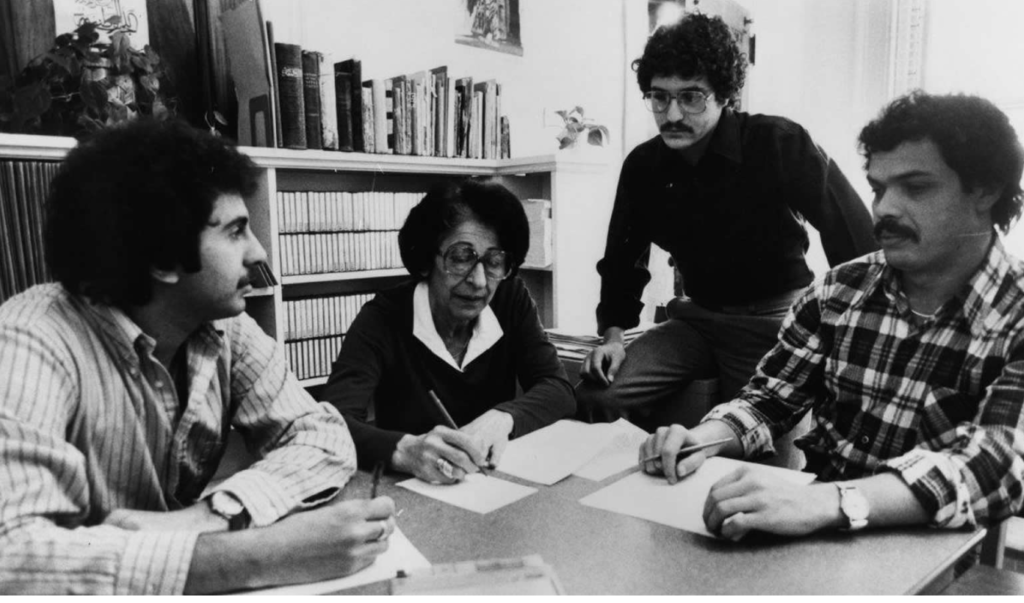
Arab Americans owe a debt to Naff for enabling them to balance an ‘uncertain ethnic identity with great pride as Americans’
A critical aspect of Naff’s work was her active role in collecting Arab American materials, aimed at “having a national impact on countering anti-Arab stereotypes with accurate information.” As part of her crusade, she messaged ‘The Washington Post,’ ‘The New York Times,’ and various members of Congress with the question: “Where are you getting your information about Arab Americans?” Through her growing collection of data and artifacts, she contributed to the Faris and Yamna Naff Arab American Collection, donated to the Smithsonian Institution in 1984 and maintained and supplemented by Naff herself for years afterward. The collection is an invaluable resource for those attempting to understand and communicate Arab American history.
In 1977, Naff moved to Washington, D.C., to work as a consultant on a documentary film about the Arab experience in the United States, and this project further emphasized the lack of basic material. She began to bolster her collection while initiating a comprehensive study of the history of Arab immigrants, culminating in the Smithsonian collection, an invaluable resource for those seeking to understand and communicate Arab American history. In addition, Naff frequently traveled the country to give lectures about the collection and her work.
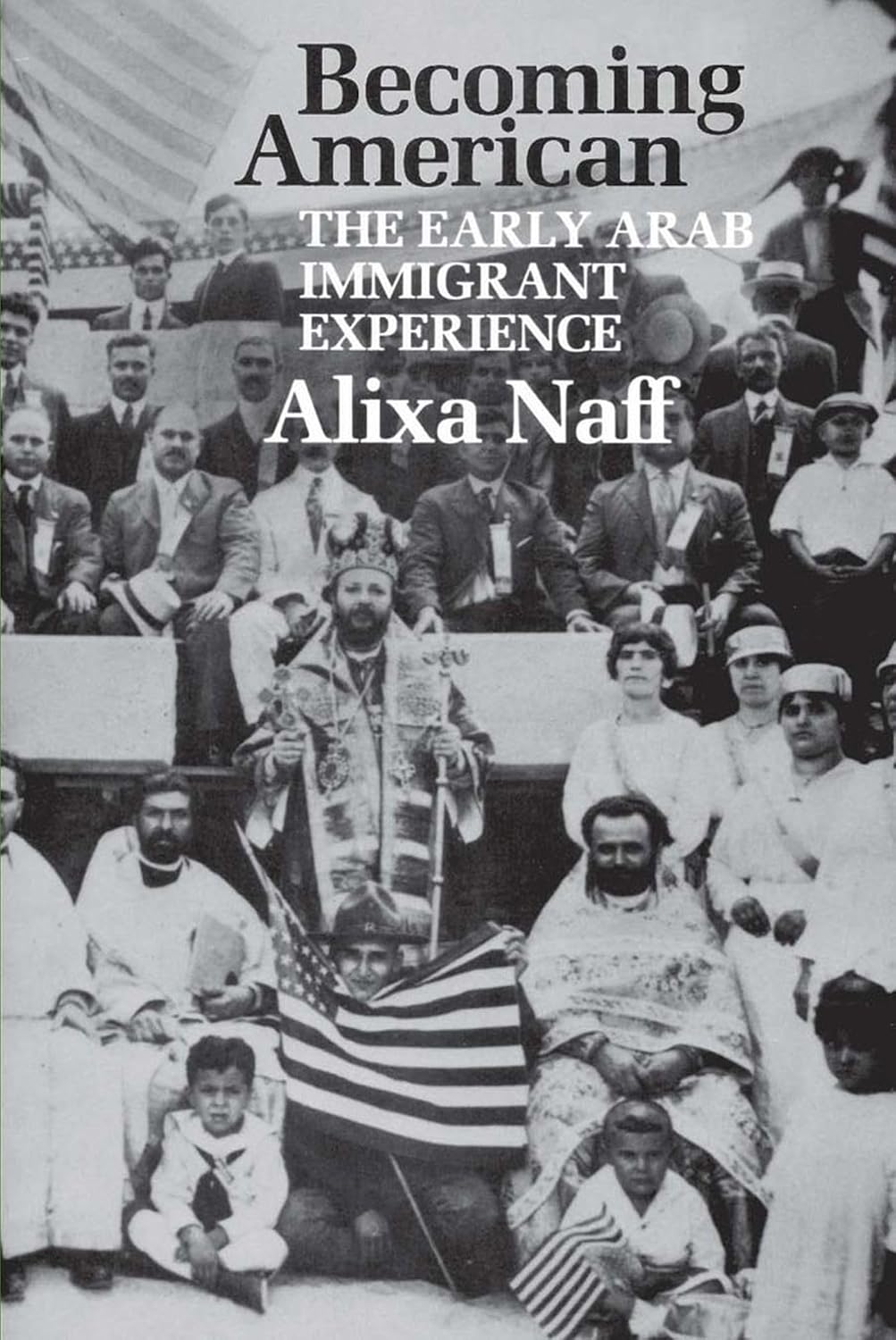
A seminal piece of Alixa’s contribution is her book, ‘Becoming American: The Early Arab Immigrant Experience.’ In it she encourages Arab Americans to imagine their parents’ generation’s “struggle with traditionalism, national identity, ignorance, and xenophobia…” In doing her research, her intellectual discipline emerges, encouraging other researchers to “to connect the disparate dots of artifacts, documents, and personal stories that could be
confounding at best.” She wanted her fellow researchers to “cultivate in others the spirit of patience and historical accuracy.”
Not to be missed is Alixa’s focus on the role of immigrant Arab women, notably the importance of women’s economic roles as itinerant saleswomen and later as shopkeepers. This represents “a significant contribution to the literature on ethnic enterprise and on immigrant women.”
In the end, Naff’s decades of study and collecting, archiving, and promoting the stories of Arab Americans were not simply a past she could be proud of—”they were Alixa’s lifeblood and sustenance.” She has been characterized as “an intrepid scholar who pioneered the preservation of the history and narrative of Arab immigration to America.”
Alixa Naff resided in Falls Church, Virginia, for many years before moving to Mitchellville, Maryland. She died from a short illness at her home in Mitchellville, Maryland, on June 1, 2013, at the age of 93.ville, Maryland. She died from a short illness at her home in Mitchellville, Maryland, on June 1, 2013, at the age of 93.
Sources:
“Alixa Naff,” Wikipedia Series on Arab Americans, 2026
“Remembering Alixa Naff: “The Mother” of Arab American Studies,” Arab American Institute, 6/6/2013
“Farewell to the Grande Dame of Arab American Social History—Reflections on my debt to Alixa Naff,” Helen Hatab Samhan, Science Open.com, Winter 2015
“Dr. Alixa Naff: A Founder of Arab American Studies,” Rosemarie M. Esber, North Carolina State University, 7/1/2020
‘Becoming American-the Early Arab Immigrant Experience,’ (autobiography) Alixa Naff, Southern Illinois University, 9/1/1985
‘Guide to the Faris and Yamna Naff Arab American Collection,’ Collection of Alixa Naff’s Research, Archives Center, National Museum of American History
John Mason, Ph.D., focuses on Arab culture, society, and history and is the author of LEFT-HANDED IN AN ISLAMIC WORLD: An Anthropologist’s Journey into the Middle East, New Academia Publishing, 2017, and of his new novel, WHISPERS FROM THE DESERT: Zaki, a Little Genie’s Tales of Good and Evil (2025), under his pen name, Yahia Al-Banna. He has taught at the University of Libya in Benghazi, Rensselaer Polytechnic Institute in New York, and the American University in Cairo. John served with the United Nations in Tripoli, Libya, and consulted extensively on socioeconomic and political development for USAID and the World Bank in 65 countries.
The views and opinions expressed in this article are those of the author and do not necessarily reflect the position of Arab America. The reproduction of this article is permissible with proper credit to Arab America and the author.
Want more articles like this? Sign up for our e-newsletter!
Check out our blog here!