Subscribe
to receive news by email

Poll
Will the Trump Administration Shift U.S. Policy in Favor of Palestine?
- No (86%)
- Yes (14%)
 Loading ...
Copyright © 2026 Arab America
Go topThe Drive for Divestment: Remembering the Detroit Dodge Main Wildcat Strike
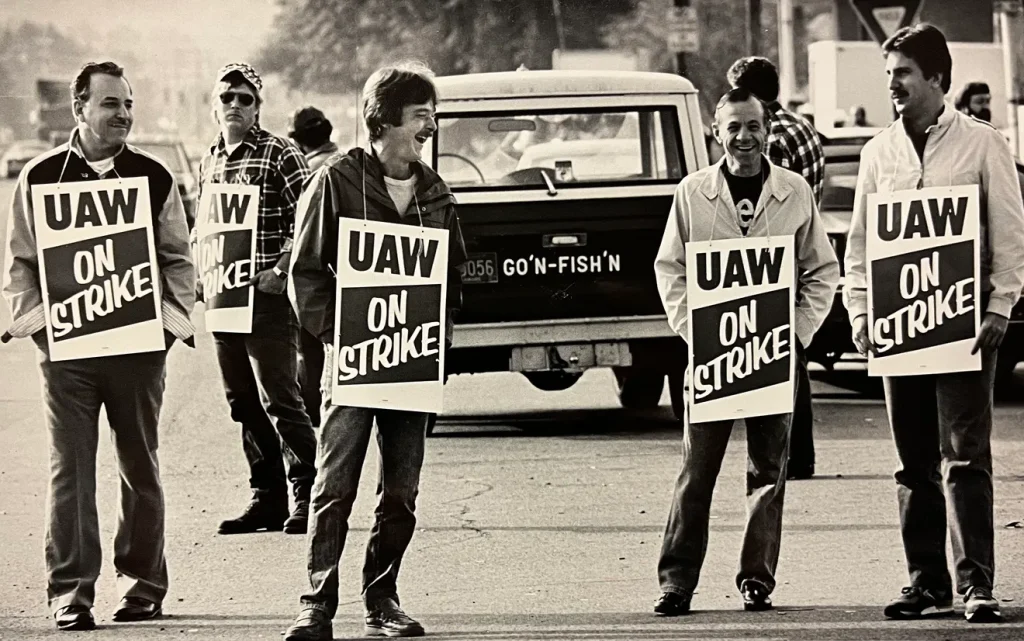
By Jahnvi Chopra / Arab America Contributing Writer
United Auto Workers
Since its founding in 1935, the United Auto Workers (UAW) union has pushed to secure workers’ benefits and better compensation for their labor through industrial organizing, targeted shutdowns, connections with partner organizations, and rolling walkouts. They formed in August of that year at a convention of the American Federation of Labor (AFL). The union has long had an industrial focus, representing and advocating for semi-skilled and unskilled workers in large plants, specifically in the automotive manufacturing sector. They have expanded their membership across numerous industries such as healthcare, casino gambling, and higher education.1
The UAW is headquartered in Detroit, Michigan, which has been the center of the automobile industry since the early twentieth century. The total starting membership of its constituent unions was 25,769, but these numbers grew exponentially due to the nationwide need for workers in the automotive industry to gain higher wages and pensions. However, after the 1970s, the UAW and other automotive-focused unions alike struggled to retain membership due to increased automation and globalization.
These factors made workers more expendable to large firms, which hindered their ability to challenge disparities and bargain. Similarly, when workers protest their work and compensation conditions via stand-up strikes and picketing, it has a much less significant effect on firms than it did sixty years ago. Today, the UAW has more than 391,000 active members and more than 580,000 retired members, maintaining their commitment to pushing for more just treatment and compensation in the workplace.
Arab Immigration
Extremely relevant to the ongoings and political engagement of the UAW is Arab immigration to Michigan. With large waves of Lebanese and Syrian immigrants in the early 1900s, and Palestinian and Yemeni immigrants in the mid-to-late twentieth century, alongside a large Muslim population, Michigan became a hub for Arab American cultural identity. Many of them were drawn to the area because of the high-wage policies in the booming automotive industry. By the later waves of immigration, there were existing community initiatives and religious organizations that helped cultivate connection among Arabs, further driving their population density.
Arab Americans integrated with the automotive industry, and as a result, did the same thing with the UAW. Early waves began working in Metro Detroit factories like the Ford River Rouge Complex, and later ones settled in industrial centers like Dearborn and Hamtramck. Corporate managers initially stereotyped Arab workers as docile, but workers quickly began to mobilize alongside Black radical caucuses and other leftist groups and joined the shop-floor labor movement.
The Trigger and the Aftermath
Arab involvement only took off from there. What led to the strike was a mix of foreign affairs and the resulting effect on the UAW, and the pent-up tensions surrounding the unrepresented Arab population in the union itself.
The Arab American community was strengthened through their solidarity with Palestine, especially after the 1968 Battle of Karameh, in which the Palestine Liberation Organization claimed its first victory over Israeli Defense Forces.
Another relevant event related to increased Arab American activism was the October 1973 War, a military conflict involving Israel and an Arab coalition led by Egypt and Syria. After the ceasefire, Arab workers in the UAW discovered that the union held hundreds of thousands of dollars in Israeli bonds with union dues money. These investments could be used by Israel for any purpose, only igniting the fire behind Arab workers. Around 3,000 of them marched to a UAW office in Dearborn, held signs that read “Stop US-Israeli Terror Against Arab People,” and demanded that the bonds be liquidated. The protestors impelled the union to divest from Israel.2
They later learned that the following month, UAW president Leonard Woodcock would be honored at a ‘Humanitarian of the Year’ award ceremony arranged and hosted by a Zionist charitable organization. Arab workers felt a deep sense of betrayal from the very people that were supposed to represent them, and in response, formed the Arab Workers Caucus and planned a wildcat strike on the day of the award ceremony. They circulated over 70,000 flyers in English and Arabic, urging Arab auto workers to join them at the Dodge Main plant. As a result of the strike, production was completely shut down, and other facilities experienced major slowdowns.3
Consequently, many workers were fired and did not receive any support or protection from their union. The bonds were heavily defended by union officials; later, only about a sixth of the amount in bonds was liquidated.4 Authorities in both the UAW and the government pushed to shut down public protests, but the Arab Workers Caucus continued organizing, calling attention to the rampant discrimination and difficulties faced by Arabs in the workplace, while overtly expressing fellowship with labor groups, unions, and workforces everywhere.5
For the most part, mobilization efforts of the Arab Workers Caucus remain overshadowed by larger-scale movements in UAW history. Still, the awareness they brought to issues like Palestine, worker protections, and the conduct of union officials was invaluable.
Want more articles like this? Sign up for our e-newsletter!
Check out our blog here!