
Subscribe
to receive news by email

Poll
Will the Trump Administration Shift U.S. Policy in Favor of Palestine?
- No (86%)
- Yes (14%)
 Loading ...
Copyright © 2026 Arab America
Go topSyria Adopts First Post-Assad Parliament
By: Connor J. Buss / Arab America Contributing Writer
After the fall of the 24 year long Assad regime in Syria, a transitional government led by president Ahmed al-Sharaa was formed to lead the country in the five years following. Just on Sunday, the new parliament with 210 seats held its first meeting, where a new constitution was discussed.
The President
From 2000-2024, Syria was led by Bashar al-Assad, a dictator responsible for various crimes against humanity during his rule. However, he was overthrown during the 14 year long Syrian Civil War which saw the Syrian Interim Government take full control of the country in December 2024. What followed was the Syrian caretaker government led by president Ahmed al-Sharaa. Al-Sharaaa is a former rebel commander who fought for al-Qaeda during the Iraq insurgency before joining Syrian rebel forces.
The past two years have seen al-Sharaa and Prime Minister Mohammed al-Bashir form and consolidate a temporary government to get the country under control. Immediately following the fall of the Assad regime, al-Sharaa integrated paramilitary forces and declared a commitment to reduce terrorist presence, namely ISIS, in Syria. This declaration has opened up diplomatic discussions between Syria and the United States. Recent meetings resulted in the American government rescinding a seven-year-old $10 million bounty for al-Sharaa’s arrest.
The Parliament
Syria’s new parliament, officially called the People’s Assembly of Syria, was formed by al-Sharaa following the creation of the 2025 Interim Constitution of Syria in March 2025. The parliamentary elections would take place nationwide on October 5, 2025 where 140 members were due to be elected (only 119 were elected due to security postponements) and 70 were appointed by president al-Sharaa. The process has been deemed undemocratic by various groups because of its lack of political opposition. Additionally, the new electoral college system has received skepticism about its representation for minorities, specifically Kurds.
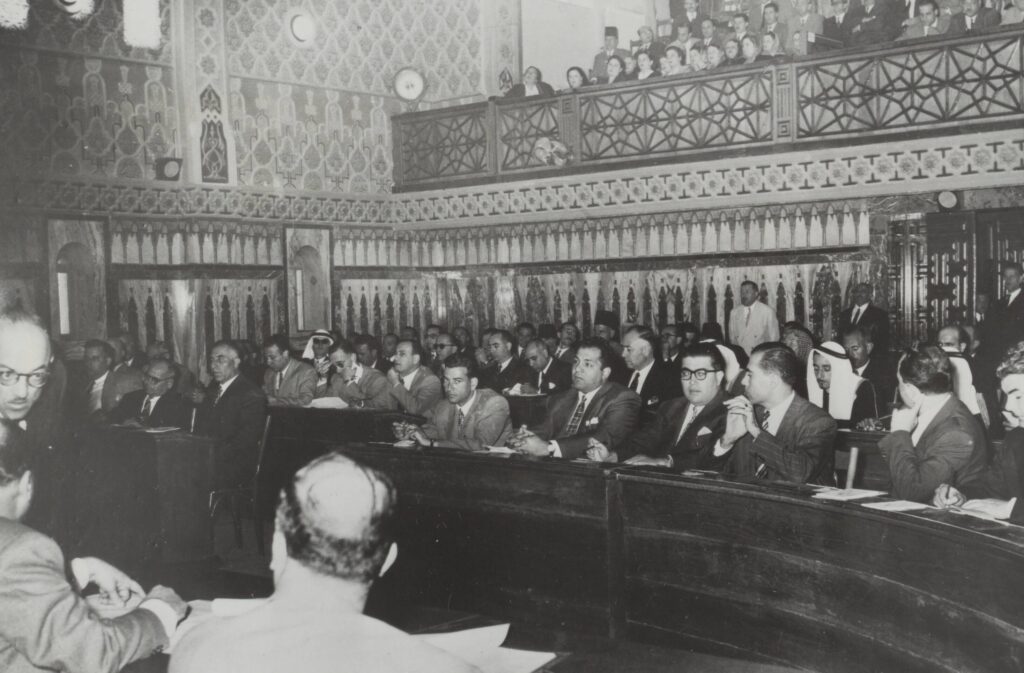
Just last Sunday, July 12, 2026, the new parliament met for the first time to swear in 206 representatives (the parliament contains 210 seats; four representatives were not present for various reasons). The parliament discussed revisions on the Interim Constitution of Syria, drafted in March 2025. The parliament also elected jurist Abdul Hamid al-Awak as the speaker of the parliament. Al-Awak was one of the drafters of the 2025 constitutional declaration and won the parliamentary vote with 99 votes.
Additionally, the parliament discussed the integration of Kurdish institutions into the provisional government. This is a milestone for Syria’s Kurdish community, which has been seeking autonomy ever since Syria became a country.
Before Assad
This is not the first time Syria has had a parliament or a constitution. The 1916 Sykes-Picot Agreement, drafted by Britain and France, divided former Ottoman lands among themselves following World War 1. In 1920, Syria would formally come under French rule alongside Lebanon as a colony. In that same year, the French would create the Syrian Representative Council, with two-thirds of the members to be elected and one-third to be appointed by the French administration. This same structure is still used today in Syria’s parliament.
In 1930, a parliamentary committee under Syrian revolutionary Ibrahim Hananu drafted Syria’s very first constitution. This constitution would last until 1950, when it was replaced following a coup. The 1950 constitution gave much of the president’s power to the parliament. It lasted until 1953, though was reinstated after a year.
In 1963, the constitution was suspended following the Ba’ath coup d’état, which would effectively continue until the 2025 Interim Constitution. While two constitutions were made in 1970 and 2012, they were purely cosmetic and only entrenched the Ba’ath party’s authority.
What a Parliament Means for Syria
A formal parliament for Syria means that after hundreds of years of lack of independence and outright oppression, the Syrian people may finally have a voice in their government. The democratization of the Arab world has consistently been an unstable and dividing process, but Syria is now showing that democracy through a parliament and constitution is possible.
Want more articles like this? Sign up for our e-newsletter!
Check out our blog here!