Subscribe
to receive news by email

Poll
Will the Trump Administration Shift U.S. Policy in Favor of Palestine?
- No (86%)
- Yes (14%)
 Loading ...
Copyright © 2026 Arab America
Go topThe Rise of Emergency Cinema in Syria
By: Susie Hayes/Arab America Contributing Writer
From Third Cinema to Emergency Cinema
Arab cinema has for a while carried the weight of politics, whether state sponsored propaganda or pushback on authoritarian regimes. From the Egyptian studio system of the 1940s-60s to the exposes of French colonialism in Algeria, film and cinema have been a stage for both national identity and opposition. However, with the boom in technology of the 21st century political cinema in the Middle East no longer appears to be mass state studios or even underground film collectives. Rather, the film industry of the region unfolds into a broken post cinematic environment shaped by pirated media, the rise of phones, exile festivals, and censorship from regimes. Now, the old promise of third cinema, a revolution against oppression, has not completely disappeared. It has shifted, forcing new filmmakers and other activists to come to new compromises between new aesthetics, markets, and state control.
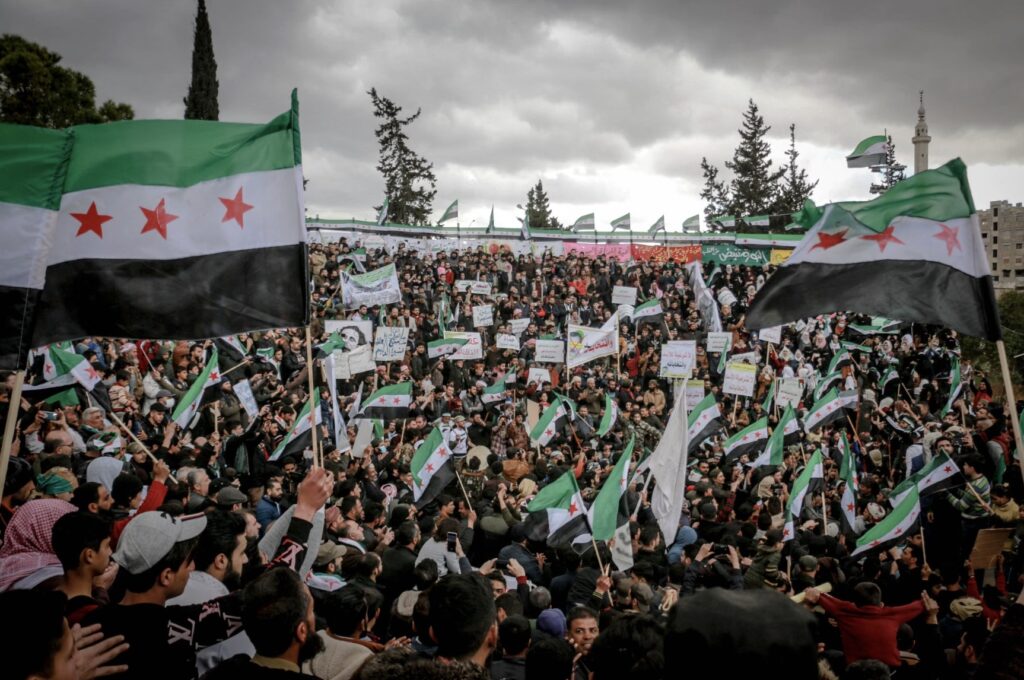
People who consumed Syrian media pointed out that during the 2011 uprising produced an “emergency cinema”, as protesters were using cell phones to document authoritarian violence. Aesthetics in this case were that of survival, not ideal scenes that may have been seen in previous cinematic protests. The images seen during the upheaval were shaky, grainy, and became evidence of the truth in Syria that was being hidden or downplayed to the rest of the world. How does cinema tell the truth in the face of oppression? What counts as a revolutionary image?
Abounaddara and Digital Resistance
One of the most prevalent examples of this shift in artwork is the Abounaddara collective. The Abounaddara, meaning ‘a man with glasses’, consisted of a group of Syrian filmmakers who released anonymous short films to the internet during the uprisings. They argued for the right to free speech and emergency cinema to document the harsh reality of the Syrian revolutions. The group fought for ordinary Syrians to be seen without exploitation or reduction to victimhood.
Activism of this new era was no longer associated with mass theatrical projects, but revolutionary cinema could circulate digitally, bypassing censorship but also facing new ethical questions about representation and privacy. Themes of this new era can still be connected to earlier traditions. Scholars have noted that Syrian documentary culture, going all the way back to the 1970s, has always had to broker authoritarian failure. What has changed in the new century is the speed and distribution of media. A single photo or video from a cell phone can be reached by millions on different platforms within days, hours, or even minutes, but it risks being weaponized by propaganda. Activism becomes not just about creating images, but about carefully creating and appraising responsibly.
Emergency Cinema: Aesthetics and Survival
The shift from third cinema to emergency cinema is key to understand. It is not simply a continuation of the original morals of third cinema, but a transformation created for new conditions of authoritarian regimes, media fragmentation, and digital circulation.
The Abounaddara Collective in Syria is one of the clearest examples of this shift. Founded in Damascus in 2010, the anonymous and volunteer run collective began releasing short films weekly online from April 2011 onward, as the uprising swept Syria. They state their practice as emergency cinema, not aimed at commercial distribution or big screen spectacle, but an immediate story and circulation of news that bypasses censorship. This brings about new questions and thoughts on ethics and aesthetics. The Abbounaddara films attempt to highlight ordinary Syrians and Syrian life, without reducing them to victims, but a portrayal of agency, dignity, pride, rather than exploitation. Additionally, because the films are released online to the internet anonymously, they challenge both state censorship (which may block, ban, arrest, and more) and the commercial market (which needs revenue, festivals, stars).
Also, instead of full length, feature films, we see a rise in small, handheld cameras. These often give the videos a grainy effect, sometimes unstable, but that is all part of its power and political truth telling. Finally, the artists and subjects face harsh risks, like exile, silencing, and disappearance. They bear a strong sense of urgency. The image becomes more of evidence to repression and struggle, rather than just art. In this sense, cinema in the face of a stalled revolution shifts to a situation of survival where the filmmaker is not just making an aesthetic statement, but he is also documenting, resisting, and surviving. The aesthetic shifts from raising awareness for what’s happening like in third cinema, but about bearing witness.
Syria and Revolutionary Filmmaking
Focusing specifically on Syria helps to clarify how third cinema changes when the revolution fails or halts. Syrian cinema has always been under strict authoritarian control, which made the act of revolutionary filmmaking hard to execute even before the events in 2011. During the uprising, these conditions gave rise to what is now known as “emergency cinema”, a breakthrough for the film industry and autonomy as a whole.
Want more articles like this? Sign up for our e-newsletter!
Check out our blog here!