Subscribe
to receive news by email

Poll
Will the Trump Administration Shift U.S. Policy in Favor of Palestine?
- No (86%)
- Yes (14%)
 Loading ...
Copyright © 2026 Arab America
Go topThe Weapon Israel Can't Fight: Nonviolent Resistance
By: Ghassan Rubeiz / Arab America Contributing Writer
Haaretz columnist Amira Hass warns that Israel’s “machinery” is “making life impossible” for Palestinians living between the “river and the sea”. The plan aims at “mass expulsions.”
The occupation’s deepest impact has been in Gaza, where children face widespread disability, malnutrition, unsanitary environment, toxic air, and a future shrinking by the day. Israel’s political climate is hardening: the Ultra-Orthodox population is growing by more than 4% a year — the fastest of any group in the developed world — and its children already make up close to a third of Jewish first-graders. That shift fosters more right-wing governments, fewer compromises, and a permanent appetite for expansion. Add Israel’s nuclear arsenal, and the conclusion is unavoidable: armed resistance is not just failing, it is suicidal.
Israel does not fear asymmetrical war. It fears clever, peaceful resistance. Armed resistance has repeatedly handed Israel the pretext it needs to kill indiscriminately, annex land, and deepen occupation. Every Palestinian rocket becomes a diplomatic shield for the claim that Israel “has the right to defend itself.” The world condemns these excesses, but by doing nearly nothing, it allows them to continue.
The record bears this out. Gaza’s devastation — genocidal in scale — was followed by the Yellow Line, which still fences off roughly two-thirds of the enclave and keeps expanding — a partition that mirrors the slow-motion ethnic cleansing and annexation ongoing in the West Bank. Armed resistance did not stop this, it accelerated it.
Palestinians have long treated “jihad” as the key to liberation. But the narrow, militarized reading of that word has not freed a single inch of Palestine. In the Quran, jihad means the exertion of intellectual, physical, and moral effort to achieve an objective. A diligent school child is praised as “mujtahed”, a derivation of the same root. Thousands of Arab children are named Jihad — not to become fighters, but to grow up smart, hard workers. The militarized version of the word may have cost Palestinians more land, lives, and international sympathy than it ever won back.
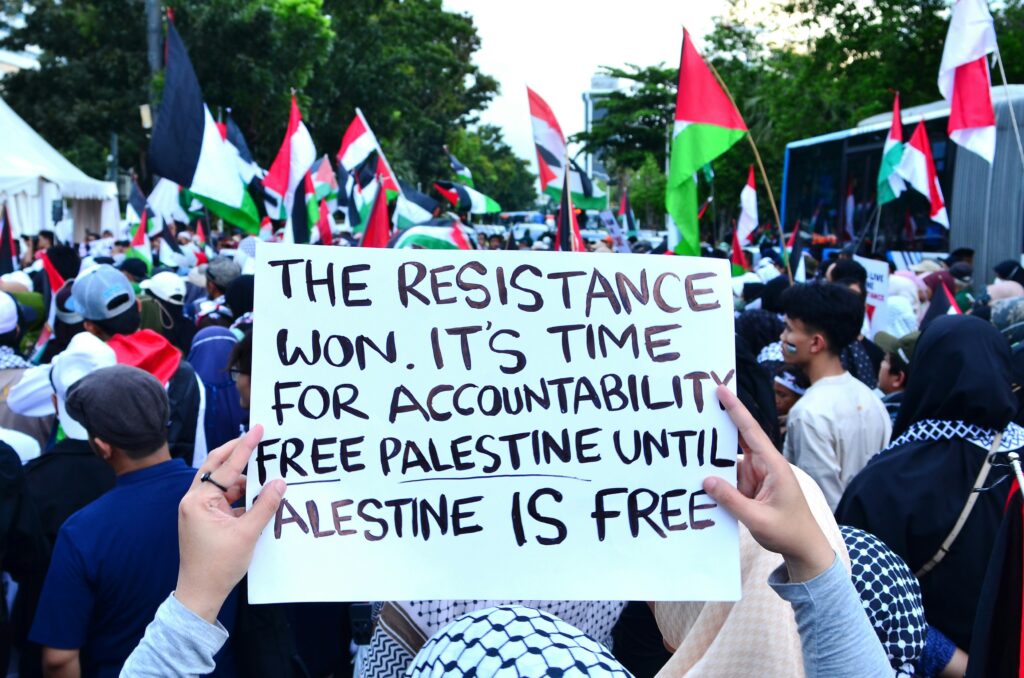
Civil nonviolent resistance has never been tried at scale; albeit its results are not perfect. The Boycott, Divestment and Sanctions movement has proven effective at mobilizing international pressure. The first Intifada began in 1987 as strikes and boycotts, and won Palestinians more sympathy than years of armed struggle — until it militarized in the early 2000s. The “Great March of Return” in 2018 and 2019, was a mostly unarmed protest at the Gaza northern fence separating it from Israel; Israeli forces killed 195 Palestinians, a fifth of them children. Nonviolence has moved Israel before. But for twenty-five years, it has been met with live fire whenever it was small and unbacked.
What must differ now are scale and changing Israeli image: millions, not thousands, backed by Arab states and a watching world that can no longer look away. What could galvanize that shift: a new peaceful intifada, a freed charismatic leader — starting with Marwan Barghouti — and international moves like the UK’s recently imposed sanctions on violent Israeli settlers.
That shift is already underway. The European Union has moved to suspend trade concessions with Israeli settlements and sanction their violent inhabitants. A Pew poll this year found that 60% of Americans now view Israel unfavorably, up from 53 % a year earlier and nearly twenty points since 2022 — a shift led by voters under 50 in both US, Congressional parties. Human Rights Watch, Amnesty International, Jewish Voice for Peace and B’Tselem have all called Israel’s rule over Palestinians apartheid. And Palestinian opinion is moving too: support for armed struggle has fallen to 27 %, its lowest in four years, while support for negotiation has climbed to 44 %. None of this has moved Israeli policy yet. But it is momentum, and momentum does fuel a nonviolent movement.
A strategic shift is overdue: a Palestinian prohibition of asymmetric war and attacks on civilians, declared and enforced by a single national leadership. That leadership does not yet exist. Several factions, the Palestinian Authority, and civil society remain divided, and building unity is a first priority task — no faction alone can hold the line. A unified peace policy would disarm Israel psychologically. It would puncture the narrative that Palestinians are inherently violent and must be controlled. And it would hand Hamas political relevance after they lay down their arms.
The countries of the region collectively have a role too. Twenty-two Arab states with half a billion people could launch an updated regional peace initiative; a diplomatic opening between Iran and the United States could make demilitarization by Hamas strategically possible. It would give the movement the outside backing it needs.
None of this dismisses sacrifice. Armed factions in Gaza, the West Bank, and Lebanon have lost members and leaders in the belief that liberation requires force. Their intentions are not ignoble. Many believe Israel will collapse under the weight of its own extremism, and that laying down arms would betray the dead. But intentions do not save Palestine or secure its future.
Civil resistance is not surrender. It is the one strategy Israel is not prepared to fight, and the one Palestinians have not yet tried at the scale this moment demands. It is being offered not as a final truth but as an urgent proposal, at a moment when time, land, and lives are being relentlessly lost.
Ghassan Rubeiz is the former Middle East Secretary of the World Council of Churches. Earlier, he taught psychology and social work in his country of birth, Lebanon, and later in the United States, where he currently lives. He has contributed to political commentary for the past twenty years and delivered occasional public talks on peace, justice, and interfaith subjects. You can reach him at rubeizg@gmail.com
The views and opinions expressed in this article are those of the author and do not necessarily reflect the position of Arab America. The reproduction of this article is permissible with proper credit to Arab America and the author.
Want more articles like this? Sign up for our e-newsletter!
Check our blog here!