
Subscribe
to receive news by email

Poll
Will the Trump Administration Shift U.S. Policy in Favor of Palestine?
- No (86%)
- Yes (14%)
 Loading ...
Copyright © 2026 Arab America
Go topArab American Democrats Double Their Number in Congress After Historic Election
By Aziz Hellal / Arab America Contributing Writer
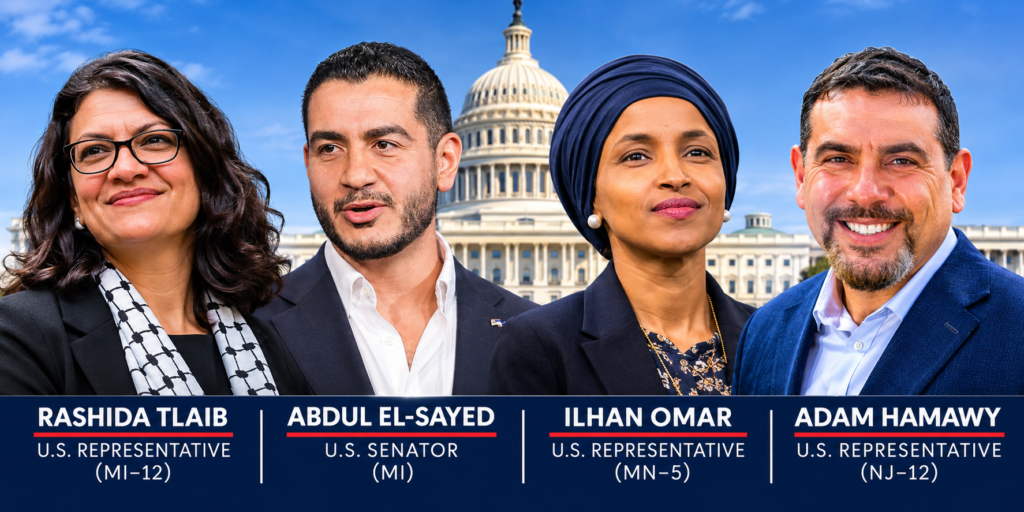
On Tuesday, November 3, 2026, Democrats won control of both chambers of Congress. But the night was about more than party control. Four Arab American Democrats won seats in Congress. Despite their different backgrounds and campaigns, all four have challenged U.S. policy toward Israel and called for greater attention to the needs of Americans at home.
The Newcomers
Abdul El-Sayed won Michigan’s U.S. Senate seat, defeating Republican Mike Rogers. He is the first Muslim ever elected to the Senate, and the first Egyptian American to win a Senate seat. He won the Democratic primary in August, beating Representative Haley Stevens by one percentage point.
El-Sayed is the son of Egyptian immigrants, and he used to run the Detroit health department. He called Israel’s war in Gaza a genocide, and he called for an end to unconditional U.S. military aid to Israel. El-Sayed said his opponents spent a record $350 million against his campaign, including $70 million in the primary.
Adam Hamawy won New Jersey’s 12th District with about 70 percent of the vote, defeating Republican Gregg Mele. He is an Egyptian-born surgeon and a former U.S. Army combat doctor. He volunteered in Gaza in 2024 and 2025, and he treated wounded Palestinians there.
He won a crowded primary with only 28 percent of the vote. He ran on four words: “health care, not bombs.” He is the first Muslim elected to Congress from New Jersey, and the first Arab American to win a House seat from the state. He succeeds Bonnie Watson Coleman, who held the seat before him.
The Returning Voices
Rashida Tlaib won a fifth term in Michigan’s 12th District. She is Palestinian American, and the only Palestinian American in Congress. She was first elected in 2018. In 2019, she became one of the first two Muslim women in Congress.
She has been one of Congress’s most outspoken advocates for Palestinian rights. She has called for an end to U.S. military aid to Israel and for a ceasefire in Gaza. In November 2023, the House censured her over her criticism of the war in Gaza. She did not change her position.
Ilhan Omar won another term in Minnesota’s 5th District. She was born in Mogadishu, Somalia, and she came to the United States as a refugee after four years in a camp in Kenya. She is the first Somali American and the first African refugee in Congress.
She was first elected in 2018. Omar has also called for a ceasefire in Gaza and for limits on American weapons to Israel.
What Unites Them
The four do not come from the same place. Two are Egyptian, one is Palestinian, and one is Somali. Two of them come from Michigan, which has the largest Arab American community in the United States. But all four challenged U.S. policy toward Israel, and all four won on the same night that Democrats took both chambers of Congress.
Gaza was part of all four campaigns. Tlaib and Omar have called for a ceasefire and for an end to U.S. military aid to Israel since the war began. Hamawy treated wounded Palestinians in Gaza in 2024 and 2025, and he ran on “health care, not bombs.” In Michigan, the war was a big issue in the Democratic primary, where El-Sayed won.
At least seven Muslim Democrats won seats in Congress this year, setting a new record. The other three are André Carson of Indiana, Lateefah Simon of California, and Darializa Avila Chevalier of New York. Chevalier is the first Latina Muslim woman in Congress. All seven are Democrats, and all seven have spoken for Palestinian rights.
What Comes Next
These four will also vote on military aid to Israel, and that is where their influence will be tested. Four votes cannot change the outcome alone, but as part of a Democratic majority, they will have a say. Tlaib and Omar spent the last two years in the minority. Now they will serve in a majority that can set the agenda.
Their victories showed that outspoken criticism of U.S. policy toward Israel did not prevent these candidates from winning. But electoral success is only the beginning. With Democrats taking control of both chambers, the question now is whether these voices can turn their campaign positions into meaningful changes in American foreign policy.
Want more articles like this? Sign up for our e-newsletter!
Check out our blog here!