

Subscribe
to receive news by email

Poll
Will the Trump Administration Shift U.S. Policy in Favor of Palestine?
- No (86%)
- Yes (14%)
 Loading ...
Copyright © 2026 Arab America
Go topArab Americans and MENA: What is the Future of Nationwide Data Collection?

By Jahnvi Chopra/Arab America Contributing Writer
The Status of “MENA” in Recent Years
The concept of a specific category for individuals of Middle Eastern or North African descent (MENA) in federal surveys was introduced in 2015 by the Office of Management and Budget (OMB). It has since been the topic of many discussions concerning identity, visibility, and accessibility within both Arab American and West Asian communities in the U.S. After decades of discourse and lobbying among MENA organizations arguing that “White” wasn’t a sufficient or representative category for the diaspora. A series of federal assessments were found to uphold this claim, and the category was set to be included in the 2020 census. Unfortunately, it was eventually rolled back by the Census Bureau during the Trump Administration. Once in office, President Biden issued a mandate that tasked the OMB with reevaluating the categories and gauging whether or not they serve the communities they’re designed to represent.
Design Flaws of the Descriptor
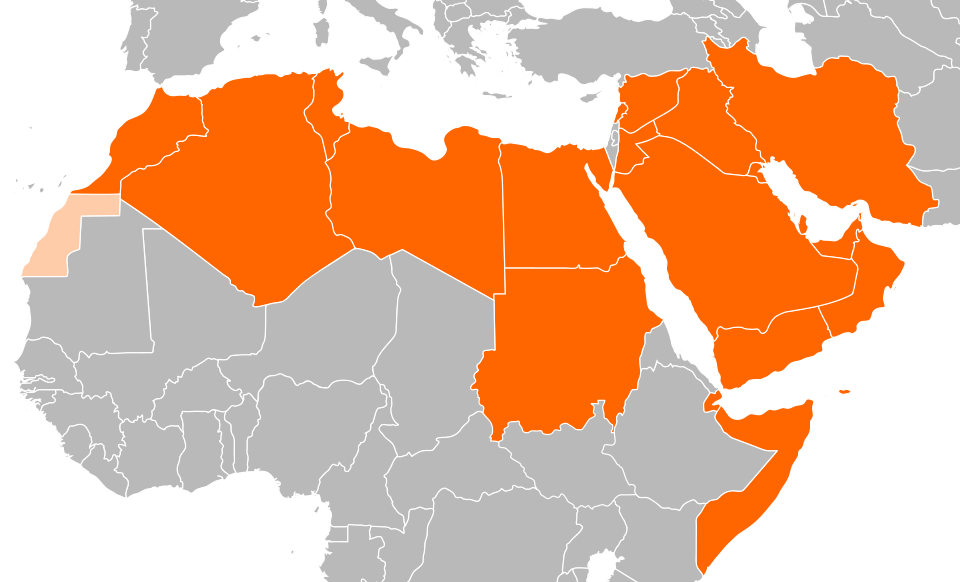
Following the Biden Administration’s extensive examination of the categories to uncover potential issues in reach or bias stemming from MENA, it was found that there were major visibility issues for a variety of communities. Some of these include Iranian Americans, Black Arabs, Armenian Arabs, among others, as these groups don’t fit into the category neatly.
Many believe that those with MENA ancestry are a distinct group, separate from European Americans, hence why there was a massive push away from the “White” category. However, most don’t fully grasp just how diverse those within the MENA region are. In terms of income and education within the U.S., the disparities are great among these members despite being listed as the same category. According to the CATO Institute, inventing a new racial category might be ineffective in closing or explaining the glaring differences in economic outcomes, as well as ethnicity, language, religion and culture. The data resulting from federal surveys would be more accurate and specific if respondents were asked to record their individual ancestry.
MENA-American Rejection of the Category
The Proceedings of the National Academy of Sciences of the United States of America conducted a study in 2022 on MENA-Americans’ treatment of the category when seen in federal surveys. It was found that 60 percent of MENA respondents “identified as MENA only, 27 percent as MENA and White, 12 percent as White, and about 1 percent as MENA in combination with another race or races,” which resulted in a few key takeaways:
First
The respondents didn’t view the category as its own distinct race. Rather, they viewed it as an ethnic label, similar to the Hispanic or Latino diasporic identity. For this reason, the category doesn’t behave with its intended purpose: to find a common thread between a large group of people and to classify them under that label.
Second
Though many individuals with MENA ancestry would choose to self-identify that way when given the option, they’d be more likely to select their “ancestral country of origin.” It would more meaningfully account for the various contrasts between the smaller regions within the Middle East and North Africa. Still, the idea behind the Census Bureau and surveys similar to it is to offer a general understanding of the makeup of a nation, not spotlight every personal identity that one may possess. This means that while MENA offers a little more geographic specificity, it isn’t much of an improvement from the original label of “White.” They are both umbrella terms that don’t quite allow space for drastically different members to be reflected evenly in the data.
Third
All the categories within federal forms are created according to different standards and face the exact same issue of misrepresenting several populations within them. The White racial category is based not only on those who have ancestral ties to Europe, but also on the lack of pigmentation in one’s skin, which is a main reason why this category has been so intensely contested. The Asian racial category is similar to MENA, in that they are both race labels founded on geography. The Hispanic or Latino ethnic category includes those from Spanish-speaking countries, so there is a major linguistic component in deciding whether someone fits under the term. These examples demonstrate how federal survey categories don’t distinguish groups under the same criteria, and that the majority of their definitions are somewhat arbitrary and far too vast to provide detailed information.
A Path Forward
MENA has sparked nationwide discussion surrounding the validity and effectiveness of racial and ethnic categorical distinctions on federal forms. We are entering an era of increased lobbying and organizing, as well as a collective redefining of what these groupings represent and how they pertain to precise data collection. These conversations ignite a deeply personal need within all Americans to understand what defines their identities and seek out true representation for themselves and their communities.
Want more articles like this? Sign up for our e-newsletter!
Check out our blog here!
Works Cited:
https://www.cato.org/people/alex-nowrasteh. “The Consequences of a Middle Eastern or North African (MENA) Survey Question.” Cato Institute, September 28, 2023. https://www.cato.org/briefing-paper/consequences-middle-eastern-or-north-african-mena-survey-question.
Niacouncil.org. “MENA Category in the U.S. Census – Memo – NIAC,” February 29, 2024. https://niacouncil.org/mena-category-in-the-u-s-census-memo/.
Maghbouleh, Neda, Ariela Schachter, and René D. Flores. “Middle Eastern and North African Americans May Not Be Perceived, nor Perceive Themselves, to Be White.” Proceedings of the National Academy of Sciences 119, no. 7 (February 7, 2022). https://doi.org/10.1073/pnas.2117940119.
New, Welcomes. “Arab American Institute.” Arab American Institute, March 28, 2024. https://www.aaiusa.org/library/arab-american-institute-welcomes-new-middle-eastern-or-north-african-mena-category-amp-revision-of-race-and-ethnicity-standards.
Bureau, US Census. “About the Topic of Race.” Census.gov, April 2, 2026. https://www.census.gov/topics/population/race/about.html.
Bureau, US Census. “Lebanese, Iranian and Egyptian Populations Represented Nearly Half of the MENA Population in 2020 Census.” Census.gov, September 21, 2023. https://www.census.gov/library/stories/2023/09/2020-census-dhc-a-mena-population.html.
Nih.gov. “The Contested Whiteness of Arab Identity in the United States: Implications for Health Disparities Research,” 2024. https://pmc.ncbi.nlm.nih.gov/articles/PMC6775909/.
Disclaimer: Any opinions reflected in the article are not representative of Arab America as an organization and are those of the writer.