
Subscribe
to receive news by email

Poll
Will the Trump Administration Shift U.S. Policy in Favor of Palestine?
- No (86%)
- Yes (14%)
 Loading ...
Copyright © 2026 Arab America
Go topRemembering the Life of an Artisan: Sliman Mansour
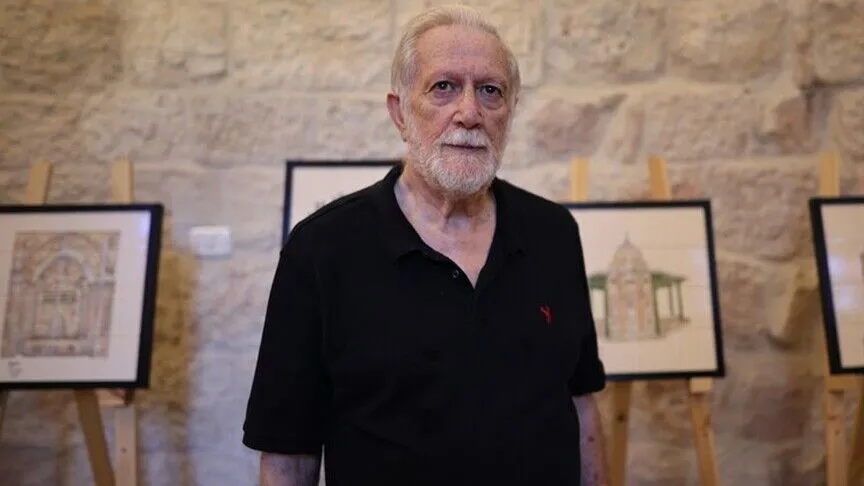
By Jahnvi Chopra / Arab America Contributing Writer
Exemplary artist and leader Sliman (Suleiman) Mansour passed away on August twenty-fourth, 2026, at age 79. He spent his life and career as an advocate for Palestinian freedom from Israeli occupation through the lenses of painting, sculpting, and writing. He is widely celebrated for his application of the cultural concept of sumud in his art, which originates from Palestine as an outlook of steadfast endurance, strength, and the quiet refusal to disappear. This article will commemorate Mansour’s life, prominent artwork, and impact on political spheres relating to Palestine. These themes of activism and sumud1 are depicted throughout his works, which can be found on his website here.
Life Story
Mansour was born in 1947, one year before the Nakba, in a Palestinian Christian town north of Jerusalem. He began his long career as an artist by studying at the Bezalel Academy of Arts and Design, where he was introduced to various styles of Surrealist art. Mansour learned that he didn’t quite like the unrealistic nature of this type of art and opted for a more lifelike form that resonated deeper with his Palestinian heritage.
His Work
Mansour’s New Vision
One of the most notable accomplishments of the artist’s life took place in 1987. Mansour, along with other Palestinian artists, founded “New Visions,” a collective that incorporated natural materials and mixed media from the Palestinian environment into an assemblage, boycotting Israeli art supplies. The overarching message was to symbolize Palestinian heritage and pride through naturally derived materials to protest Israeli occupation during the First Intifada. One of Mansour’s contributions to the art piece was mud, a revolutionary idea at the time. He took inspiration from his childhood outdoor building experiences with his grandmother, remembering the versatility of wet dirt. When applied to the canvas, he found that human fate could be represented in the cracks that formed as the mud dried.
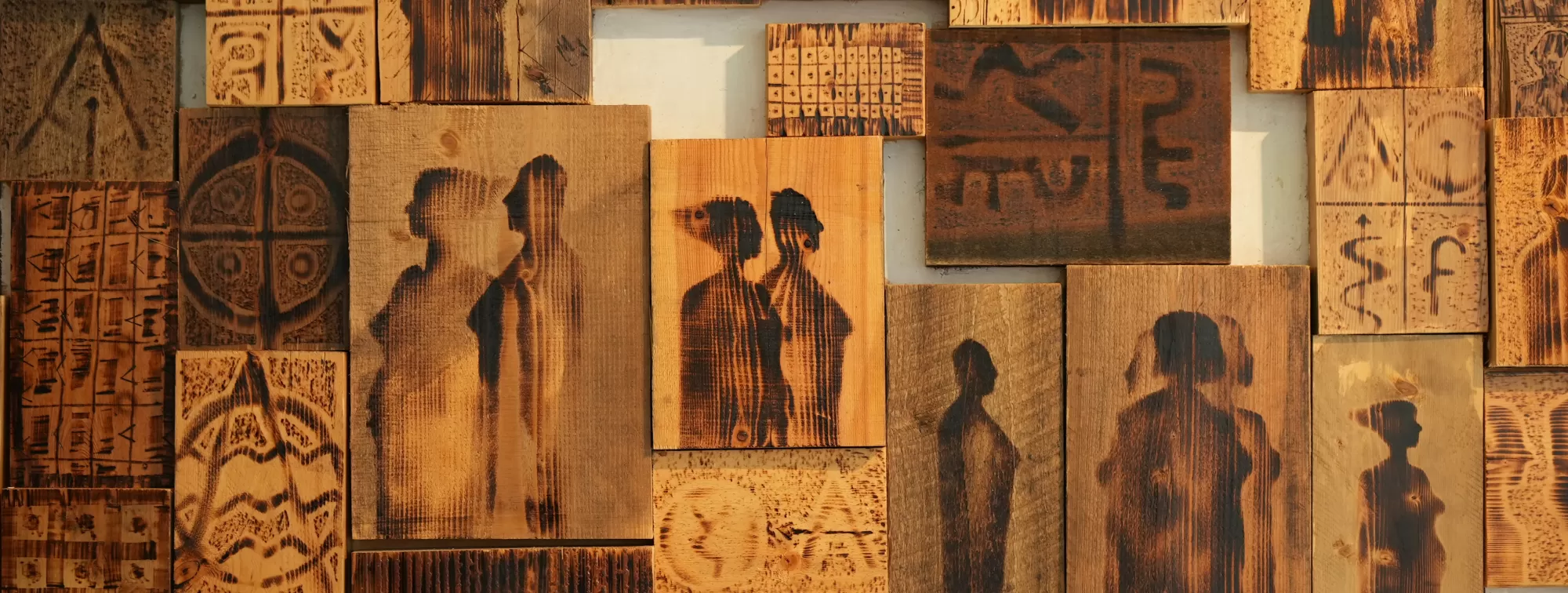
The Nakba marked a pivotal point in his life where he began to be more politically forward with his depictions and messaging. People began to recognize his work and what he stood for, plunging him into the world of activism, which he expressed artistically. Mansour established himself as an outspoken leader who sought to represent the dynamic identity and resilience of the Palestinian people.
A Generational Landmark
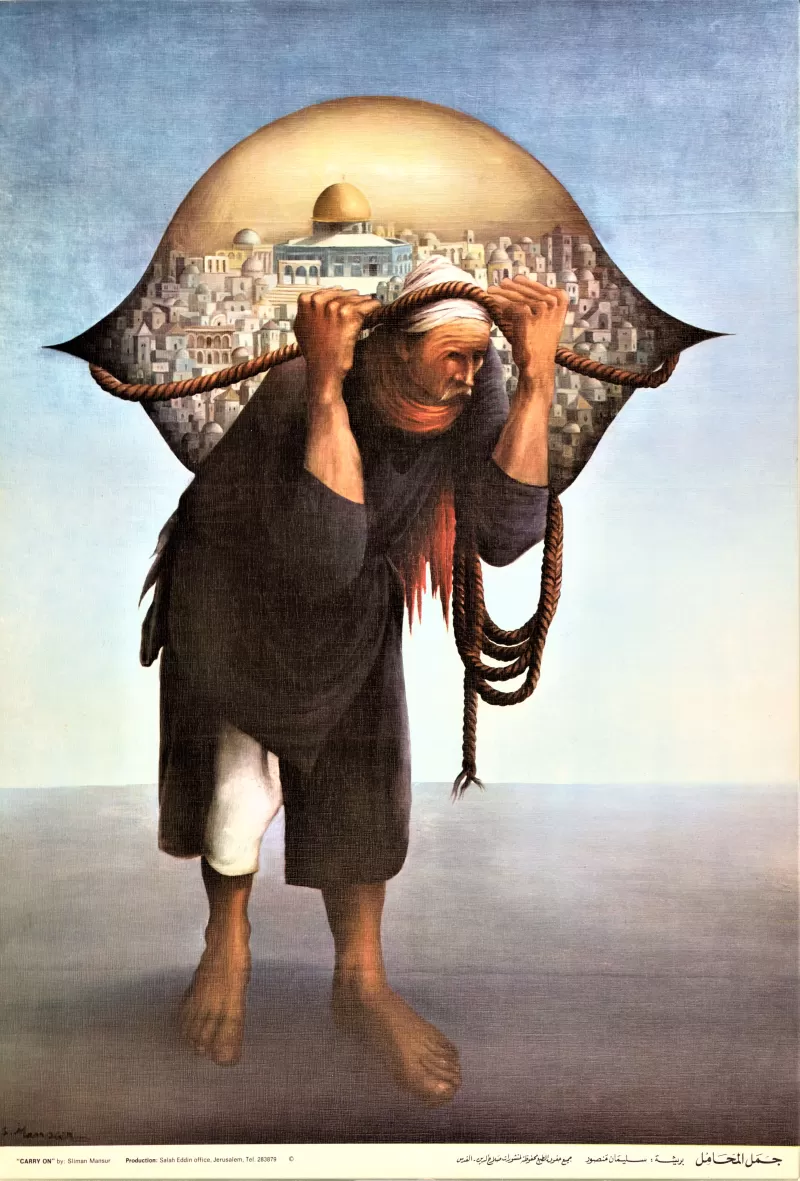
Arguably his most iconic piece was the Camel of Hardships, a work he created at only twenty-six, demonstrating his true skill in portrait-making and vivid imagery. The artist was inspired by a real-life encounter with an elderly, weathered porter struggling through the streets of Jerusalem. The subject’s age signifies how long the conflict has gone on without an end in sight, referencing the struggles of the past and present. The man was transporting heavy cargo on his back, but upon watching him, Mansour’s imaginative mind recognized something else. The man was carrying more than what the average eye could see.
In the painting, we can see the exact scene that Mansour recalled in an episode of the Tarwida Podcast titled “The Brush that Carried a Homeland,” but instead of the boxes, there is an eye-shaped figure.2 Within it, Mansour depicts the radiant, almost utopian city of Jerusalem, surrounded by an empty void. Contained within the eye is the famous gold dome, which many Muslims believe is the place from which the Prophet (PBUH) rose to heaven, as well as numerous Christian motifs that come together to represent religious diversity and unity. The bare scene outside the eye is the main feature of the piece, as it envelops the man and the eclipse upon his back, representing the fall of Jerusalem at the hands of Israeli authorities and the desolation that ensued.
Of the three versions of this painting, this is the first one, created in 1973 when Palestine had already been occupied for seven years. The image of Jerusalem evolved to be one of the most important symbols of hope and perseverance for the Palestinian people, which is both why this painting came to be and why it gained so much popularity.3 The work remains today as an emblem of Palestinian history and struggle through adversity.
His Memory Lives On
From the olive trees and sunbirds in his landscapes to the elderly and pregnant women in his portraits, Sliman Mansour seditiously depicted sumud to urge Palestinians and the international art world alike to continue using their voices and art to resist the occupation. This attitude of steadfastness existed during the Nakba, and will continue for as long as the struggle remains. Though Mansour’s passing poses a loss, it is not the end of his activism because his art lives on. And just like the contemporary meaning of sumud epitomizes, “al-hayat lazim tistamirr” (life must go on).4
Want more articles like this? Sign up for our e-newsletter!
Check out our blog here!