
Subscribe
to receive news by email
Poll
Will the Trump Administration Shift U.S. Policy in Favor of Palestine?
- No (86%)
- Yes (14%)
 Loading ...
Copyright © 2026 Arab America
Go topWhy is Riyadh the Capital of Saudi Arabia?
By: Connor J. Buss / Arab America Contributing Writer
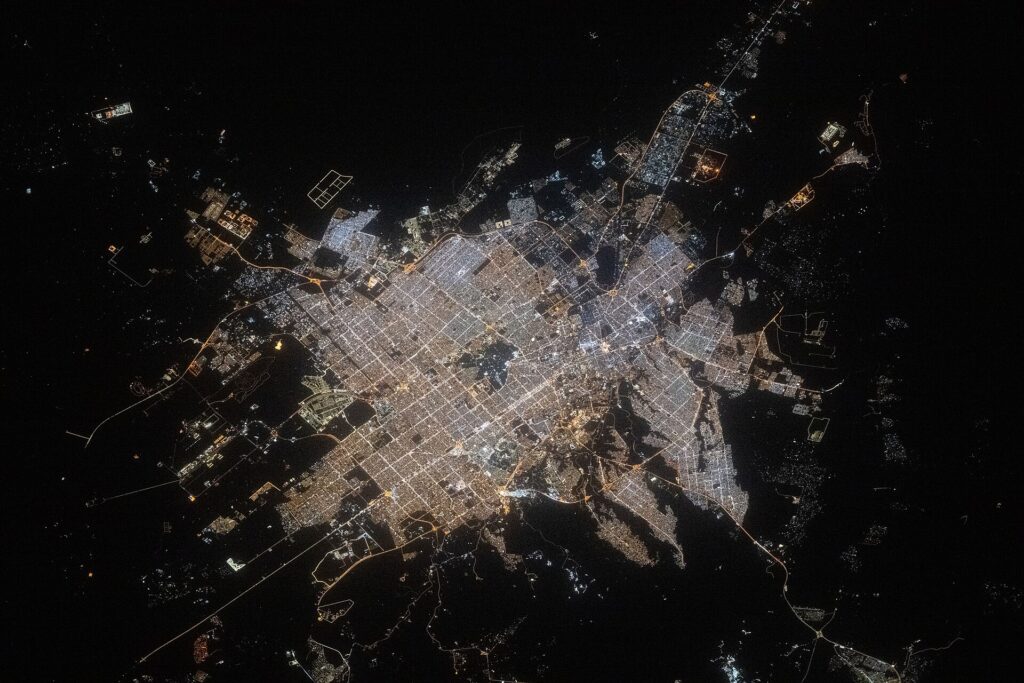
A question often heard in Arab and non-Arab communities alike is the question of why Riyadh is the capital of Saudi Arabia. Given its mountainous location in the middle of the Arabian desert, it seems odd at first to have the city as the seat of government. Even more so, one might ask why the capital wouldn’t be the holy city of Mecca, or the port city of Jeddah. At first glance, it seems like there are simply better options that allow for more access with the rest of the world.
However, the odd location actually has very clever reasoning behind it.
Geography
The Arabian Peninsula is home to long mountain ranges and steep plateaus. Riyadh sits right in the middle of one of the Tuwaiq Escarpment, a series of steep cliffs that stretch 800 kilometers from the Al-Qassim province in the north to the Rub’ Al Khali desert in the south. For thousands of years as a result, travelers, merchants, and various caravans would need to pass through narrow stretches of the escarpment in order to go from one end to the other. Subsequently, trade boomed in the settlement and Riyadh was born, though it was known as Hajr at the time.
However, settlement could not have occurred without the ability to farm. Riyadh comes from the Arabic word meaning “the gardens.” This is because the city is around an oasis with some of the most fertile land in the Arabian Peninsula. Such fertile land has always been valuable, especially considering the dryness of the Arabian Desert.
Military
Riyadh holds a strong military advantage. Throughout history, the city has been well defended by the surrounding terrain. As previously mentioned, the city is surrounded by steep cliffs and harsh desert. Invading armies would have to cross a desert with little ability to sustain livestock/crops and navigate around cliffs. Then, they would face defenders with a sustainable food supply and only one direction to defend.
As the value of such a vital city would call for, there are many great castles constructed around the city. Just northwest of the Riyadh city center lies the At-Turaif district in Diriyah, which has castles and mosques over 500 years old. These buildings were made of mud brick, and still stand today. In fact, they are a UNESCO World Heritage Site.
Additionally, great mud walls were built in the 18th century to encircle all of the oases into the city proper. As a result, Riyadh became a fortress city. While the city has grown and sprawled since then, the “walled town of Riyadh” still exists and acts as the “old town” historical core of Riyadh.
Another geographical military advantage is that the city is far away from the sea. Other contenders for the country’s capital are port cities, or are at least very close to the coast. Jeddah and Mecca have this characteristic, and are sizable cities with Mecca being the site of the Hajj, the mandatory pilgrimage in Islam. Being far from the coast means that seafaring invaders cannot attack Riyadh without having to cross the desert, something the defenders would be prepared for.
Politics
The House of Saud, Saudi Arabia’s ruling family, was from the Nejd region of Arabia, in which Riyadh lies. Specifically, they were from Diriyah, a neighbouring town mentioned earlier. In 1744, an agreement occurred between Muhammad bin Saud and Muhammad ibn Abd al-Wahhab, creating the Emirate of Diriyah. The ruler of Riyadh itself at the time, ibn Dawwas, attacked the Emirate of Diriyah due to a religious disagreement with al-Wahhab, and an ensuing war with Riyadh began. After a 30-year campaign, ibn Saud was victorious, and the House of Saud consolidated control over the Nejd region. At this point, the First Saudi State was created.
In 1818, the Ottoman army captured Diriyah during a war, and the Saudi government relocated to Riyadh. From there, the Second Saudi State was declared. In the north, the house of Rashid grew in power and destabilized the Saudis. Power struggles led to the fall of the Second Saudi State, but from it came the king Ibn Saud, who expanded the kingdom and beat the House of Rashid, forming the Third Saudi State, which still exists as the modern Saudi Arabia today.
In terms of the city, it was formally declared the state’s capital in 1932 by Ibn Saud. Riyadh had served as the capital of the second and third Saudi states, which left the government already seated there.
Importantly, oil discoveries in the 1930s brought economic prospects to the city. Overnight, Riyadh went from a trade hub farming town to the Arab world’s manufacturing powerhouse, a reputation upheld today. Economic growth led to the city rapidly growing in population, with eight million current residents and ten million by 2030.
Want more articles like this? Sign up for our e-newsletter!
Check out our blog here!