

Subscribe
to receive news by email

Poll
Will the Trump Administration Shift U.S. Policy in Favor of Palestine?
- No (86%)
- Yes (14%)
 Loading ...
Copyright © 2026 Arab America
Go topSolidarity Against Occupation: From Ukraine to Palestine
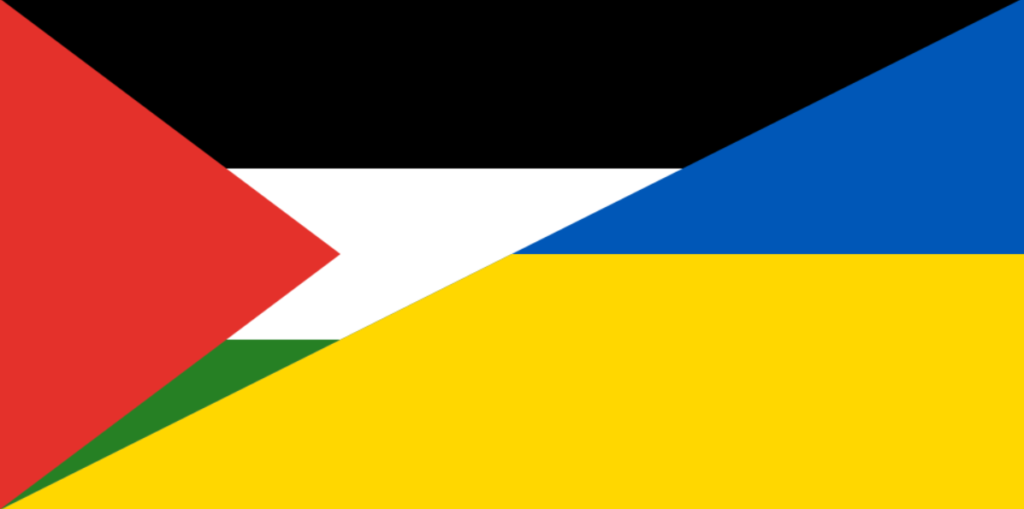
Image by Wikimedia Commons
By: Rami Balin / Arab America Contributing Writer
At the end of 2024, I found myself at a Slavic conference in Boston, in the second year of the genocide in Gaza and the third year of Russia’s war against Ukraine. Throughout the conference I wore two pins, Palestinian and Ukrainian flags; it was an experiment as much as a statement. I watched people noticing me, recognizing the message, giving me looks – some of support, some of stifled hostility and annoyance, but mostly confusion. At the end of the conference, I met three young people wearing vyshivankas – traditional Ukrainian embroidered shirts – with two of them wearing Palestinian kuffiyehs on their shoulders. That was not a scene I was used to. One of the young people explained to me that his favorite kuffiyeh is blue and yellow, the colors of the Ukrainian flag. The woman next to him also said somewhat exasperatedly that she doesn’t understand how it’s possible for people to support one and not support the other – it seemed so obvious.
All too often people tend to look at the world through the lens of geopolitical camps and alliances instead of centering peoples’ struggles against their oppressors who tend to have the same faces, and the same methods of control and subjugation, supported by the structures of domination that persist globally. In the cases of Palestine and Ukraine, settle-colonialism has been the greatest obstacle to both countries’ self-determination and independence. By joining the Global Sumud Flotilla in the spring of 2026, prominent Ukrainian activists Nina Potarska and Andrii Movchan sought to help open the humanitarian corridor into the besieged Gaza Strip, making visible the intersections of their own country’s decolonial efforts with those of Palestine, not only to their own society but to the world at large.
Media Bias and Shifts of Public Opinion
Similarly to the US and other Western countries, the coverage of the events and conditions in historic Palestine by Ukrainian media has often, but not always, displayed the existing bias towards Israel. In part, that stems from the scarcity of Palestinian voices in the media – many Ukrainians migrated to Israel during and after the fall of the Soviet Union, and more recently after the start of Russia’s war against Ukraine in Donbass in 2014 and the full-scale invasion of 2022. People with Zionist views and backgrounds can more easily be present and vocal in different types of media than Palestinians, some of whom came to Ukraine in the soviet years and afterwards to study at universities and colleges, integrating into Ukrainian society and identifying with both Ukraine and Palestine. This leads to considerable gatekeeping when it comes to coverage of events in historic Palestine.
However, not all media outlets adhere to these views and practices. The public opinion in Ukraine has shifted in recent years, especially since 2014 and more prominently since October 7, 2023, and the rhetoric has changed with it. Public displays of support for Palestine have become more widespread, taking forms of protests, open letters of solidarity, and more, with people drawing parallels between the two countries.
Contexts in Conversation
While the situations and conditions in Palestine and Ukraine are undeniably different, there are plenty of commonalities. For instance, same rhetorics and figures of speech, at times word for word, have been used by Russian and Israeli governments to dehumanize Ukrainians and Palestinians, respectively, and to delegitimize their civil initiatives as well as governing structures in place. Ukrainians, just like Palestinians, have faced claims that their identity and country do not exist, or have a right to exist, with massive propaganda campaigns aimed at de-historicizing their presence in their native lands and justifying their mass extermination.
Both Putin and Netanyahu have described the assaults as “special military operations”, claimed that the lands they seek to take by force are “originally theirs” to justify civilian death toll, and to prolong their military campaigns. Israel’s assault on Gaza has been conclusively described as a genocide by a number of human rights organizations while Russia’s war on Ukraine has also been deemed genocidal. The term “genocide” in this case is not used to equate conditions all over Ukraine and Palestine but to establish the severity of human rights violations and the intent to exterminate both peoples. Rows of martyrs in Gaza and mass graves in Bucha, Mariupol and other places have become synonymous, as have the ways of resistance to erasure.
Palestinian and Ukrainian cultures have been continuously appropriated by their colonizers as an attempt to erase their origins, systematically denying their geographies and histories. In response to that, people created art and music, wrote novels and poems, danced their traditional dances, embroidered their identities, told folk stories to each other, spoke their language, and so much more. A lot of it happened through dissident movements and everyday practices alike, under constant censure and threat of retaliation or imprisonment by the oppressor. Despite deliberate targeting of cultural institutions, archives, libraries, and education centers, the cultures of Palestine and Ukraine remain rich and vibrant.
Global Contradictions
By standing in solidarity with Palestine, Ukrainian activists make visible not only the connections but also the double standards that exist in the Western world and within international systems that are supposed to uphold international law but, in fact, hardly ever do. The overwhelming outpouring of support for Ukraine at the beginning of Russia’s full-scale invasion contrasted with the hesitation and often unwillingness of the international community to call out Israeli war crimes and human rights violations for decades. Increasingly, activists like Nina Potarska and Andrii Movchan seek to expose those inconsistencies on the global stage.
Israel has been using and developing cutting-edge weapons and technologies and deploying them against a population of Palestinians who are largely defenseless before such a force. Despite ample evidence of human rights violations, these weapons are generously handed over by the Western imperial powers, including the US, UK, France, Germany and others. Incidentally, those same Western imperial powers supply Ukraine with weapons that have become vital for protecting civilians and infrastructure as well as staving off Russian incursion into Ukrainian territory. The very survival of Ukrainian people depends on this support, which has become all too evident during these last months with the delay in shipments of missiles for the air defense systems that have stood guard over cities like Kyiv. With no one to intercept them, Russian rockets have been hitting civilian buildings and vital infrastructure daily, as its bombing campaign intensifies.
Cynically, a lot of Western politicians who proclaim support for Ukraine do so because they have invested in or are lobbied by weapons companies. Their failure to impose sufficient sanctions on Russia and to get rid of loopholes ensures, among other things, that all Russian weapons currently contain American-made parts and components made in European countries. Most of these same politicians also support unconditional military aid to Israel. For them, weapons are often the only solution to every problem under the sun while diplomatic and economic pressure is not considered as seriously and isn’t given as much effort.
Under conditions of prolonged war and intense violence, some Ukrainians have come to identify with Gaza as their “worst-case scenario”. The world’s ambivalence about Ukrainian territories occupied by Russia have led to multiple “peace” proposals where those lands remain under Russian control, widely described as the “West Bank scenario”, a parallel too obvious to ignore.
The Liberated Future
Close alliances with the Western powers and their weapons industries make a lot of Palestinians distrust Ukraine’s potential for being an ally in the anti-colonial movements. Whether current changes signal a potential unambiguous shift in Ukrainian policy towards Palestine remains to be seen. The public perception and opinions, however, are undeniably moving. Currently, most of the world’s geo-political alliances are incoherent at best, built within and guided by the structures of colonial and imperial domination, thereby enforcing them instead of forming visions of a liberated future centered around people, not state interests. What that future looks like is for Palestinians and Ukrainians to decide, but as long as there are activists bridging together both of these struggles, there is hope for wider solidarity and a potential for liberation.
Read the interview with Nina Potarska and Andrii Movchan here.
Want more articles like this? Sign up for our e-newsletter!
Check our blog here!