

Subscribe
to receive news by email

Poll
Will the Trump Administration Shift U.S. Policy in Favor of Palestine?
- No (86%)
- Yes (14%)
 Loading ...
Copyright © 2026 Arab America
Go topSyria’s Return to the World: A Real Opening or a Fragile One?
By Aziz Hellal / Arab America Contributing Writer
After more than a year of monumental change following the end of the Assad regime in December 2024, Syria is no longer just trying to return to the international stage—it is actively working through the challenges of reintegration.
Under the new administration, the country is shifting from complete isolation to active engagement with partners such as Turkey and some Gulf countries, especially Qatar and Saudi Arabia.
However, as we look at the current situation, the question is no longer whether Syria can talk to the world, but whether it can turn these diplomatic handshakes into long-term stability.
A Return to the World
Syria began a noticeable return to international engagement in 2025. During President Trump’s visit to Saudi Arabia in May, he met the president of Syria, Ahmed Al-Sharaa, and announced that the United States would move to lift sanctions on the country. In the months that followed, Washington began easing major restrictions, and Al-Sharaa visited the White House in November 2025, marking the first visit by a Syrian president to Washington in decades.
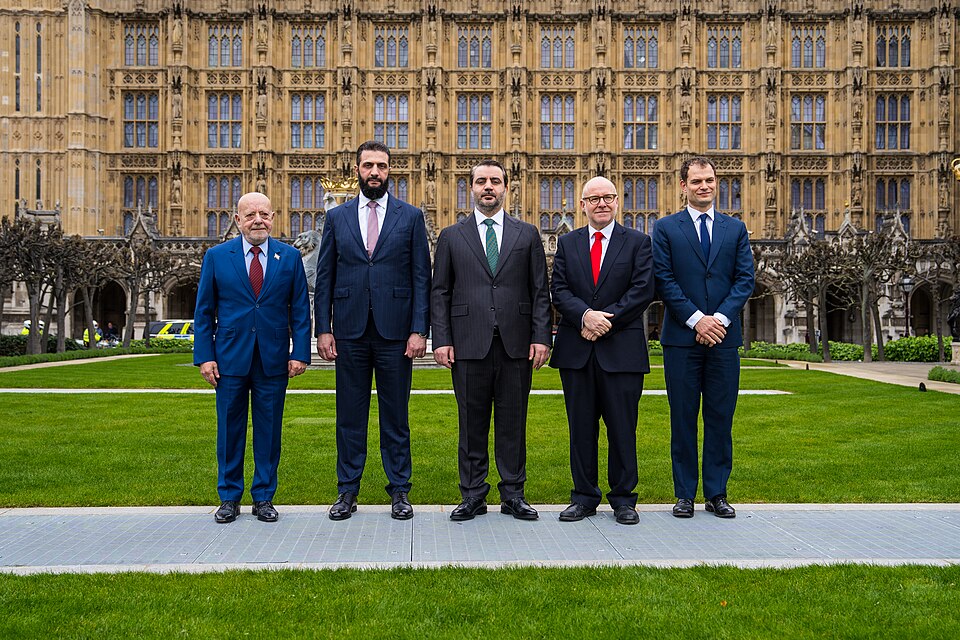
This shift in U.S. policy encouraged several Western countries to become more open to reengaging with Syria. Al-Sharaa later visited the United Kingdom and Germany in March 2026, a move that would have been more difficult if U.S. sanctions had remained fully in place.
Through these visits, the new administration sought to remove more long-standing sanctions, secure support for reconstruction after years of civil war, and encourage Syrians abroad to invest in rebuilding the country.
Together, these developments reflected a clear shift in Syria’s international position and pointed to deeper political and economic reasons behind this opening.
Why Is This Happening Now?
Syria’s opening to the world is not happening by chance. After years of war, sanctions, and isolation, the country needs outside support to rebuild its economy and restore basic stability.
At the same time, shifting regional dynamics have created more space for engagement, making reconnection with the world both a political and economic necessity.
Challenges Inside Syria
Diplomacy may be the easier part. The real, grinding work for the Al-Shara administration lies at home. We are currently seeing the results of an economy that spent years suffocating under sanctions and war.
Despite the improved political optics, inflation remains a major hurdle, and the physical reality of the country—damaged infrastructure and the desperate need for electricity, water, and healthcare—is what truly defines a citizen’s daily experience.
The political challenges are just as layered. While the central government is strengthening its grip, the mosaic of local armed groups, Kurdish forces, and other community-based actors continues to complicate efforts to fully stabilize the country. These internal divisions make long-term stability harder to achieve.
Trust between Syria and many Western countries is still limited, and questions about political reform continue to affect how far international engagement can go. Millions of Syrians also remain displaced, and their return will depend on stability, economic improvement, and confidence in the country’s future.
These internal challenges show that while Syria may be reopening to the world, conditions within the country could make this process slow and uncertain.
A Complicated Region
Syria’s return to the world is also shaped by the complex regional environment. Ongoing tensions in the Middle East continue to affect Syria’s opening. Relations with neighboring countries remain sensitive, especially with the presence of different regional powers operating inside Syria.
The situation in Lebanon, along with continued tensions with Israel, adds another layer of uncertainty. Turkey also remains an important player in Syria, and the wider instability in the region continues to affect the country’s path forward. These pressures make it harder for Syria to fully normalize its relations with the world.
As a result, Syria’s path back to international engagement is not only about internal reforms, but also about navigating a region filled with competing interests and ongoing instability.
What Comes Next?
If you look at the trajectory since December 2024, it’s clear that Syria has successfully bypassed the first phase of total isolation. But it is now entering the second, much harder phase: the “normalization” phase.
Rebuilding trust with Western countries and, more importantly, with millions of displaced Syrians who are watching from abroad, will determine the success of this administration. This isn’t just about external relations anymore; it’s about whether the government can prove that its internal reforms are as solid as its diplomatic ones.
For now, the path forward remains a delicate balance. Syria has undoubtedly rejoined the world, but whether this opening turns into a lasting foundation for recovery or remains a fragile experiment will be the defining story of the next few years.
In the end, Syria’s return to the world is no longer in question — what matters now is whether it can last.
Want more articles like this? Sign up for our e-newsletter!
Check our blog here!






.jpg)