

Subscribe
to receive news by email

Poll
Will the Trump Administration Shift U.S. Policy in Favor of Palestine?
- No (86%)
- Yes (14%)
 Loading ...
Copyright © 2026 Arab America
Go topThe Spillover Effect: Why Conflict in the Arab World Expands Beyond Borders
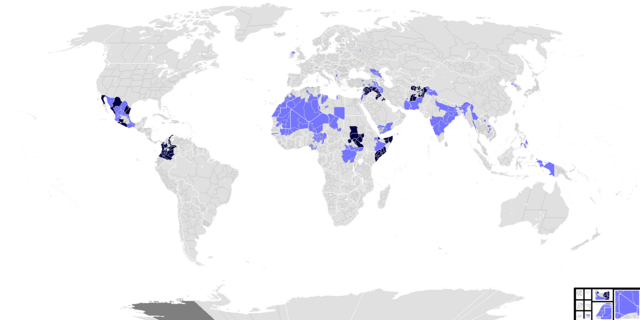
By Ben Samuels/Arab America Contributing Writer
Regional conflict in the Arab World and its surrounding states is rarely contained to the original states involved. These conflicts often cross borders, leading to further escalation and prolonged war, and often drawing global superpowers into what were once regional disputes, known as a ‘spill over effect’. This spillover effect of regional conflict heavily contributes to increased need or interference of proxy warfare. This isn’t a new theme in geopolitical history; this unfortunate occurrence has been ingrained in many states for decades, and may persist unless there is a major shakeup in the region’s dynamics. History shows that proxy warfare and unstable governments hold true in modern-day dynamics, explaining why regional conflicts tend to spill over.
The history of conflict spillover dates back over a hundred years, with one of the first defining events being the signing of the Sykes-Picot agreement. This was a secret agreement between Britain and France that divided the Ottoman Empire into their respective spheres of influence. This was crucial to the region’s development, as it established many borders; however, it failed to consider much of the region’s religious and ethnic culture, which became a recipe for disaster.
According to Kamal Salibi via Al Jazeera, “Prominent Lebanese historian Kamal Salibi believed that the main considerations taken at that time were related to oil and transportation tracks. The British faced many difficulties during the war as they tried to occupy Iraq. The outbreak of the war had proved the strategic significance of oil. At that time, Britain was controlling oil resources in Iran. Its main concern was to prevent the Germans, key contributors to the Turkish Petroleum Company, from reaching oil fields that were known to exist in Iraq’s Kirkuk region.” These borders, drawn without regard for those living in the region, significantly contribute to the region’s instability and the potential for conflict.
Spillover in Current Times
Another example of regional spillover is the Gulf War in 1991, when Iraq invaded Kuwait, a U.S.-led group of forces quickly enacted Operation Desert Shield. At the time, Iraq was under the rule of Saddam Hussein, which made the U.S more interested in intervening, aside from the obvious oil and trade reasoning. Hussein was a highly aggressive leader and was seen as an imminent threat to the U.S up until his capture in 2003.
Overall, the aggressive/unpredictable leadership played a role in how quickly global forces chose to intervene, thus causing spillover and escalation of the war. A more contemporary example of spillover is the recent conflict between Israel and Palestine. Since very early on in the war, outside forces such as the U.S and Iran have been deeply ingrained in the conflict, and it has dragged on for an extended period of time. In addition, the U.S-Iran war has strong ties to the Israel conflict, and this war has pulled numerous nations within the Arab World into the mix.
These examples make it clear that conflict spillover in the region is not random. Instead, it follows a pattern shaped by past decisions and current political forces, making it very hard to prevent conflicts from spreading.
What causes a spill-over effect?
Two of the main reasons for spillover are proxy warfare and unstable governments. Proxy warfare brings groups from all over into the mix, expanding the number of nations and people involved, and larger global actors pump more money and resources into the conflicts. But why the Arab World specifically?
Many Arab World nations are of interest to global superpowers due to their location and economic potential. Many of these nations then become interested in regional conflicts because they affect their business, and they prefer to deal with them through proxies rather than direct intervention, because it keeps their hands cleaner. For example, during the Syrian civil war. Powers such as the U.S and Russia backed opposing sides due to competing interests in the region, even though they didn’t end up being the group that won the war, as there were many competing forces against Bashar Al-Assad. The U.S. backed groups like the Free Syrian Army, while Russia backed Assad till the very end. This made the war drag on longer as more money was pumped into it. In addition, Unstable governments in the Arab World are a reason for spillover. For example, Hezbollah, which has been deemed a terrorist organization by many nations, holds 13 seats in the Lebanese parliament, which creates a bit of instability within the government and draws Lebanon into conflicts such as the current one with Israel. When proxy warfare and unstable governments are present, conflicts often grow larger and involve more groups, which makes it very likely that the violence will spread.
In conclusion, spillover is by no means an accidental sequence as it has been deeply ingrained in the history of the region and modern geopolitics play right into it with their economic and political interests. Superpowers over get involved through proxy warfare which creates much more turmoil and unstable governments can cause an increase in intervention and frequency of conflict that by historical nature will oftentimes spillover. As a result, in the Arab world, conflict is rarely contained—it is almost expected to spread.
Want more articles like this? Sign up for our e-newsletter!
Check our blog here!