Subscribe
to receive news by email

Poll
Will the Trump Administration Shift U.S. Policy in Favor of Palestine?
- No (86%)
- Yes (14%)
 Loading ...
Copyright © 2026 Arab America
Go topThe Arab American Guide to Reading a Family Last Name
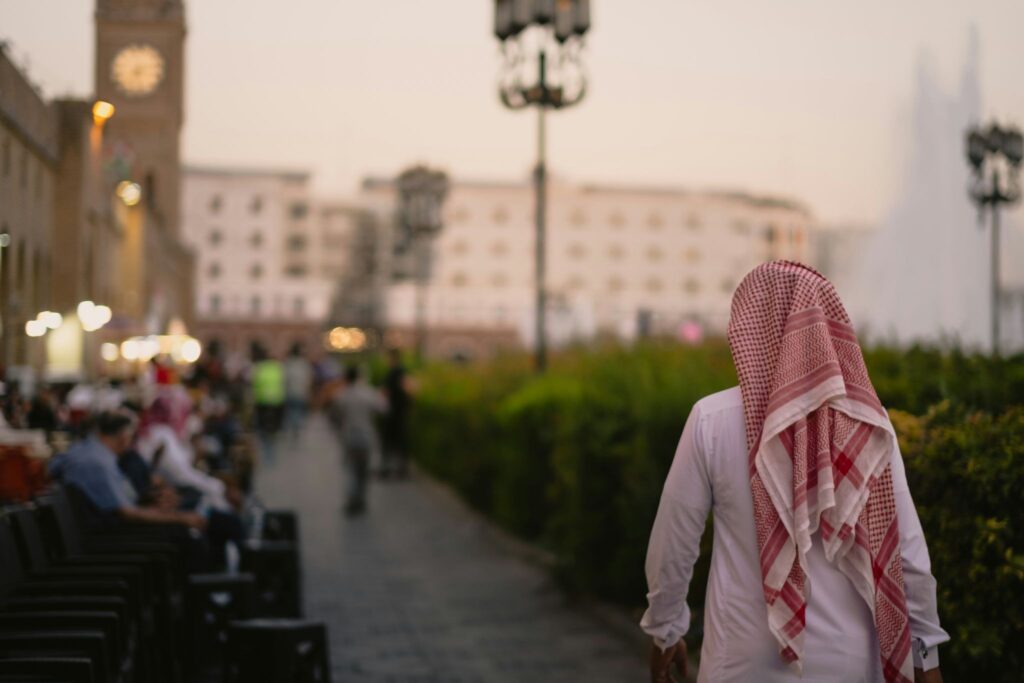
Photo by Levi Meir Clancy on Unsplash
By: Shayla Frank / Arab America Contributing Writer
First, the Decoder Toolkit
Arab families build their last names rather than invent them. The same handful of parts repeats from Morocco to Iraq. Learn them and you can read almost any name like a road sign. Arab last names are part of a greater story, they can help paint the picture of histories, occupations, and faith.
Start with al-, which just means the. In a surname it sits before a job or a trait. So al-Najjar is the carpenter, al-Tawil the tall one. One root can reach you as Elhaddad, Al-Haddad, or plain Haddad.
Next is abu, father of. Its mirror is ibn, son of, which also travels as bin and ben. A bin before a lone first name points straight up the family tree. Its sister word bint marks a daughter of.
The last piece is the quietest: a long -i on the end of a word, a nisba. It turns a place into a badge of belonging, so Halabi says from Aleppo and Masri from Egypt. Catch that final -i and you can often guess where a family’s story began. After covering that, let’s move on to regions and understand what your last name might say about you.
The Levant: Lebanon, Syria, Jordan, Palestine
In the Levant, Lebanon, Syria, Jordan, and Palestine share one pool of names, and a few may already be familiar.
- Khalil means friend, but not the casual kind. The root kh-l-l points to an intimate companion. It is also the Qur’an’s title for Abraham: Khalil Allah, Friend of God. From that epithet the city of Hebron takes its Arabic name, al-Khalil, The Friend. Here a family’s name and a city’s name are one and the same.
- Halabi is the nisba at work. It means from Aleppo, but a place-name surname is least useful at home. Inside Aleppo, the Aleppan singles out no one. So the label settled on the families who left, turning up in Damascus, Cairo, and beyond. Because a hometown crosses faiths, Halabis can be Muslim, Christian, Druze, or Jewish.
- Haddad is the blacksmith, from the root ḥ-d-d, to forge. Muslims and Christians both carry it, though in Lebanon it leans Christian.
- Khoury, the priest, is almost always a Christian name. Eastern churches let priests marry, so the title passed down within a priest’s family.
- Mansour comes from the root for victory, but in a passive form. It points not to the victor but to the one God has carried to victory.
Egypt and Sudan
Follow the Nile south and the names change character. Egypt layers Arabic over Coptic over older roots, while Sudan, as we will see, plays by partly different rules.
- El-Sayed means the master, from sayyid. The same word also honors a descendant of the Prophet, so the name can hint at a bloodline.
- El-Masri is the Egyptian, from Masr. Like Halabi, it clings hardest to families who left, so you meet more Masris abroad.
- Boutros is Egypt’s own form of Peter, the rock. A Coptic Christian name, it marks the faith of Egypt long before Arabic.
- Abdallah, servant of God, opens a whole family of names. The piece abd, servant, can attach only to God or to one of his ninety-nine names. So Abdel-Rahman is servant of the Merciful. You cannot be the servant of a mere person. It tops Sudan’s surname list and is widespread in Egypt as well.
- Sudan adds a wrinkle: many Sudanese carry no inherited surname at all. The last name on the form is often just a grandfather’s first name. The real marker, the clan or tribe, comes up separately in conversation.
- El-Mahdi is the guided one, the awaited redeemer of Islamic tradition. The name carries history you can date. In 1881 a man named Muhammad Ahmad declared himself that Mahdi and led a revolt that seized Khartoum. His descendants bear the name still. For a Sudanese family, it can hold both a sacred lineage and a national memory.
The Arabian Peninsula: Saudi Arabia, the Emirates, Kuwait, Qatar, Bahrain, Oman, and Yemen
Move into the Arabian Peninsula, the six Gulf states and Yemen to the south. Here a last name is usually a family tree, and one small word carries a lot.
- Al Saud turns on a word the toolkit doesn’t cover. With a long vowel, Āl means the house of, not the al- that means the. So Al Saud is the House of Saud. Saudi Arabia is one of the very few countries to carry its ruling family’s name. The peninsula is full of such houses, Al Thani and Al Sabah among them.
- Al-Qahtani is the peninsula naming itself by tribe. The -i is our nisba, so it means the Qahtan, a great tribal confederation. Tradition makes Qahtan the forefather of all the southern Arabs, with roots reaching into Yemen. He stands at the source of half the Arab family tree. The name is a genealogy fading into legend.
- Al-Otaibi marks the Utaybah, a vast tribe of the central deserts and a common name across Saudi Arabia.
- Al-Mutairi belongs to Mutair, a great Bedouin people of the Najd, its reach running from Kuwait down the peninsula.
- Al-Hadrami comes from Hadhramaut in Yemen, whose merchant families sailed the Indian Ocean to East Africa and Indonesia.
North Africa: Morocco, Algeria, Tunisia, Libya
Cross into the Maghreb, Morocco, Algeria, Tunisia, and Libya, where names carry an extra layer. Beneath the Arabic sits an older Berber world, and over it a French one. The ou for u and the Bou for Abu are colonial spellings.
- Mazigh is the deepest layer. It echoes Amazigh, the Berbers’ name for themselves, the free people, here before Arabic. Their language, Tamazight, still shapes the region’s names. Look for Ait, people of, and Ou, son of, the Berber cousins of ibn and ben. The footballer Zinedine Zidane is one famous Kabyle face.
- El Fassi looks simple, just from Fes, but the name hides a migration. When Spain expelled its Muslims and Jews five centuries ago, many rebuilt their lives in Fes. There they rose to the city’s elite. So a Fassi family may be Moroccan to the core and quietly Andalusian. The name still carries a lost city across the water.
- Benali, son of Ali, is among the most common patronymics in the Maghreb, the ben at its usual work.
- Trabelsi traces to Tripoli, whose own name is Greek for three cities, and it turns up most in Tunisia.
- Meziane is Berber again, the younger or smaller one, a familiar name across Algeria and the Kabyle highlands.
Iraq
Finish in Iraq, ancient Mesopotamia. The land between the rivers held cities while most of the world had none. Iraqi names lean on two things: the tribe and the holy city.
- Al-Najafi places a family in Najaf, and few small cities carry more weight. Najaf grew around the tomb of Imam Ali and became the foremost seat of Shia scholarship. On its edge spreads Wadi al-Salam, the Valley of Peace, likely the largest cemetery on earth. A Najafi hails from one of Islam’s spiritual capitals.
- Al-Tamimi points to Banu Tamim, where a surname outruns the modern map. Tamim was one of the largest Arab tribes before Islam began, its poets filling the early histories. Its descendants scattered so widely that a Tamimi today might be Iraqi or Saudi. Either way, the tribe is older than the borders that now separate them.
- Al-Jubouri is one of the largest tribal names in Iraq, with families across its center and north.
- Al-Samarrai marks a family from Samarra, the old Abbasid capital famous for its great spiraling minaret.
- Al-Dulaimi names the Dulaim, a major tribe of the western desert and one of the country’s most familiar surnames.
By now the trick should feel less like memorizing and more like reading. A name that looked like a wall of letters opened up. Inside is a trade, or a town a family once came from. These five regions hold most Arab American roots. The League itself spans twenty-two countries, from Mauritania to the Comoros, each with names of its own. So try yours. Run it past the toolkit and listen: the al-, the abu, the bin, the long -i. Hear what it has been saying all along.
Want more articles like this? Sign up for our e-newsletter!
Check our blog here!