Subscribe
to receive news by email

Poll
Will the Trump Administration Shift U.S. Policy in Favor of Palestine?
- No (86%)
- Yes (14%)
 Loading ...
Copyright © 2026 Arab America
Go topThe Great Olive Tree Return: Why Arab Americans Are Planting Their Heritage
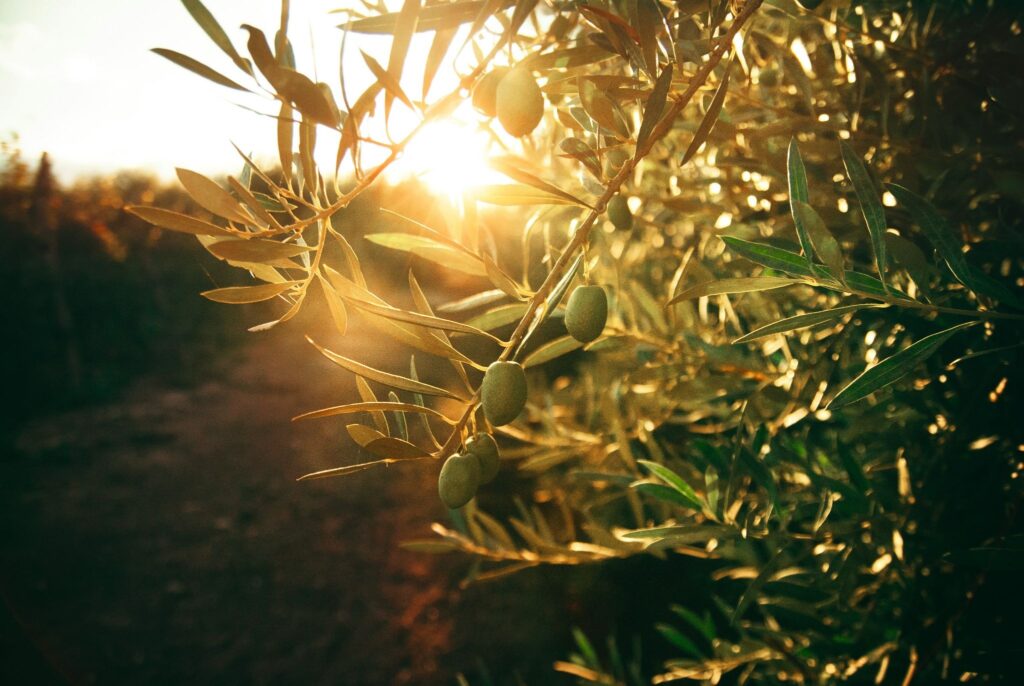
Photo by Flor Saurina on Unsplash
By: Shayla Frank / Arab America Contributing Writer
On eight acres in Larkfield, north of San Francisco, Mousa Husary and his family spent an afternoon last autumn planting fifteen hundred olive trees. The saplings were not the Mediterranean varieties that fill American nurseries. Instead, they were Nabali and Souri, olives native to Palestine, grown from cuttings that had traveled an unlikely road to that hillside. Husary’s twenty-year-old daughter, Talia, describes the day less as farm work than as a way of keeping hold of something. Olives and the pressing of oil sit near the center of Palestinian life, and on that California slope the inheritance was taking root again, far from the groves that gave it meaning.
Across the United States, a younger generation of Arab Americans is doing a version of the same thing – which is planting the trees of their heritage in unfamiliar ground and, in the same breath, sending support to keep those trees alive where they came from. Some set a single olive in a backyard. Others sponsor saplings for West Bank farmers through the Arab Group for the Protection of Nature, the Amman organization whose replanting campaign is among the clearest expressions of that impulse. All at once, these trees root a heritage in new soil while refusing to let it be uprooted from the old.
Palestinian Olive Tree, American Soil
The road that brought those trees to California began in Jerusalem. In 2009, Husary, who is forty-seven, stood among the ancient groves on the Mount of Olives and felt something shift. He came home with a question he had never thought to ask. What kind of olives grow in Palestine? The answer was Nabali and Souri, two varieties his family had lived alongside for generations without ever naming. Upon returning to the United States, he went looking for them. But every nursery he called offered the same Mediterranean stock, trees out of Greece or Spain, and none of the Palestinian kind. His search ended at UC Davis, which held cuttings that had reached the country through the federal agriculture service and agreed to send him a few.
He did not know how to plant them at first. He learned, and then he began teaching others, raising young Nabali and Souri and shipping them to Arab American families across the country. For Husary, the trees are more than horticulture. Olives, he says, are “a symbol of freedom for Palestinians,” and much of what gives them their identity. Harvesting and pressing oil, Talia says, is “so big within the Palestinian tradition,” and now that tradition grows where the family lives.
Husary is the most visible example, not the only one. In Dearborn, Michigan, the Arab American National Museum built a rooftop heritage garden from cuttings and seeds that community members carried from home. Among the figs and jasmine grows an olive tree, given by a family who wanted a piece of the old country living above a Midwestern street.
The Groves Coming Down
The return matters because the original groves are disappearing, and faster than before. Israeli rights groups and UN monitors have logged a sharp acceleration over the past two years. The number of Palestinian trees uprooted or damaged in the West Bank more than doubled between 2024 and 2025, past 35,000, and the first five months of 2026 alone brought more than 10,000, most of them olive. On June 28, 2026, Israeli forces bulldozed roughly five hundred olive trees near Zububa, outside Jenin, less than three months before the harvest they would have fed. Against a longer record of some 800,000 olive trees removed since 1967, the recent figures read as a present grievance, not a historical one.
And olives are not scenery. They are the first or second source of income for as many as 100,000 Palestinian families, and in the West Bank they cover close to half of all cultivated land.
Ten Olive Trees for Every One
For families who cannot plant on the land itself, there is a second way to reach it. The Arab Group for the Protection of Nature, founded in Amman and working across the Arab world, has run its Million Tree Campaign in Palestine since 2001 under a stubborn slogan: they uproot one, we replant ten. In the years since, the group has put more than two and a half million trees in Palestinian soil, most of them olive, and has reached tens of thousands of farming families in the process. A few dollars from Sacramento becomes a sapling handed to a farmer near Nablus, on land chosen because it sits under threat of confiscation. A living olive, rooted where someone tried to erase one, is proof that the land was never empty of the people who tended it.
APN is one channel among several. The US Campaign for Palestinian Rights plants a West Bank sapling for every twenty-five-dollar gift, and each season diaspora families and their allies fund them by the thousand. This is the far end of the gesture that begins in a California backyard. One family plans to remember. Another plant remains.
What the Olive Keeps
The saplings in Larkfield are still young; many are only a few feet high, generations from the old trees Husary stood beneath in Jerusalem. For Arab Americans, and Palestinian Americans most of all, the point is to allow future generations to know the taste of oil pressed from their own ground. No one in California can stop a bulldozer outside Jenin. But they can put a tree in the soil here, and fund one where the last was torn out, and hold onto an identity that distance wears thin. For Talia’s generation, the olive is no longer a story told about somewhere else. It is a thing in the yard, green through the California winter. The heritage did not survive by being remembered. It survived by being planted.
Want more articles like this? Sign up for our e-newsletter!
Check our blog here!