Subscribe
to receive news by email
Poll
Will the Trump Administration Shift U.S. Policy in Favor of Palestine?
- No (86%)
- Yes (14%)
 Loading ...
Copyright © 2026 Arab America
Go topThe Cloth We Are Made Of: Puerto-Rican Artist Witnesses Gaza
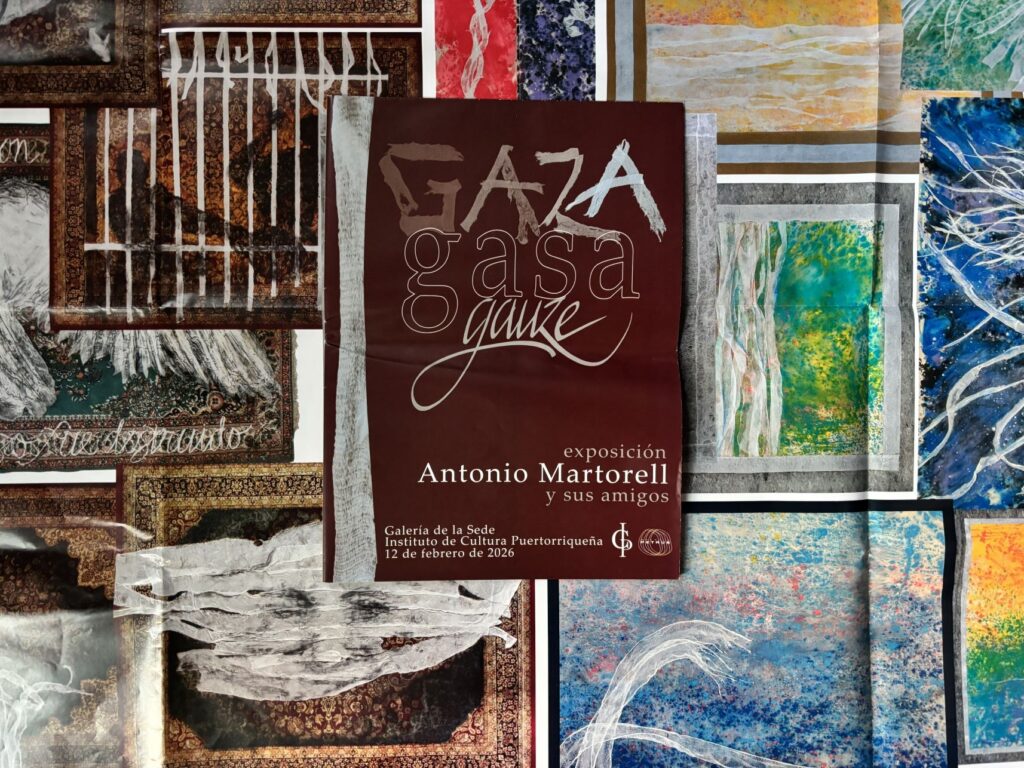
Photo of the exhibition booklet by Rami Balin
By Rami Balin / Arab America Contributing Writer
Centuries ago, in the Middle Ages, gauze (or qazz), the raw silk fabric produced in Palestine and originally used in clothing, drapery and surgical dressings, traveled to Europe via trade routes and became named after the city it was made in – Gaza. Today, Antonio Martorell, a Puerto-Rican painter, printmaker, installation artist and writer, attempts to express the destruction of Gaza and simultaneously rebuild it by using gauze as the central material in his paintings and installations. In doing so, he emphasizes not only the act of collective witnessing but also solidarity that arises from the intersectionality of Palestinian and Puerto-Rican struggles against colonialism.
Gaza, gasa, gauze – “a territory, a bandage (in Spanish), and its translation into English. […] With strips of gauze we attempt to rebuild towns and residents of what is now just desert,” writes Antonio Martorell about his work that spans more than two decades, from the beginning of the Second Intifada to present day, most of it during the most recent Israeli assault on the enclave. Combining gauze with materials such as acrylic paint, spray paint, pencil, wood, felt, fabric and even Turkish rugs, Martorell creates layered images and landscapes. These works are not meant to be comforting, the textures within them gritty and frayed, the charcoal a shadow, a burn, a focus and a setting. In a triptych titled “GAZA I”, on dark blue, crimson red and colorless grey rectangular cloths, the dreamy, almost whimsical cityscape of Gaza violently disintegrates. Paper cutouts of a sewing pattern are shaped as a child’s body falling apart into chaos and into the rubble, leaving empty spaces and dusty grey outlines where people used to be, until the absence and the calamity overtake the landscape completely, making it unrecognizable, no trace of the fragile beauty of what was before. Gauze here builds not only the life that used to be but the injury that became, cloth upon cloth upon cloth. The work becomes a portrait, a landscape, a snapshot of life that may no longer exist, an artistic document of violence and destruction. The thin cris-crossed cloth is the wound it hides underneath when layered.
However abstract or metaphorical, these images are in and of themselves a document – perhaps not one that would be cited as evidence in legal proceedings but a document, nonetheless. The gauze and other textures add materiality to the experience of witnessing that Martorell describes as both an entry to Gaza, a solidarity and an accusation. Martorell is clinging to the life and death of the place that he cannot reach or witness except through the screen on which images of destruction are shown. Here, the gauze that’s used to conceal wounds while they heal makes the wound of occupation more visible, impossible to escape without facing it first.
The exhibition is the only one on display at the Instituto de Cultura Puertorriqueña, located in the old colonial Spanish Welfare House in the middle of Old San Juan fortress. It is a striking space, constantly framed by the presence of Spanish colonial history that shaped Puerto Rico, also known by its Indigenous name Borikén, now an unincorporated US territory. Only allowed one non-voting representative to the US Congress, Puerto Rico has been facing decades of subjugation, extractivism and denial of its right to self-determination. Anti-colonial resistance on the island is often viewed as parallel, connected to other decolonial struggles around the world, especially Palestine where colonial oppression has permeated most if not all aspects of people’s daily lives.
Foregrounding the destruction of Gaza in his artworks, Martorell makes viewing the genocide through paint and fabric a profoundly political act, not only placing the audience of the exhibition in the same room with the paintings and installations and all the grief and pain they contain, but also framing this experience as a reckoning, scrutiny of one’s own position in relation to the genocide. While acknowledging the feelings of helplessness in the face of carpet bombings and mass death, Martorell also acknowledges the fact that the United States and the Western world in general are complicit in enabling the massacres of civilians by rejecting the UN ceasefire resolutions and other means. In his own words, “the least we can do is echo the lament of the Palestine people and demand justice.”
About the exhibition by the artist: https://www.instagram.com/reel/DWjyVzpDFg4/
Want more articles like this? Sign up for our e-newsletter!
Check our blog here!