

Subscribe
to receive news by email

Poll
Will the Trump Administration Shift U.S. Policy in Favor of Palestine?
- No (86%)
- Yes (14%)
 Loading ...
Copyright © 2026 Arab America
Go topLebanon Faces Israel’s Occupation and Hezbollah’s Intransigence
By: Ghassan Rubeiz / Arab America Contributing Writer
Lebanese President Joseph Aoun is feeling very nervous: “I am not fond of Israel … I am telling those who oppose this framework that I am waiting for any solution or agreement that will get us out of wars.” Is Lebanon running out of time? Beirut cannot afford another lost decade of paralysis, occupation, and proxy conflict, in being asked to disarm a militia it cannot control, confront an occupying army it cannot deter, and navigate regional rivalries it cannot escape.
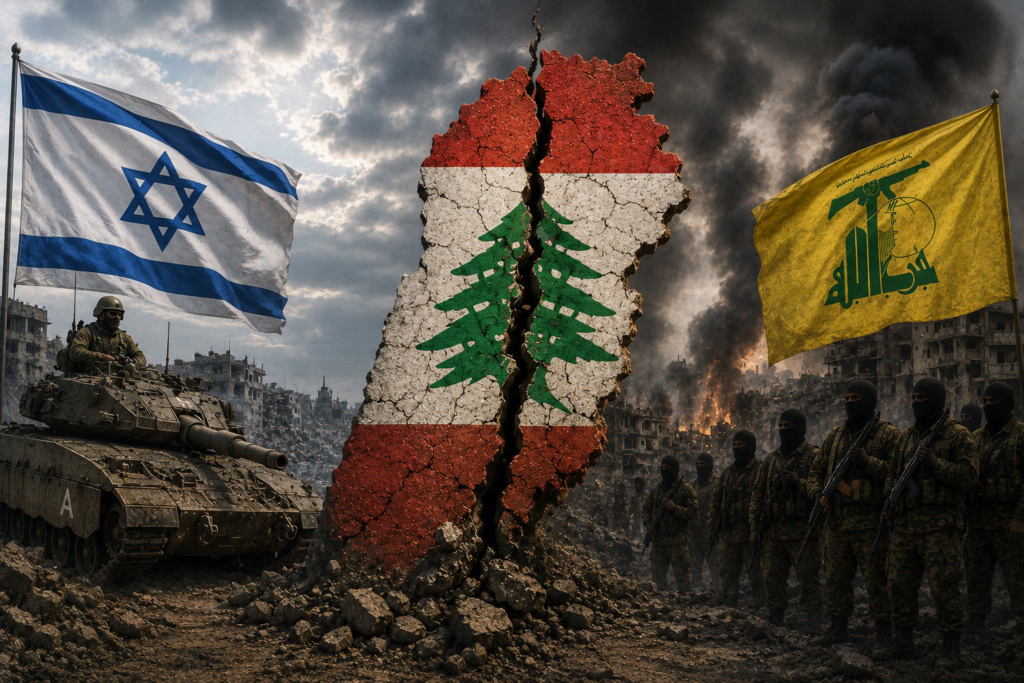
Last week’s trilateral Framework Agreement (FA) signed by Lebanon, Israel, and the United States has shifted the Hezbollah-Israel conflict from a war of attrition into a war among the Lebanese political factions themselves. According to the FA, Israel is no longer obliged to withdraw from Lebanese territory unless the Lebanese state disarms Hezbollah—an unrealistic requirement given the relative weakness of the Lebanese Armed Forces (LAF) and the fact that the Shiite community, from which Hezbollah draws its manpower, is well represented within the LAF. If the military fails to act, Israel would gain diplomatic cover to expand its occupation, cause further displacement of population, and increase civilian destruction—repeating, since 1978, a pattern in which civilians pay the highest price.
A central flaw in the Framework Agreement is the disparate treatment of Israel and Hezbollah. Washington treats Israel as a sovereign state defending its security, while Hezbollah is cast simply as a terrorist organization to be eliminated. This is politically convenient, but strategically misleading. Israel occupies land in neighboring countries: Shebaa Farms and southern Lebanon, the Syrian Golan Heights, and Palestinian territories—recognized internationally as occupation under multiple UN resolutions. Hezbollah, for its part, continues (despite significant weakening) to somewhat limit Lebanon’s sovereign decision-making space, maintaining an armed force outside state control and holding veto power over some important national decisions- like launching war on its own. Critics of Hezbollah assert that despite its formidable past in defending Lebanon from Israeli aggression, its armed resistance is, in fact, exposing the nation to devastation. Israel occupies Lebanese land; Hezbollah threatens Lebanese sovereignty. Both must be treated firmly but creatively and realistically. However, things are not that simple: should the current Framework Agreement serve as a “license” for Israel to exercise full freedom of military action in Lebanon, Hezbollah would then regain its past status as the “real defender” of the nation.
To avoid another civil war, the context, dynamics, and duration of negotiations must change; for five decades the rhetoric has not changed and lessons go unlearned. Perhaps the first needed adjustment should be the integration of the Iran-US negotiations with the parallel Beirut-Tel Aviv-Washington talks. The US agreement with Iran implies full Israeli withdrawal from Lebanon; the Lebanon-Israel agreement, signed a week later, does not. Iran’s concerns must be satisfied, since Tehran and Hezbollah coordinate closely. Washington is divided between those willing to pressure Israel toward realistic engagement and those who back it unconditionally. But President Trump can and must pressure Israel to commit to a withdrawal timetable, synchronized with a gradual reduction of Hezbollah’s military footprint—rebuilding Lebanese confidence in Israel’s claim that it has no territorial ambitions. It would also signal to Hezbollah that its raison d’être is no longer fully justified, should Israel fully withdraw.
A second adjustment should come from Syria. Geography and history make Damascus an unavoidable player in Lebanon’s security equation. Hezbollah feels abandoned not only by Lebanon’s political class but by Syria’s new leadership after the Assad dynasty’s collapse. Lebanon’s Shiites are demographically and politically connected to Syria’s Alawite minority, who feel similarly orphaned by Assad’s departure. Syria’s foreign minister visited Beirut last week and expressed interest in meeting Hezbollah leadership “if necessary,” a potentially significant reconciliation opening. Reconciliation between Damascus and its Alawites could score on two accounts: Allow Hezbollah to relax posture and accelerate promised political reforms from the new Syrian regime. History offers a warning as much as a lesson: oppressed minorities do not simply fade. Left marginalized long enough, as the Alawites once were before their five-decade rule under the Assad family, marginalized minorities can eventually seize power and rule with brutal force. Lebanon’s Shiites, cornered today, are not immune to that trajectory—though a less-threatened Hezbollah is more likely to negotiate. There is a possibility for a multiplier effect: Syria has its own unresolved conflict with Israel; with a new spirit, Israeli realistic peace talks, conducted with both Lebanon and Syria, could trigger a diplomatic sea change. A serious engagement with the long-ignored Palestinian question would be part of a new multilateral, regional approach to peacemaking.
A third necessary change is extending the time allowed for negotiations. The current negotiation window is artificially compressed, built for political optics rather than achieving results. But how would this time factor work? Politics is shifting on two tracks: The Democratic Party’s support for curtailing unauthorized US involvement in Lebanon has grown quickly, whereas Republicans in Congress remain almost uniformly aligned with Israel—even as an “America First” revolt gathers force outside Capitol Hill. Tucker Carlson and Marjorie Taylor Greene, both longtime Trump loyalists, have broken with the GOP over this very issue, accusing the party of putting a foreign country’s interests ahead of US interests. With time, Trump may realize that pressuring Israel toward withdrawal is a strategic necessity, not a liability. A longer diplomatic horizon—twelve months rather than eight weeks—might let Washington build political support across both parties and prepare the ground for a firmer stance toward Israel.
Finding a solution for Lebanon need not be risky. It requires serious, coordinated planning: Washington must pressure Israel toward withdrawal, Damascus must engage constructively, Palestine must not be forgotten, Tehran must be part of the conversation, and Tel Aviv must recognize that its security will never be won through perpetual occupation.
President Aoun is nervous for a good reason.
Ghassan Rubeiz is the former Middle East Secretary of the World Council of Churches. Earlier, he taught psychology and social work in his country of birth, Lebanon, and later in the United States, where he currently lives. He has contributed to political commentary for the past twenty years and has delivered occasional public talks on peace, justice, and interfaith topics. You can reach him at rubeizg@gmail.com
The views and opinions expressed in this article are those of the author and do not necessarily reflect the position of Arab America. The reproduction of this article is permissible with proper credit to Arab America and the author.
Want more articles like this? Sign up for our e-newsletter!
Check our blog here!