Subscribe
to receive news by email

Poll
Will the Trump Administration Shift U.S. Policy in Favor of Palestine?
- No (86%)
- Yes (14%)
 Loading ...
Copyright © 2026 Arab America
Go topWhat Spain's World Cup Victory Means to Many Arabs
By Aziz Hellal / Arab America Contributing Writer
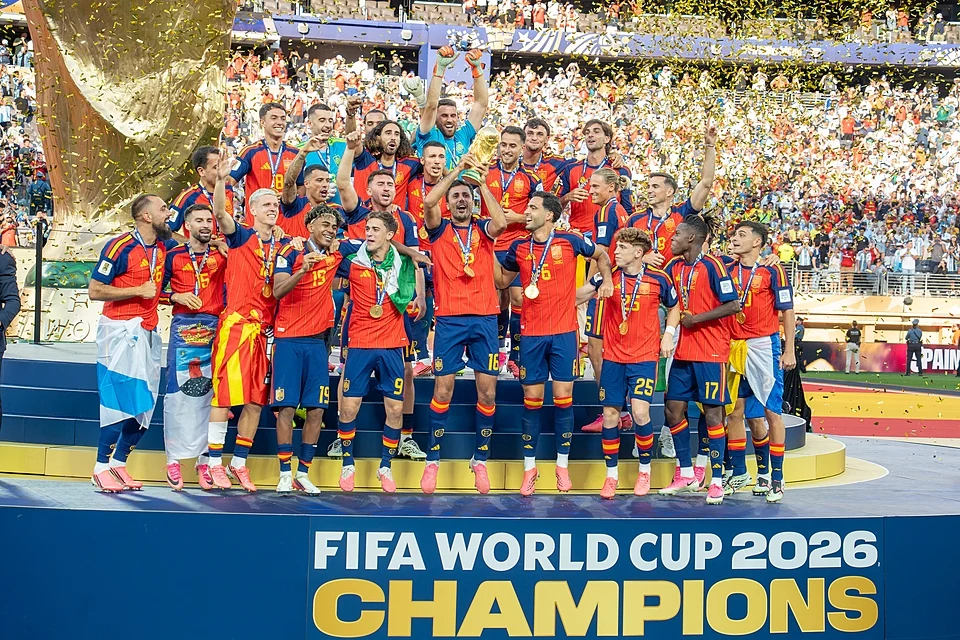
When Ferran Torres scored in extra time to give Spain a 1–0 World Cup final victory over Argentina, the celebrations extended far beyond MetLife Stadium in New Jersey. Around makeshift screens in Gaza, in the streets of the occupied West Bank, and inside Arab American cafes in Brooklyn, many fans erupted in celebration. Red and yellow Spanish flags were waved right alongside Palestinian ones.
To anyone watching from the outside, the sight of Arab football fans celebrating a European team’s victory with such emotion may have seemed unusual. But for many across the Arab world and its diaspora, supporting La Roja was not simply about tactics, star players, or tournament statistics.
It was about gratitude. Ever since Spain recognized Palestinian statehood in 2024 and spoke out against the war in Gaza, Spanish figures—including young star Lamine Yamal—earned deep respect across the region.
Spain was competing for a World Cup title, but for many Arab fans, cheering for the team also became a way of recognizing a country—and a generation of Spanish public figures—that had made Palestinians feel seen during one of the darkest periods in their history.
Why Spain Won Over Many Arab Fans
Spain’s popularity across the Arab world didn’t happen by accident. While football has always been huge across the Arab world, the way Arab fans viewed Spain shifted after Madrid officially recognized the State of Palestine in May 2024 alongside Ireland and Norway.
Since then, Spanish Prime Minister Pedro Sánchez has consistently spoken out about the crisis in Gaza, taking a stance that was widely covered across Arab media and social platforms.
Those decisions meant a lot to people on the ground. For many Arabs, Spain became one of the few Western nations willing to break away from the main European consensus on Gaza. By the time the 2026 World Cup rolled around, supporting Spain wasn’t just about liking their style of play. For a lot of fans, it became emotional.
That connection showed up everywhere during the final against Argentina. Videos out of Gaza showed crowds squeezing around makeshift screens to watch the game, bursting into celebration after the final whistle.
You saw the same thing in diaspora neighborhoods across the U.S. and Europe, where fans flew Spanish and Palestinian flags side by side. At the end of the day, football was the main event, but the love for Spain was built on real solidarity.
From Politics to the Pitch
The 2026 World Cup final showed just how quickly international politics can shape who people root for. Football has always been about identity, but in today’s media environment, political moves can push fans to support teams they have no physical or historical ties to.
Spain and Argentina entered the final carrying very different political images. For months, Spain had made headlines for recognizing Palestinian statehood and demanding a ceasefire in Gaza. Argentina, on the other hand, was tied to President Javier Milei’s close relationship with Israel.
Just before the game, Israeli Prime Minister Benjamin Netanyahu publicly wished Argentina good luck, while videos of Israeli flags in the crowd circulated across Arab social media. Even if those flags came from a small group of fans, the symbolic line was drawn.
For many Arab fans, the match wasn’t just about football tactics anymore. Rooting for Spain wasn’t about hating Argentina’s squad; it was about backing a country that took a stand when others didn’t.
When the final whistle blew, the celebrations in Gaza and across the diaspora proved that sometimes, what happens off the pitch matters just as much as what happens on it.
A Connection That Goes Beyond the Field
Spain’s victory shows how a country’s decisions can shape how people view it around the world. While leaders usually measure foreign policy by signed treaties and diplomatic meetings, regular people feel the impact differently. For Arab fans, seeing Spain take a stand made it easy to feel a real connection to the team.
Of course, that doesn’t mean every Arab fan was cheering for Spain, or that politics replaced the love of the game itself. But the tournament showed that taking a stand off the field leaves a lasting impression. For Spain, that turned into genuine goodwill across the region—something that won’t fade just because the World Cup is over.
More Than a Football Match
Spain’s victory over Argentina lasted just 120 minutes, but the bond behind it had been building for years. The celebrations in Gaza and across diaspora communities showed how quickly football can become a way to express gratitude, identity, and political support.
For a lot of people watching, this wasn’t just about picking a favorite team. They were reacting to what those countries represented on the world stage. Spain’s vocal support for Palestinian rights built genuine respect, while Netanyahu’s public backing of Argentina added a heavy layer of political symbolism to the match.
That doesn’t mean every Arab fan dropped their love for Argentina, or that everyone thought the exact same way. But it proved how real-world events can shift who we root for. In the end, Spain’s World Cup win wasn’t just remembered for the trophy—it was remembered as a moment where sport and solidarity came together.
Want more articles like this? Sign up for our e-newsletter!
Check out our blog here!