
Subscribe
to receive news by email

Poll
Will the Trump Administration Shift U.S. Policy in Favor of Palestine?
- No (86%)
- Yes (14%)
 Loading ...
Copyright © 2026 Arab America
Go topWildfires in Algeria: The Long-Term Affect of Climate Change on Africa
By: Connor J. Buss / Arab America Contributing Writer
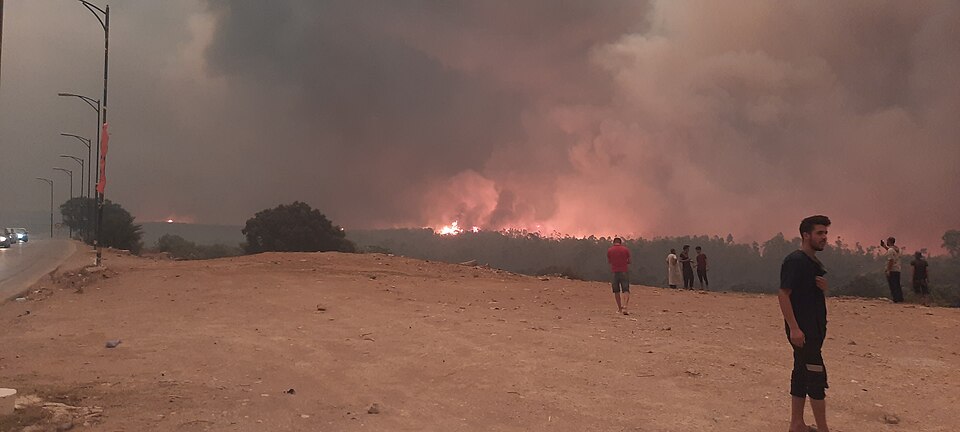
Heatwaves worldwide have resulted in environmental catastrophes this summer. Algeria is no exception, at the forefront of wildfires sweeping across the nation’s forests. However, this is not a new occurrence. Algeria has been battling the consequences of climate change for decades, and this summer is only a milestone of North Africa’s spot at the forefront.
Algeria Aflame
Between 1985 and 2022, Algeria recorded over 75,000 forest fires. Every year, an average of 35,000 hectares of land burns. As climate change became more intense, so did its effects in Algeria. Longer droughts, harm to agriculture, and frequency of fires in the nation increased dramatically, with a peak in 2021. The devastation that engulfed rural regions of Algeria’s forests had agricultural production and farmers losing their livelihoods overnight. 2021 was proof that the preventative measures Algeria had in place were no longer sufficient to stop the ever more intense fires.
The recent worldwide heatwaves are giving 2026 the potential to be the hottest year in history. Combining this with the ever-increasing intensity of wildfires across the nation, Algeria is facing a wildfire catastrophe that could be worse than that of 2021. Already, the wildfires have killed one person, with the blazes growing across Northern regions of Algeria.
Additionally, a recent fire at an orphanage in Algiers claimed 11 lives. The fire was attributed to heatwaves that caused 932 fires in Algeria within a week.
The Why
However, the struggle to contain the fires is also in part the result of administrative ignorance. Forest management plans remain without update, and as such contain old and faulty information. Data systems are incomplete and lack the proper information to approach fires and their prevention. Boundary registration is incomplete, leading the land to be unprotected by firefighting teams. There are even communication gaps that lead to bad coordination between firefighting teams.
Additionally, the overuse of the land for farming activities, namely overgrazing, land clearing, and inconsistent law enforcement lead to nature’s defenses against fires being degraded. For example, fire-dampening moisture present in many plants is often cleared out for farming and cattle grazing.
Though the fires are a catastrophe difficult to contain, it is important to address the efforts made by Algerian authorities to prevent future devastation. Groups like PROGREEN, an organization supported by the World Bank Group, have began working with the government to conduct diagnostics that provide information vital to preventing future fires. Much of the information I have stated so far has come from PROGREEN diagnostics, which highlight faults in essential infrastructure like those aforementioned. Through working with organizations like PROGREEN, Algeria is enabling itself to improve firefighting and fire-prevention capabilities in accordance with predictions in climate change. Simply put, Algeria is making big improvements on fire-prevention infrastructure.
Wider Cause
According to The United Nations, the continent of Africa is the most at risk for the impacts of climate change and global warming. In addition to natural disasters like droughts, floods, and wildfires like those seen in Algeria now, there has been a consistent decrease in farming capabilities, including the desertification of fertile land. Additionally, water becomes increasingly scarce while becoming increasingly necessary as the continent becomes hotter. These are important statistics when considering the development of African nations, as the continent collectively struggles to match the world in development of various sectors and industries. This is only made more difficult because of the sharp increases in climate change. Simply put, due to climate change, it is significantly harder to even start a farm, keeping undeveloped nations undeveloped.
The most disheartening part of the whole equation is that the entire continent of Africa only contributes 3-4% of the world’s greenhouse gas (2006), while the USA and China alone contribute 11% and 33%, respectively. Despite having nearly the least contribution to climate change, the continent suffers disproportionately more consequence than any other.
The wildfires in Algeria mark a milestone in nature’s health plunge. But, they also uncover part of the background that keeps the continent of Africa so underdeveloped. Algeria has shown what happens when the environment gets ignored for long stretches of time, even across oceans. The wildfires are just the face of decades-long environmental neglect.
“Climate change will manifest as a series of disasters viewed through phones with footage that gets closer and closer to where you live until you’re the one filming it.” – Twitter Post
Want more articles like this? Sign up for our e-newsletter!
Check our blog here!