
Subscribe
to receive news by email
Poll
Will the Trump Administration Shift U.S. Policy in Favor of Palestine?
- No (86%)
- Yes (14%)
 Loading ...
Copyright © 2026 Arab America
Go topComoros: Arab by Tongue
By: Connor J. Buss / Arab America Contributing Writer
A unique but overlooked member of the Arab League is the archipelagic country of Comoros. Comoros is a country off the coast of Southeast Africa, in the subsequently named Comoros island chain. Comoros is special in that it is the only Arab country entirely in the southern hemisphere, very far from the rest of the Arab world. In fact, it is nearly 1000 miles away from its nearest Arab country, being Somalia.
However, the country is in the Arab league for a reason. It is almost entirely a Sunni Muslim country, the only one in sub-Saharan Africa with this characteristic. It has Arabic as an official language, also being the only country in the region with this characteristic. Such begs the question, how did this small chain of islands end up with such close ties to Islam and the Arab world?
Initial Settlement
To understand Comoros today, we must look at the history of the country. The Comoros islands contains four islands, and were inhabited together by Bantu and Austronesian seafarers. As time went by, the island’s inhabitants began extensively trading with groups along the Swahili Coast and in the Arabian Peninsula. One of these main groups was the people of Oman.
The Omani had fostered a large trade empire around the Indian Ocean and surrounding areas, and the Comoros islands were a frequent destination. This is because the islands had a great habitat for ylang-ylang, cloves, and vanilla, all of which could be sold for good money in the spice trade. The habitat for aromas gave the Comoros islands the iconic nickname of the “Perfume Islands.”
These Omani merchants notably brought with them their religion of Islam and the language of Arabic.
Introduction to Islam
Over time, interactions between Omani merchants and Comorians lead to the adoption of Islam and the widespread use of Arabic. Arabic became a language of wealth, because if a Comorian spoke it, they would be interacting with merchants and handling the wealth.
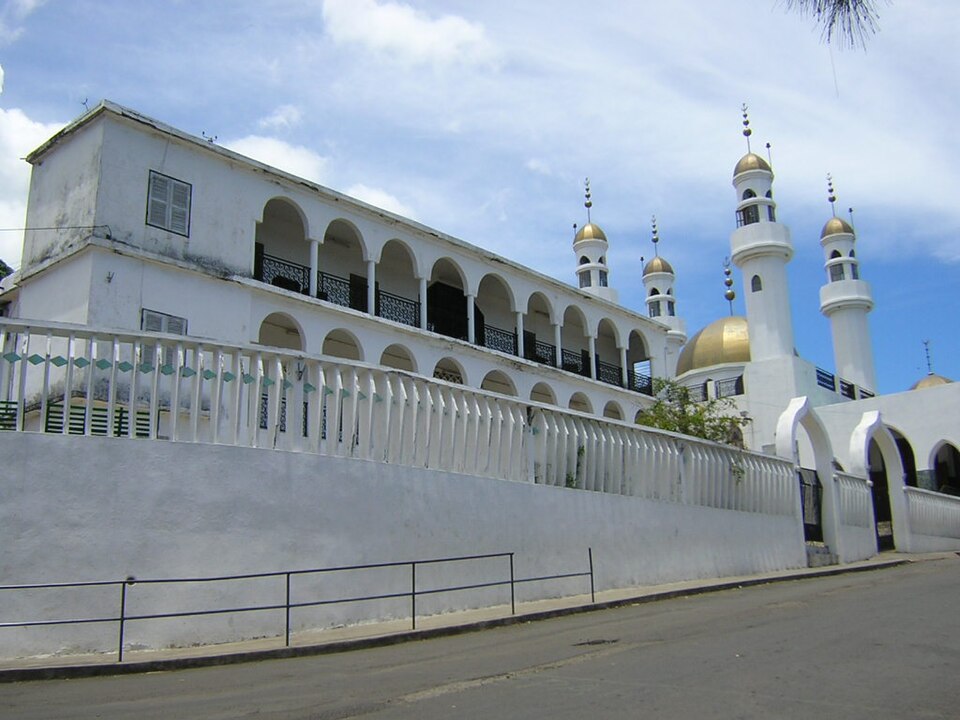
As more people converted to Islam, mosques were constructed. These mosques became places where people would learn the Arabic language to read the Qur’an, Islam’s holy scripture. Not only was Arabic a language of wealth, it was also the language of God. Prayers were done in Arabic in accordance with the people who introduced the prayers, and writing within the mosques were depicted in the language.
Mtswa-Mwindza
However, Comoros’s connection to Islam goes even further than contact with Omani merchants. According to legend, in 632 AD the Comorians heard of Islam for the first time. Curious, they sent an emissary named Mtswa-Mwindza to Mecca to investigate. While the Islamic prophet Muhammad had already died before Mtswa-Mwindza arrived, he converted to Islam and built a mosque upon his return to Comoros.
While this is legend, there are actually records that indicate contact with Arab and Persian traders prior to the consistent Omani visits. A short period before Omani merchants stayed, the Arab geographer Al-Masudi noted that the Comoros islands were frequently visited by Arab traders seeking coral, ivory, gold, amber, tortoiseshell, and slaves for the Arabic slave trade. Islam was also introduced by these traders to groups along the Swahili coast (modern day Tanzania & Mozambique). Most notably, Islam was introduced to Zanzibar, which would become an important trading hub for the Omani.
European Contact
As European empires expanded, Comoros’s geography between Madagascar and the Swahili Coast became an attractive place to resupply European ships. Additionally, European navies battling native resistance during the scramble for Africa would find shelter in the area.
Eventually, the islands were raided for slaves, and Comoros fell victim to the scramble as they became a French colony alongside neighbouring island chains. Comoros continued to be an important supply station for all European traders traveling to Asia. This ended once the Suez Canal opened and the Middle East was colonized, eliminating the need to go around Africa to reach the Indian Ocean.
Independence
In 1975, Comoros gained independence from France. The four islands were given a referendum to either become part of an independent Comoros, or stay with France. Three of the four voted to become part of independent Comoros, whereas the island of Mayotte chose to stay with France.
Fun fact: the Comoros flag has four stars and stripes with each representing an island in the chain, despite not containing all four islands.
What followed was political turmoil. Since independence, Comoros has had 20 coups. The government has been shaky military juntas, Maoist communism that oppressed Muslims, then even dictatorships that oppressed all non-Muslims.
Comoros nowadays has somewhat stabilized, and today is a proud member of the Arab league and the African Union. Comoros was even president of the African Union in 2023-2024! Today, the country celebrates its Muslim identity, with Arabic as an official language spoken alongside the indigenous Comorian.
Want more articles like this? Sign up for our e-newsletter!
Check out our blog here!