

Subscribe
to receive news by email

Poll
Will the Trump Administration Shift U.S. Policy in Favor of Palestine?
- No (86%)
- Yes (14%)
 Loading ...
Copyright © 2026 Arab America
Go topThe Growing Role of Women in the Arab World
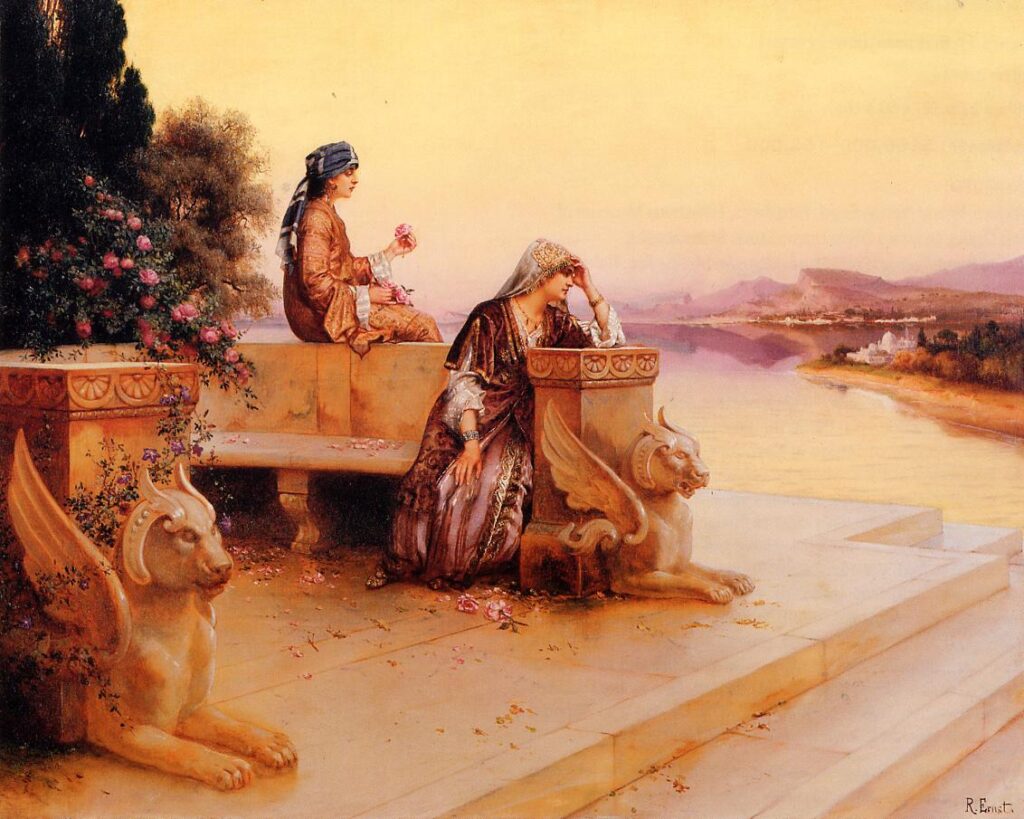
Image: Rudolf Ernst, Public domain, via Wikimedia Commons
By: Connor J. Buss / Arab America Contributing Writer
Over the last few years, the Arab world has seen major strides in women’s rights and gender equality. Social projects such as the various gulf states’ “vision” plans have increased the quality of life for the average woman. This article will highlight some of the major recent milestones that the Arab world has made in women’s rights and equality.
Role in Government
Across the Arab world, women are getting a larger voice in government. Though most of the Arab world gave women suffrage during the 1950s and ‘60s, most Arab hadn’t had any female ministers or representatives in government. Notably, over half of the Arab world didn’t get female representation in government until the 21st century. However, female leadership in government has only risen since then.
Despite the 21st century being the beginning of women filling roles in government, it has also marked major milestones in the Arab world. Tunisia, for example, became the first country to elect a female prime minister, Najla Bouden, in 2021. In 2013, King Abdullah of Saudi Arabia appointed 30 women to the Shura Council, the highest advisory board in the kingdom. This comes just two years before Saudi women were given the right to vote, in 2015. Saudi Arabia is the most recent country to allow women to vote.
In some Arab governments, there is a ratio or percentage requirement of women within a government organization or department. For example, in Iraq’s post-2003 parliament, 25% of the parliament was required to be made up of women. Requirements like this across the Arab world have been criticized as being a “state tool” to make a country appear feminist.
Changes to the quota system can change the view towards female representation, though. In Algeria, the percentage of women in parliament changed from 26% to 8% following a quota adjustment. This came despite women making up 37% of candidates. The Inter-Parliamentary Union attributed this change to “blatant discrimination.”
Most of the Arab countries with the lowest female government representation are all countries that are or recently have been in major conflicts/civil wars. Countries like Yemen, Libya, Syria, Lebanon, and Iraq consistently rank rather low on representation and coincidentally are or have been in major wars. However, women’s representation is actually still increasing in these environments nonetheless.
Social Reforms
Women’s suffrage and representation is not the only goal or measure of women’s rights, though. For the everyday woman in the Arab world, social rights are the most relevant characteristic. Throughout history, Arab women have not had various rights or entitlements that men have had. For example, the “Women to Drive” movement in Saudi Arabia pushed the government to revoke its long-standing ban on women operating motor vehicles. The movement was successful, and since 2018 women have been allowed to drive.
The “Women to Drive” movement is just one of many sweeping social reforms in the Arab world. One of the most prevalent topics tackled by the Arab world is child marriage. In the past 25 years, the practice has dropped from 1 in 3 to 1 in 5 young women married before 18. This comes from cooperation with supranational organizations such as UNICEF, the election of female government officials, and domestic pressure to enact reforms.
Additionally, many Arab countries have recently removed “marry-your-rapist” laws, which allows people to get away with rape by marrying their victims. Egypt repealed these laws in 1999, Morocco in 2014, and most recently Jordan, Lebanon, and Tunisia together in 2017. Female genital mutilation (FGM) has also been more strictly persecuted in some areas, namely Sudan which criminalized it in 2020 and Egypt which elevated it to a felony in 2016. Though, many Arab states have yet to fully restrict it.
Though there have been major steps taken in social reform, there is still a long way to go. Much of the Arab world still faces these issues despite laws declaring them illegal or imposing restrictions.
Women’s Economic Involvement
The last major marker for women’s rights is economic involvement. This is a value depicting the amount of women that participate in their country’s economy. When it comes to the Arab world, this number varies significantly. To put that in perspective, the 2022 female economic involvement average in the Arab world was 27%, but that number ranged from under 5% in Yemen to over 60% in Qatar.
However, when it comes to recent developments, the Gulf region has seen a shocking spike upward. These economic (and many social) changes are easily attributed to various “vision” programs. Saudi Vision 2030 has brought economic reforms that increased women’s participation rate from 21.2% to 35.4%. UAE Vision 2031 brought similar reforms that pushed women to holding 66% of public sector jobs and 70% of private sector jobs. Qatar’s aforementioned 60% came from Qatar National Vision 2030’s economic reforms creating jobs for women.
However, the Gulf states are the only part of the Arab world that has seen such a spike in economic activity. According to the World Bank, The Middle East region only collectively had 19% of the labour force. This comes at a shock considering that the region has received praise for its social reforms, for example Jordan’s 100% women’s literacy rate. Arab Africa is not much better, with averages revolving around 20-24% and lacking many of the social reforms the Middle East region boasts.
Want more articles like this? Sign up for our e-newsletter!
Check out our blog here!
Bibliography
Alhazred, Abdul. 2016. “May 16, 2005: Kuwait Becomes Latest Muslim Country to Allow Women to Vote.” HistoryHeaders. May 16, 2016. https://www.historyandheadlines.com/history-may-16- 2005-kuwait-becomes-latest-muslim-country-allow-women-vote/.
Amnesty International. 2018. “Saudi Arabia: Women Now Allowed to Drive, but More Reforms Must Follow.” Amnesty International. June 21, 2018. https://www.amnesty.org/en/latest/news/2018/06/saudi-arabia-women-now-allowed-to-drive- but-more-reforms-must-follow/.
Batha, Emma. 2023. “Which Countries Have the Most Gender-Equal Parliaments?.” World Economic Forum. February 16, 2023. https://www.context.news/socioeconomic-inclusion/women-in- parliament-which-countries-are-making-progress.
Bouri, Christina . 2023. “Women’s Labor-Force Participation in the Middle East | Think Global Health.” Council on Foreign Relations. September 19, 2023. https://www.thinkglobalhealth.org/article/womens-labor-force-participation-middle-east.
“Child Marriage.” 2014. UNFPA Arabstates. December 2, 2014. https://arabstates.unfpa.org/en/topics/child-marriage-5.
Human Rights Watch. 2015. “Saudi Arabia: Landmark Elections for Women.” Human Rights Watch. December 11, 2015. https://www.hrw.org/news/2015/12/11/saudi-arabia-landmark-elections- women.
MENA, UNICEF. 2022. “Facts and Figures: Child Marriage in the Middle East and North Africa.” Www.Unicef.Org. February 2022. https://www.unicef.org/mena/reports/facts-and-figures-child- marriage-middle-east-and-north-africa.
“Women’s Labor Market Participation: A Cornerstone of Saudi Arabia’s Economic Growth.” 2023. Spa.Gov.Sa. SaudiPressAgency. 2023. https://www.spa.gov.sa/en/N2278026.