Subscribe
to receive news by email

Poll
Will the Trump Administration Shift U.S. Policy in Favor of Palestine?
- No (86%)
- Yes (14%)
 Loading ...
Copyright © 2026 Arab America
Go topIsrael Seizes More Territory but Risks Losing its Soul
By: Ghassan Rubeiz / Arab America Contributing Writer
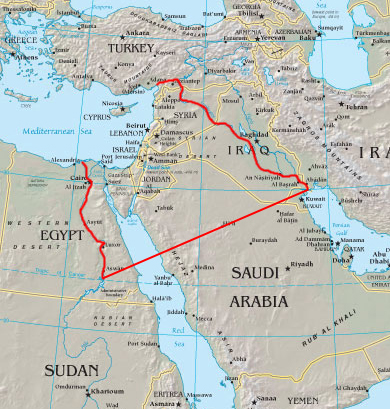
Israel complied last week with President Trump’s demand for a short ceasefire in Lebanon, while he negotiated with Iran, but Israel’s military automatically created a provocative “yellow” line around its occupation of Southern Lebanon. By drawing a yellow line to mark a buffer zone inside Lebanon — just as it did in its occupation of eastern Gaza—Israel again grabs land beyond its borders while framing the expansion as a quest for security.
Israel’s evolution from a refuge for a persecuted people into a state defined by shifting borders and recurring wars has reached a critical point. What began as a sanctuary has become a project of expansion, displacing Palestinians, Syrians, and now Lebanese communities across successive generations. The world no longer sees Israel as the underdog. Increasingly, it sees a regional hegemon whose security doctrine depends on force. This is no longer a defensive posture. It is a long-term pattern that has destabilized the region and reshaped global perceptions of Israel’s intentions for coexistence.
That pattern is now dramatically reflected in American public opinion, which has shifted in ways unthinkable a decade ago. A March 2026 Pew Research Center survey found that 60% of Americans now view Israel unfavorably — the highest level ever recorded. Younger Americans, in particular, are questioning whether Israel’s security genuinely requires perpetual war or the displacement of yet another generation of Arab populations. The same shift is visible in Congress as well. Democratic lawmakers who once hesitated to criticize Israeli policy now speak openly about the humanitarian and strategic costs of Israel’s aggressive actions. Even President Trump, historically one of Israel’s staunchest allies, has expressed frustration with Israel’s prolonged ruthless campaign against Lebanon. What is eroding is the support that once made Israel a bipartisan cause in Washington.
Similar changes are taking place in Europe, particularly in Italy, Spain and Ireland. In Haaretz this week Liza Rosovski reports that: “Across the EU and in capitals across Europe, Israel’s attacks on Lebanon, West Bank violence and the death penalty law for Palestinian convicts are fueling high tensions.”
Inside Israel, on the other hand, the dominant mood is very different. The majority of the Israeli public and its political leadership remain convinced that the military campaigns in Gaza, Lebanon, and against Iran must continue until Israel’s enemies are decisively and permanently “neutralized”. The prevailing security culture — defined by force, deterrence, and triumphal military solutions — has hardened over decades into something closer to a national obsessive bent of mind. A society that organizes itself around conflict inevitably finds new threats, enemies and frontiers to capture. What is largely absent from Israel’s mainstream political discourse is remorse and a sense of compassion: not only over the conduct of the wars, but towards the Palestinian and Lebanese civilian lives consumed by them.
It is from within Israel itself that some of the most sobering warnings now emerge. In a recent Times of Israel commentary titled “These wars will not bring true victory” historian Jonathan Dekel-Chen wrote that ” With our hostages home and our enemies battered, Israel still faces its deepest reckoning within.” His argument is that Israel’s gravest danger may not lie across its borders but inside its own society — in the erosion of democratic norms, civic unity, and moral clarity. Dekel-Chen describes a country experiencing strategic loss disguised as tactical gain: battlefield victories that mask deepening internal fractures. A society that wages perpetual war risks becoming unable to imagine peace — or to recognize the humanity of those it fights.
Prophets proclaim that a nation can win every battle and still lose its soul. The Biblical admonition “What does it profit a man to gain the whole world and forfeit his soul?” is not only a question for individuals — it is a warning to societies that mistake power for purpose. Israel today risks precisely such a fate. Its battlefield victories are real. But so is what is being lost: the internal compass that once allowed Israel to define itself by something more than the accumulation of enemies defeated.
Israel now faces a choice that will define its future more than any military campaign. It can continue down the path of endless war and territorial expansion, or it can confront the deeper truth: that no nation can secure itself by abandoning its moral center. As America reassesses, the region boils with anger, and as the world watches, Israel’s most consequential battle is no longer being fought on its borders. Ultimately, it will be fought within its own soul.
Ghassan Rubeiz is the former Middle East Secretary of the World Council of Churches. Earlier, he taught psychology and social work in his country of birth, Lebanon, and later in the United States, where he currently lives. He has contributed to political commentary for the past twenty years and has delivered occasional public talks on peace, justice, and interfaith topics. You can reach him at rubeizg@gmail.com
The views and opinions expressed in this article are those of the author and do not necessarily reflect the position of Arab America. The reproduction of this article is permissible with proper credit to Arab America and the author.
Want more articles like this? Sign up for our e-newsletter!
Check our blog here!