

Subscribe
to receive news by email

Poll
Will the Trump Administration Shift U.S. Policy in Favor of Palestine?
- No (86%)
- Yes (14%)
 Loading ...
Copyright © 2026 Arab America
Go topPalms and Irises: Symbols of Protection in the Arab World
By Jahnvi Chopra / Arab America Contributing Writer
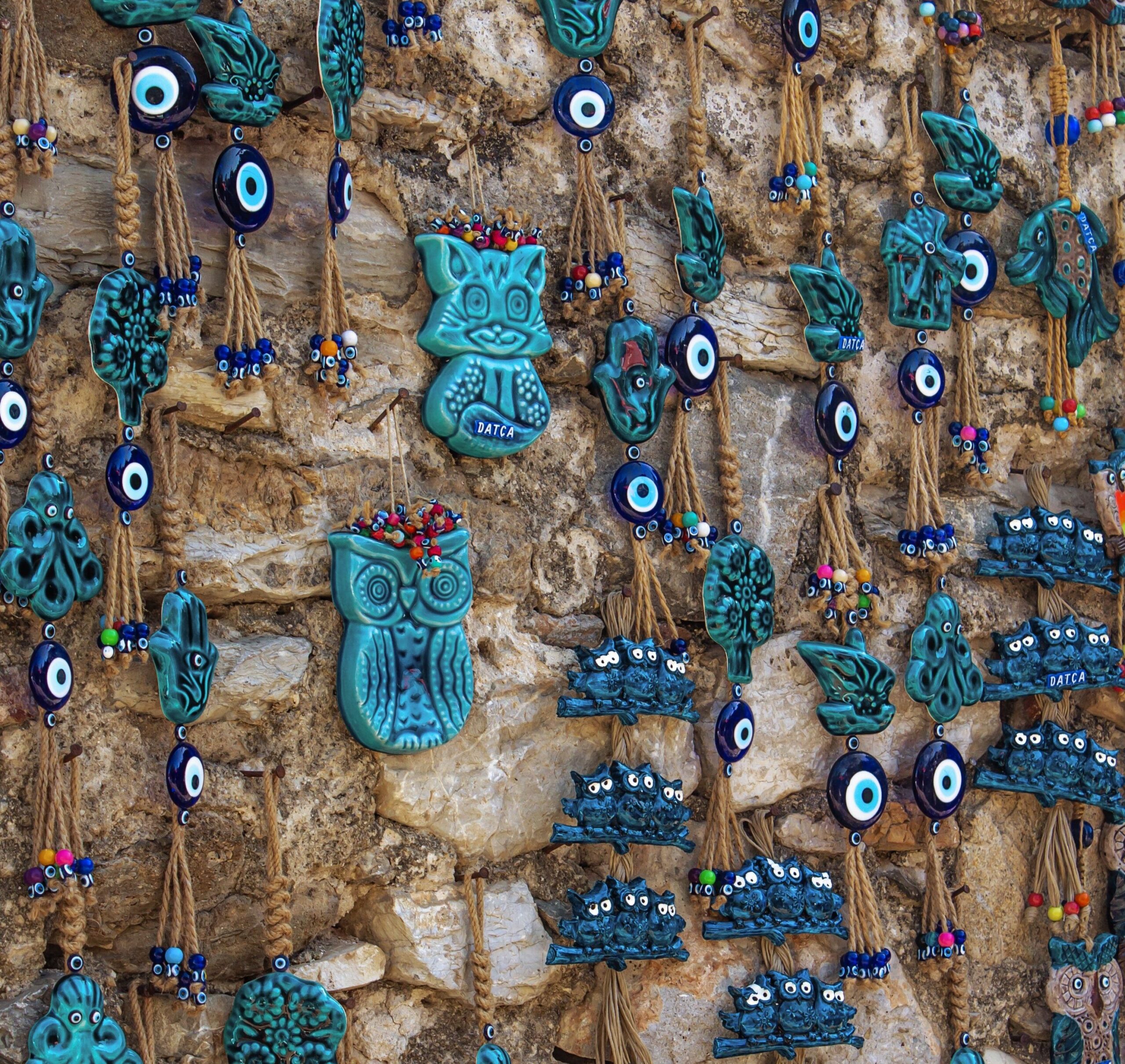
In communities across the Arab World, small blue glass eyes and open palms hang above doorways, from the rearview mirrors of taxis, and on the blankets of newborn children, serving as visible reminders of a belief that predates any single nation or faith in the region. The nazar and the hamsa, two of the most widely recognized protective symbols in the Arab world, respond to the same concern that an envious glance can bring harm to a person, a household, or a livelihood.
In Arabic, the evil eye is known as al-ayn, literally “the eye,” and it is closely associated with hasad, the word for envy, since the glance believed to cause harm is usually one fueled by jealousy.1 In some situations, admiration expressed without care is also thought capable of the same effect. In many households the belief functions less as superstition than as an inherited habit of caution, one that discourages families from praising a healthy child, a new home, a pay raise, or a recent success too openly.
Ancient Origins
Fear of the evil eye extends back several thousand years, with written references appearing in ancient Mesopotamia and comparable beliefs documented in Egypt, Greece, and Rome. The Eye of Horus, an ancient Egyptian symbol, although a distinct symbol with its own mythology, reflects the same broader conviction that the image of an eye could be placed between a person and harm.2
The craft of glassmaking also shaped the symbol’s development, since early glass beads were produced across Mesopotamia, Egypt, and the Phoenician coast and carried by traders throughout the Mediterranean. The deep blue color, which was difficult and costly to produce as it was derived from silica and plant ash, came to be associated with protection. Over time, the eye-shaped bead that emerged from this tradition became the object now commonly known as the ‘nazar.’3
The word nazar derives from the Arabic term for sight or gaze and passed into Persian and Turkish, and although the glass bead is today most often associated with Turkey, where it is called ‘nazar boncuğu,’ it is equally familiar in the Levant, Egypt, and the Gulf. Its spread followed the routes of trade and empire, and with merchants and pilgrims as they moved through the Ottoman world.4 The practice of hanging a blue amulet near the entrance of a home or shop moved with them, taking on local variations wherever it settled.
The Open Hand
The hamsa, also spelled khamsa, takes its name from the Arabic word for ‘five,’ a reference to the fingers of the hand. Some historians trace the open-hand motif to other civilizations in the region, where hand symbols appeared in religious art. In the centuries that followed, the image became widespread in North Africa and the Middle East, appearing on doors, jewelry, and ceramics, and many more items. Many examples place an eye at the center to join both forms of protection in a single design.
Among Muslims the hand is frequently called the Hand of Fatima, after the daughter of the Prophet Muhammad, while in Jewish communities it is sometimes known as the Hand of Miriam. This overlap reflects the degree to which communities in the region have shared customs and imagery over many centuries.5
Meaning in Modern Arab Households
Today the nazar and the hamsa carry as much cultural and sentimental weight as protective purpose, and they are commonly given as gifts to new homeowners, pinned to the clothing of infants, hung from the mirrors of taxis, and placed above the cash registers of shops. They have also entered fashion, home decor, and tattoo art, especially among younger generations and in the diaspora, where a hamsa necklace often serves as a link to an older relative’s home or a family doorway left behind.6
Whether individuals believe in the evil eye literally or value the symbols mainly as a cultural concept, both objects continue to connect contemporary households to a long history of trade, faith, and shared belief. In a region as diverse as the Arab world, they remain an emblem of common ground, small objects that carry centuries of care from one generation to the next.
Want more articles like this? Sign up for our e-newsletter!
Check out our blog here!
- Islam Land ↩︎
- James Clarke ↩︎
- Wikipedia ↩︎
- The Guide Istanbul ↩︎
- Wikipedia ↩︎
- Edward Westermarck, Ritual and Belief in Morocco (1926) ↩︎