
Subscribe
to receive news by email

Poll
Will the Trump Administration Shift U.S. Policy in Favor of Palestine?
- No (86%)
- Yes (14%)
 Loading ...
Copyright © 2026 Arab America
Go topUS Miscalculations Leading to a War Without End
By: Ghassan Rubeiz / Arab America Contributing Writer
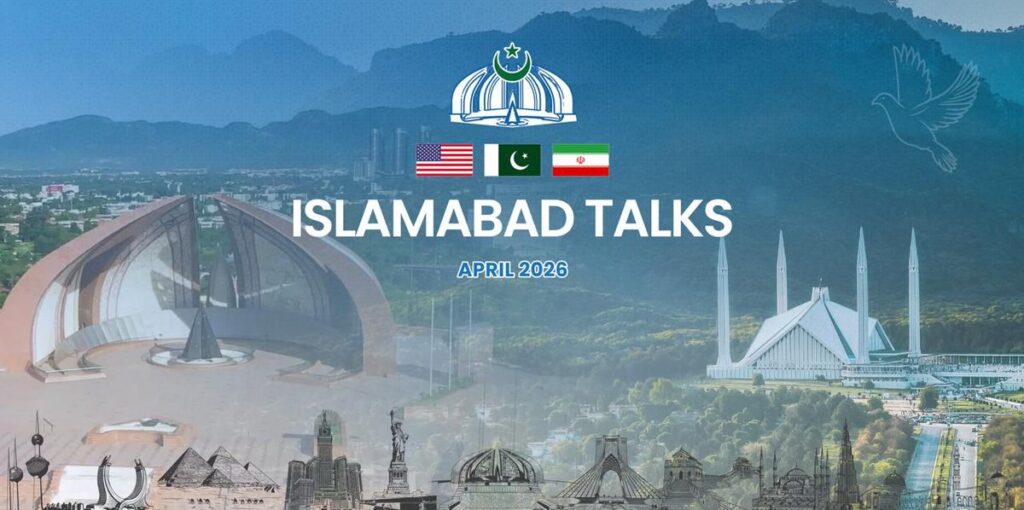
The collapse of ceasefire negotiations in Pakistan marks a grim turning point in the U.S.–Iran war. After twenty-one hours of talks, Vice President JD Vance declared that dialogue with Iran had failed and that Washington would impose a naval blockade on the Strait of Hormuz. The shift is astonishing. Only a week earlier, the administration had framed its objective in maximalist terms — dismantling of Iran’s civilization. Today, strategy has lurched toward maritime containment, a move that risks global economic shock and further military escalation.
This abrupt pivot is more than a tactical adjustment. It reflects a deeper loss of strategic direction. A superpower that oscillates between maximalist rhetoric and improvised blockades within days is not acting with clarity or purpose. It is reacting to events it no longer fully controls.
It has become increasingly difficult to see how this war ends. The gap between the American-Israeli position and Iran’s is vast, and neither side shows any sign of recalibrating. What is clear is that the United States — having initiated the conflict last year and escalated it again on February 28, when U.S. strikes on Iranian territory resumed — bears a disproportionate responsibility for turning a dangerous situation into a potentially catastrophic one. Washington’s predicament is the product of four compounding miscalculations.
The first grave mistake was the administration’s embrace of Israel’s argument that Iran is the singular source of instability in the Middle East. This framing ignores decades of structural grievances, unresolved conflicts, and the accumulated weight of occupation, sanctions, and regional power vacuums. Reducing the region’s complexity to a single villain was always a recipe for strategic blindness.
The second was the belief that Iran’s leadership was fragile and that renewed military pressure would trigger the regime’s collapse. Scholars and diplomats had long warned that Iranian society tends to rally around the flag under external threat, as most societies would. That warning was dismissed. A large, historically resilient nation with deep national pride does not crumble on command. It absorbs pain, reorganizes, and pushes back.
The third was Washington’s underestimation of the strategic centrality of the Strait of Hormuz. Iran has long signaled that it views the Strait as a vital national security asset and that it possesses the capability to disrupt global energy shipments. The declared blockade acknowledges — belatedly — that this leverage is real, and that confrontation there risks economic turmoil far beyond the region.
The fourth was the failure to anticipate how Washington’s military intervention in the Middle East would impact China’s calculations. Beijing sees the use of force against Iran a precedent — and an opportunity. Supporting Iran technologically or escalating pressure on Taiwan would impose costs on the United States at a moment of strategic overextension. U.S. actions have effectively broadened the battlefield.
Where this war goes is impossible to predict with certainty. What is certain is that it will not end soon. The positions are too entrenched, the grievances too deep and the stakeholders are too many. Only a major development — political, military, or economic — can prevent the conflict from widening. A political shift after the upcoming November US elections, a change of leadership in Israel following Israel’s elections by October 27, or mounting US domestic pressure from inflation and debt could each alter the trajectory. So could China’s decision to deepen its involvement. But the timing and nature of any such shift remain entirely unpredictable.
None of these possibilities, however, can substitute for strategic clarity. The United States cannot continue improvising from week to week. A war of this magnitude requires sober assessment of interests, limits, and consequences — and diplomacy grounded in realism rather than the expectation of regime collapse. Military coercion, no matter how overwhelming, has never been a strategy in itself. Until Washington recovers its compass and opens a credible diplomatic channel, the risk of a wider war will only grow.
Diplomacy has to start with what is negotiable. Separating Iran’s nuclear program from the region’s territorial disputes is not a concession — it is a precondition for any serious conversation.
Ghassan Rubeiz is the former Middle East Secretary of the World Council of Churches. Earlier, he taught psychology and social work in his country of birth, Lebanon, and later in the United States, where he currently lives. He has contributed to political commentary for the past twenty years and has delivered occasional public talks on peace, justice, and interfaith topics. You can reach him at rubeizg@gmail.com
The views and opinions expressed in this article are those of the author and do not necessarily reflect the position of Arab America. The reproduction of this article is permissible with proper credit to Arab America and the author.
Want more articles like this? Sign up for our e-newsletter!
Check our blog here!