Subscribe
to receive news by email

Poll
Will the Trump Administration Shift U.S. Policy in Favor of Palestine?
- No (86%)
- Yes (14%)
 Loading ...
Copyright © 2026 Arab America
Go topWhat Does it Mean to Be Arab American, According to Gen Z
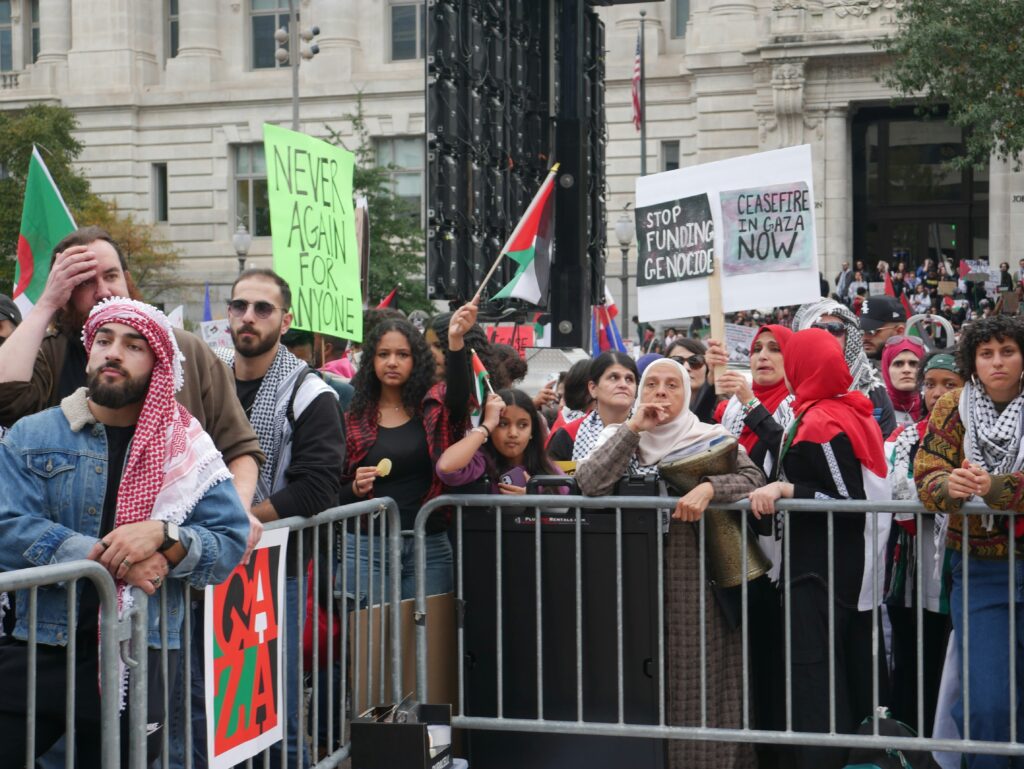
Photo taken by Brian Pilling on Unsplash
By: Megan Guzman Abbott / Arab America Contributing Writer
For decades, the Arab American narrative was largely shaped by older generations navigating a post-9/11 world. It was a time when survival often meant blending in, staying quiet, and keeping cultural pride hidden.
But for Generation Z, that script has changed drastically.
Today’s young Arab Americans are stepping into their identities with a different mindset: they are less bound by traditional expectations, connected through digital spaces, and committed to expressing their heritage. The young Arab diaspora in the US is redefining what it means to belong to two worlds.
A Shift in the Arab American Mindset
Generation Z has built its identity “horizontally” (Elsa Gerges, 2026). Rather than relying strictly on older generations to define what it means to be Arab, younger generations look towards their peers. This horizontal mindset makes this generation less bound by the traditional expectations older ones live by, and instead, are connected through digital spaces where they can openly express their heritage. Through this, they have created a unity between both worlds: what it means to be American and Arab.
Yousuf Gahin, a current student at Stevens Institute of Technology, described his experience being Arab American as a beautiful place where “we all treat each other as if we are from the same country, and it makes me proud to be a part of that community.” Being Egyptian American from New Jersey, he believed “older generations were much more reserved (especially after 9/11), but with time and the nature of Gen Z being more culturally inclusive, it made us much more open and comfortable with our identities.”
This openness requires breaking away from strict cultural stereotypes. Layan Ahmad, a current student at Montclair State University, has noticed a generational divide herself: “The last few generations are much closer to their identity (my family specifically), as they didn’t grow up in America… and so they are much more cultural and not really comfortable being open to different ideas and people.”
However, for Gen Z, the pressure to conform to ideals has been replaced by individual expectations: “My generation is much more open and doesn’t really care too much about the culture’s ‘expectations’ put onto them,” Layan explains. “Like, we don’t care much about getting married as soon as possible, and we’re much more career-oriented. I’d say the main difference is mindset.”
Escaping the Authenticity Trap
This horizontal mindset continues to thrive online. Within digital spaces, Arab American Gen Z has found comfort and the freedom to express themselves beyond strict cultural expectations or institutional constraints. According to The New Global Order, the internet gives young people an escape from the pressure of having to prove they are “real” or “authentic” Arabs. For older generations, being authentically Arab often meant keeping things exactly as they were back home, driven by a fear of adopting Western habits. But for Gen Z, that fear is fading.
Specifically online, they have transformed social media into modern digital Majlis (Elsa Gerges, 2026). A Majlis is a traditional council, but Gen Z has digitized it. Through slideshow activism on platforms such as Instagram, Gen Z breaks down taboo topics and dense political issues into easy-to-digest, shareable content. This practice made advocacy accessible and turned social media into a place where Arab American culture is shared and written every single day.
This was evident in 2024 at universities across the United States, where students gathered in mass protests in solidarity with Palestine. The movement originating online exploded into physical mobilization, most visibly seen at Columbia University and then at more than 130 colleges (Cabral & Faguy 2024). Arab American students were often at the front of these protests: organizing teach-ins, walkouts, and challenging university investments. Mahmoud Khalil, Maryam Alwan, and Maryam Iqbal are a few of the major Arab American activists of the protests. They framed Palestinian liberation through the lens of human rights and anti-colonialism, making Arab American identity a huge pillar of modern social activism.
A New Blueprint for Being Arab American
Ultimately, the Gen Z Arab American experience is not about abandoning heritage, but evolving it. By shifting from a vertical inheritance to a horizontal one, this generation has stripped away the authenticity trap and pressure of outdated expectations. Whether they are finding community in pan-Arab neighborhoods or advocating for Arab issues, they are proving that cultures don’t have to survive under rigid structures. One does not have to choose between two worlds, but by mixing them, one can build a new blueprint of what it means to be Arab American today.
Source Cited:
https://thenewglobalorder.com/world-news/report-how-social-media-is-reshaping-arab-identity-among-gen-z/
https://www.bbc.com/news/world-us-canada-68908885
https://www.reuters.com/world/us/over-100-pro-palestinian-protesters-arrested-new-yorks-columbia-campus-2024-04-19/
https://www.reuters.com/world/us/over-100-pro-palestinian-protesters-arrested-new-yorks-columbia-campus-2024-04-19/
Want more articles like this? Sign up for our e-newsletter!
Check our blog here!