

Subscribe
to receive news by email

Poll
Will the Trump Administration Shift U.S. Policy in Favor of Palestine?
- No (86%)
- Yes (14%)
 Loading ...
Copyright © 2026 Arab America
Go topDiesel and Grain Go to War: Ukraine, Middle East and Food Security
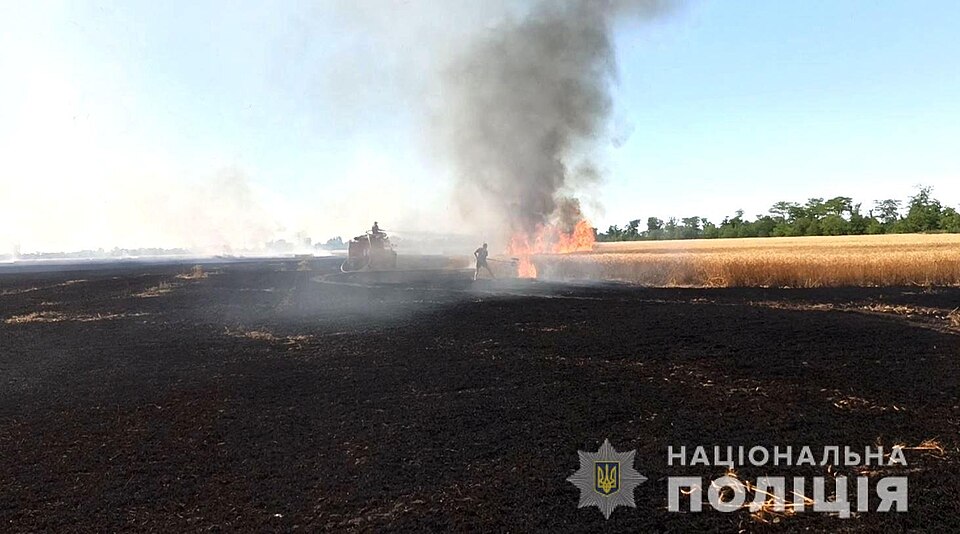
Zaporizhzhia Oblast after Russian shelling, 2022-08-06. © National Police of Ukraine (Wikimedia Commons)
By: Rami Balin / Arab America Contributing Writer
The Diesel Deal
On October 9, 2026, Trump struck a deal with Putin, establishing that Russia is now going to be supplying the US with diesel to compensate for the shortage of fuel caused by Trump’s war of attrition with Iran. With Hormuz Strait remaining a precarious route, the US-Israel war on Iran drags on with no sign of a definitive ceasefire anytime soon, causing the US economy to destabilize further, impacted by soaring gas prices which are felt significantly in all areas of the everyday life. As the cost of living rises, the elections looming less than a month ahead, Trump attempts to quell the increasing discontent by making one of his signature deals. His only problem this time (according to him, anyway) is Ukraine, whose leaders have been successful in carrying out retaliatory airstrikes on military objects inside Russia, including oil refineries that quite literally fuel the war.
Throughout the war but especially in the last weeks, Russia’s bombing of Ukrainian essential infrastructure has led to water and electricity shortages and blackouts in Ukrainian cities on the eve of what is shaping up to be the hardest winter for Ukraine yet. Meanwhile, Ukraine has been successful in hitting and shutting down major oil refineries in Russia, causing gas shortages for Russian citizens and forcing Russia to buy back its own oil from India. This puts Trump’s plan in question as it is not clear whether Russia has any diesel to supply the US with. Nonetheless, the deal is made, and now the US is funding Russia’s war economy, sponsoring another war that affects supply chains around the world and already impacts the Middle East.
Ukraine’s Role in MENA Food Supply Chains
Russia and Ukraine produce about a quarter of grain exports globally, and Ukraine is one of the largest exporters of grain and other agricultural products in the world. Its incredibly rich soil, chernozem, has been used for growing crops like wheat and sunflowers, which have a special place in Ukrainian culture, not just economy. Nonetheless, agriculture has become a battlefield, both literally and metaphorically. Since the beginning of the full-scale invasion into Ukraine, Russia has been targeting crops, destroying arable fields, preventing Ukrainian farmers from working on them and harvesting by denying access and shelling continuously.
Since 2022, Russia has been targeting Ukrainian ships transporting grain in the Black Sea. Ukraine has been engaged in trade with countries across the Middle East and Africa, serving as a key supplier of essential food supplies. Before the all-out war in 2022, over half of wheat imports in fifteen African countries such as Egypt, Sudan, Eritrea and Benin came from Ukraine. Roughly half of all the Ukraine’s wheat exports went to the Middle East and North Africa. The precarity of Black Sea trade routes puts these global supply chains at risk, causing food shortages and climbing prices as the threat of food insecurity persists.
Ukraine provides 80% of wheat to Lebanon, in addition to sunflower oil and corn. It remains a key trade partner, pledging to deliver the products despite the constant danger of having their ships bombed by Russia. These trade partnerships have been essential to ensuring and maintaining food security in Lebanon and other countries around the world, including many others in the Global South. Prior to the war, Ukraine was one of the key contributors to the World Food Programme. In 2022, despite Russia’s attacks, Ukraine launched a global humanitarian program called Grain From Ukraine, delivering grain to the poorest countries in Africa and Asia, including Somalia, Democratic Republic of Congo, Syria, Yemen, and more. Nonetheless, Russia’s war has already pushed millions on the brink of hunger, making Ukraine’s exports inaccessible or scarce.
Stolen Grain and Russia’s Bloody Trade
Russia has been stealing Ukrainian crops as well, blocking Ukrainians from reaching them and evacuating the harvest from storage facilities – instead, Russian army has made it its mission to pillage as much as it can from the occupied territories, sometimes destroying the harvest if moving it is too taxing.
As a result, Russia has developed a lucrative market, trading stolen Ukrainian grain and other goods, the fact that Ukrainian officials and international community have been consistently drawing attention to since the first weeks of the all-out war. Russia also openly recognizes these practices. Just this year, tensions between Ukraine and Israel rose once again as a Russian cargo ship with stolen Ukrainian grain was docked at a port in Haifa, with Ukrainian president Volodymir Zelensky calling out Israel for regularly allowing such illegitimate shipments and going as far as threatening sanctions on Israel. Russia supplies 90% of wheat to Israel, with imports growing significantly in recent years.
Profit Over People
The trade routes that ensure food security globally are constantly endangered by Russia’s aggression that is now being sponsored by the US through Trump’s diesel deal. This deal will not end any of the problems in the US economy that wouldn’t have existed in the first place if it wasn’t for Trump’s war on Iran and the tariffs.
The politicians of the world who put profit over people seem to have decided that the solution to this war is for the oppressed, the Ukrainians, to stop defending themselves and to give the colonizer, Russia, what it wants, which is control over Ukrainian territories and their resources. In the contexts of Ukraine, Palestine, Lebanon and other historically colonized lands, the occupation is not going to end if the resistance is disarmed. In fact, the opposite is true. Arming the oppressor and sponsoring its conquests materially affirms its power and, in this case, undermines global economy and food supply indefinitely.
The aim of Trump and the likes of him is not, and never has been, to stabilize global supply chains and ensure sustainable economic growth for the benefit of all people. This leaves whole populations, especially in historically colonized and therefore intrinsically disadvantaged regions, in a state of precarity that only enhances. The diesel deal prolongs the war and threatens much more than just Ukrainian lives.
Read the article on Ukrainian-Palestinian solidarity here.